
PHOTO SPOT GUIDE
Floating Hydrangeas at Amabiki Kannon ― Blooms on the Water, Ducks at Play
In Sakuragawa, Ibaraki, cradled against the slopes of Mount Amabiki, an old temple holds a scene that appears only in early summer. Across its stone water basins and its Benten pond, hydrangeas in blue, violet and the palest pink are set gently afloat, until the water itself seems to be in bloom. Locals call it suichuka — flowers in the water — and I came to see it during a break in the rainy season.
Hydrangeas that bloom on the water
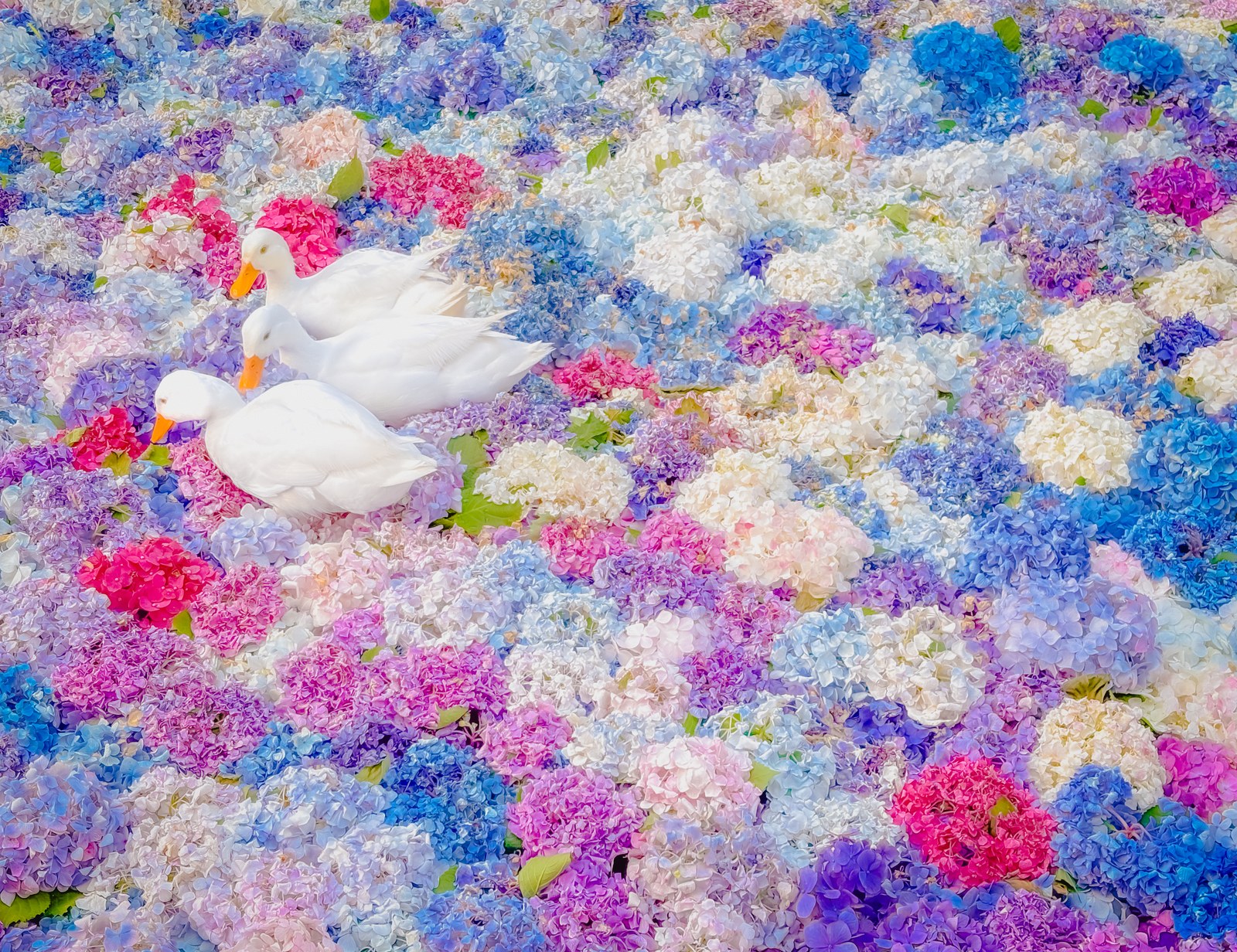
Cut hydrangea heads, set adrift on still water — it is the simplest of gestures, and yet I could not look away. The sky lies mirrored on the surface, and the blooms gather slowly together, then part again, in a drift you never tire of watching. On land, hydrangeas grow heavy with rain and bow their heads; set free on the water, they are weightless. A flower whose work was done seems to take on life a second time, and watching that quiet renewal, something in me felt clearer too. Colour melts into the blue of the water until you can no longer tell where the flower ends and the pond begins.
The calm Benten pond, where the ducks play
On the pond where the flowers drift, ducks and wild ducks paddle without a care, threading between the blooms and pausing now and then to preen. There is something in their unhurried ease that loosens your own sense of time. My working days are spent in the emergency room, chased by the second hand of the clock. Perhaps that is why, standing in the temple grounds after the rain, in the slow hour the flowers and water birds make together, I felt some held tension quietly let go. Even the grey of the rainy-season sky turns to a soft, gentle light before this pond.
On the water, a flower opens once again.
And a duck slips quietly across it.
Planning your visit — season
A few notes on the loveliest weeks.
The hydrangeas of Amabiki Kannon are usually at their best from early June to mid-July. The grounds are said to hold around a hundred varieties and some five thousand plants, and an Ajisai Matsuri (hydrangea festival) is held in early summer. The celebrated suichuka adorns the basins and the Benten pond for a set period during the festival, and in some years there are evening illuminations as well. Blooming shifts with the weather, so it is worth checking the latest conditions before you set out.
Getting there
The nearest station is Iwase on the JR Mito Line, about a fifteen-minute taxi ride from the station front. By car it is roughly ten minutes from the Sakuragawa-Chikusei interchange on the Kita-Kanto Expressway, with ample free parking at the foot of the grounds. Roads and car parks fill up during the festival, so arriving early in the morning lets you take your time.
Tips for photographers
Shoot the suichuka from almost directly above and the rings of flowers fill the frame, turning the blue water into something close to an abstract painting. Drop the camera low, near the surface, and you can hold the floating blooms and a duck on the same plane — and a small story appears. The finest light comes on a rainy or just-rained day: a soft overcast kills the glare on the water and lets the true colours sink in deep. The ducks keep moving, so wait with a slightly faster shutter and be patient for the one moment when bird and flowers fall into balance.
While you're in the area
Amabiki Kannon is also known for prayers for safe childbirth and for raising children, and as a place of cherry blossoms — in spring some three thousand trees are said to colour the hillside. A little further on rises Mount Tsukuba, sung of since ancient times, with a ropeway and cable car to carry you easily to the summit. In the town of Sakuragawa the old streets of Makabe still remain, and a day spent among hydrangeas and stone storehouses makes a small, unhurried journey through early-summer northern Kanto.
Bring home the suichuka of Amabiki Kannon as a true silver-halide print on FUJICOLOR's finest professional paper. Its deep tones and rich gradation are preserved for framing, and we ship worldwide.
💾 A digital download is also available ($4.00 each). Bundles cost less: 3 for $10.20, 5 for $15.00 ($3.00 each) — mix any photographs you like.
View the print →