
PHOTO SPOT GUIDE
Hananomiyako Park — An Autumn Flower Field Before Mount Fuji
Lake Yamanaka, Yamanashi. On a highland plateau at the foot of Mount Fuji, some 1,000 metres up, an entire field of flowers opens out each autumn. Golden cosmos sway in waves, threaded here and there with the ruby of red buckwheat, and whenever you lift your eyes, Fuji is simply there. The air turns crisp and clear, in a brief season that belongs neither quite to summer nor to winter.
Before Fuji, the flowers sway all at once
Standing in Hananomiyako Park, the first thing that strikes you is the sheer width of the sky. On this open plateau, with nothing to interrupt the view, golden cosmos run to the far edge of the land, and beyond them Mount Fuji rises straight and clear. Each time the wind moves through, the whole field ripples as if drawing a single breath. There is the great stillness of the mountain, and at your feet the ceaseless trembling of countless small flowers — the unmoving and the always-moving, held in quiet balance within one frame. That contrast, I think, is what moves the heart. At the foot of so vast a mountain, such small flowers bloom with such confidence. Watching them, the tension in your own shoulders quietly lets go.
The colour of dawn, and autumn on the plateau
What stays with me most is the hour before sunrise. Setting up the tripod while the sky is still deep indigo and waiting, you watch the eastern rim slowly warm to crimson, until that light sets both the summit of Fuji and the whole field aglow at once. For a few minutes the cosmos, which ought to be yellow, turn the colour of rubies in the morning light — it is enough to hold your breath. By September the plateau is already cool, and your breath shows faintly white. On night shifts in the emergency department, I live by the clock, marking out the seconds. Yet a morning in this field feels as though time has been poured out generously, and simply standing there, waiting for the light to fill, becomes the only task that matters. Each time I come, I remember how much I need a stretch of time like that.
Fuji holds still; the flowers murmur.
The colour of dawn sets them both alight.
Planning your visit — season
Autumn moves quickly on the plateau. A few notes before you set out.
The yellow cosmos usually begin to open around late August, peaking through September and lingering into the middle of October. The red buckwheat — known here as Takane Ruby — tends to colour from late September into early October, so it overlaps beautifully with the cosmos. Fuji often receives its first dusting of snow around this same time, giving you a handful of rare days when a snow-capped peak stands above an autumn flower field. The broad flower-field area is generally free to walk, while Seiryu-no-Sato, with its facilities, is a paid section. As blooming shifts with the weather, it is worth checking the latest flowering report before you go.
Getting there
By train, your starting points are Fujisan Station or Kawaguchiko Station on the Fujikyu Railway. From either, the Fujikko-go loop bus circles Fujiyoshida, Oshino Hakkai and Lake Yamanaka; get off at the Hananomiyako-koen-iriguchi stop and the park is right there. If you take a highway bus from places such as Shinjuku, you can ride toward the Kawaguchiko area and walk in from the nearest stop. By car, the Yamanakako interchange on the Higashi-Fujigoko Road is close, and the park has ample parking. Since some time slots have few departures, it is wise to check the bus timetable in advance.
Tips for photographers
To hold both Fuji and the flowers in one image, decide first where to place the mountain, and the composition falls into place. Set the flowers large in the foreground with Fuji small behind, and the openness of the plateau comes through on its own. At dawn, when the loveliest light arrives, the sun rises in the east and lights both flowers and mountain head-on, so the colours register cleanly. In the slanting light of late afternoon, by contrast, the petals glow translucent and their edges turn to gold — a different mood altogether. Because the wind keeps the flowers moving, choose between opening up to soften the foreground or stopping down a little to let each bloom stand out, depending on what you are after. Lean in close to a single flower at your feet and look out, over its shoulder, to a distant Fuji: that kind of foreground works especially well here.
While you're in the area
Hananomiyako Park also sits conveniently as a base for touring the Fuji Five Lakes. Lake Yamanaka, just nearby, is lovely for a lakeside walk and the chance to meet its swans, and at dusk an inverted Fuji mirrors gorgeously on the water. A little farther on lies Oshino Hakkai, a set of crystalline ponds fed by Fuji's underground springs, whose see-through clarity holds a stillness quite different from the flower field. Linking Lake Kawaguchi, Lake Sai and the rest of the Five Lakes, and following how Fuji's expression shifts from one shore to the next, is a way of spending time that belongs uniquely to this region.
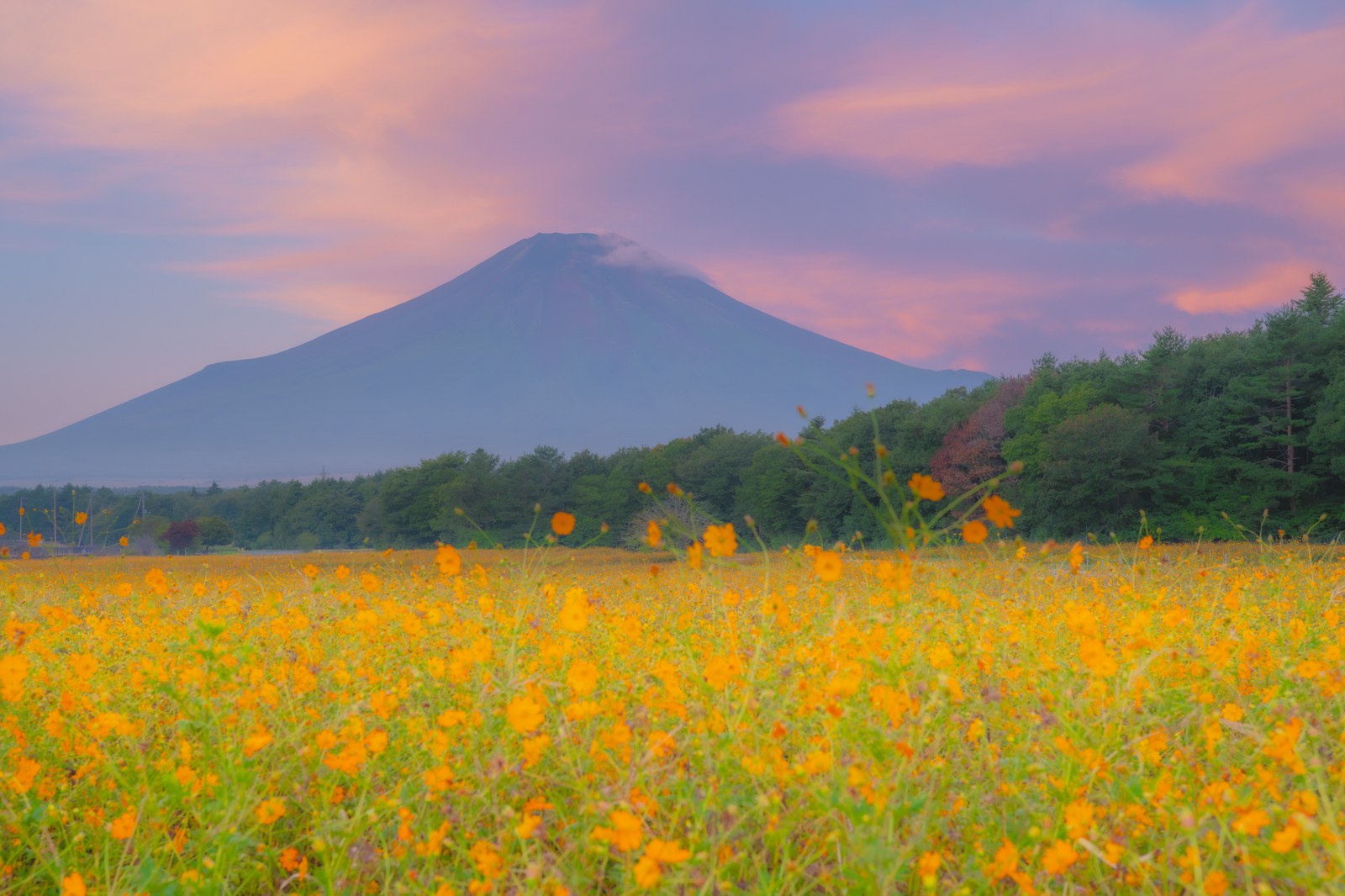
Those few minutes at dawn in Hananomiyako Park, when Fuji and the flowers turn red together, delivered as a traditional silver-halide print on FUJICOLOR's finest photographic paper. Framed for your wall, it carries the clear morning air of the plateau with it. We ship worldwide.
💾 A digital download is also available ($7.00 each). Bundles cost less: 3 for $17.84, 5 for $26.23 ($5.25 each) — mix any photographs you like.
View the print →