
PHOTO SPOT GUIDE
Mitarashi Pond ― A Clear Blue Spring in a Sanctuary of Moss
In Katsuyama, Fukui, deep within a forest where giant cedars close over the sky and an unbroken carpet of moss spreads underfoot, there lies a spring. This is Mitarashi Pond at Heisenji Hakusan Shrine, a sacred upwelling where, thirteen centuries ago, the monk Taicho is said to have met the goddess of Mount Hakusan. The water is impossibly clear, and only the green light stirs, quietly, in the stillness.
Meeting a single spring in a forest that breathes moss
The moment you step onto the approach, the air changes. Ancient cedars interlace their branches overhead, the light that filters down is soft, and every inch of ground is covered in deep green moss. With Pyrrhobryum at its heart, more than two hundred species of moss grow here when the surrounding area is counted, and over time this precinct came to be called the 'moss shrine' or 'moss temple'. Walk a while across that sea of green and a small surface of water appears among the trees: Mitarashi Pond. The water rising from below is astonishingly transparent, so clear that you can see every pebble and fallen leaf on the bed. In that one green-shrouded corner, time itself seemed to have gently come to rest.
The first water, welling up for thirteen hundred years
As the tradition tells it, Taicho, who had been training on Mount Ochi, came to this land at the goddess's invitation. As he prayed beside a spring in the woods, the goddess of Hakusan appeared upon a stone within the pond and urged him to make the ascent. In time a small shrine to the great deity of Hakusan was raised beside this spring, and that became the origin of the shrine we see today. Once known as Hira-shimizu, this very water also gave the temple its name. In the emergency room, my own time always passes in seconds. Yet standing beside this spring, I am reminded that thirteen hundred years can simply rest here, held in perfect quiet. The spring water, then as now, remains clear.
The moss breathes; the spring keeps welling up.
Thirteen centuries, in unchanging stillness.
Planning your visit — season
It is most beautiful when rain-washed moss drinks in the light.
The moss is at its most vivid, by most accounts, roughly from June into July, around the rainy season. Soaked with rain, it deepens to a rich, saturated green, and the morning after a rainfall in particular it glistens, the whole forest breathing fresh and alive. The fresh green of May and the early summer after a shower are wonderful too, when the young cedar leaves and the moss layer their greens upon one another. The precinct is open to visitors freely; a round trip to the worship and main halls takes about an hour. Walk slowly, and let the sea of moss and the quiet of the spring settle into you.
Getting there
Katsuyama Station on the Echizen Railway is your starting point. From the station, a bus toward Heisenji or a taxi takes about ten minutes. By car, access from the Hokuriku Expressway is convenient as well. Rental bicycles are available at Katsuyama Station, and in the fresh-green season it is a fine thing to ride out toward the shrine, following the quiet country scenery. Please check the latest timetables before you set out.
Tips for photographers
This place suits an overcast sky or the hour after rain far better than bright sun. Soft cloudy light renders every gradation of green in the moss with care, and erases the hard shadows that harsh sunlight casts. To capture the transparency of the spring, a polarising filter that tames the surface reflections a little will bring out the texture of water clear all the way to the bed. Watch, too, for the small world underfoot: dappled light falling on the moss, a leaf tip wearing a raindrop. This is sacred ground, so please keep out of areas closed to entry, and make your single frame gently, without disturbing the stillness itself.
While you're in the area
The whole precinct is designated a National Historic Site, the 'Former Grounds of Hakusan Heisenji', and was once a vast religious city many times its present size. The adjoining history museum, Mahoroba, lets you touch that grand past and the story of Hakusan faith. And Katsuyama is, of course, home to the world-renowned Fukui Prefectural Dinosaur Museum. The stillness of moss and spring, and the dynamism of ancient life: that contrast, too, is a pleasure particular to this land.
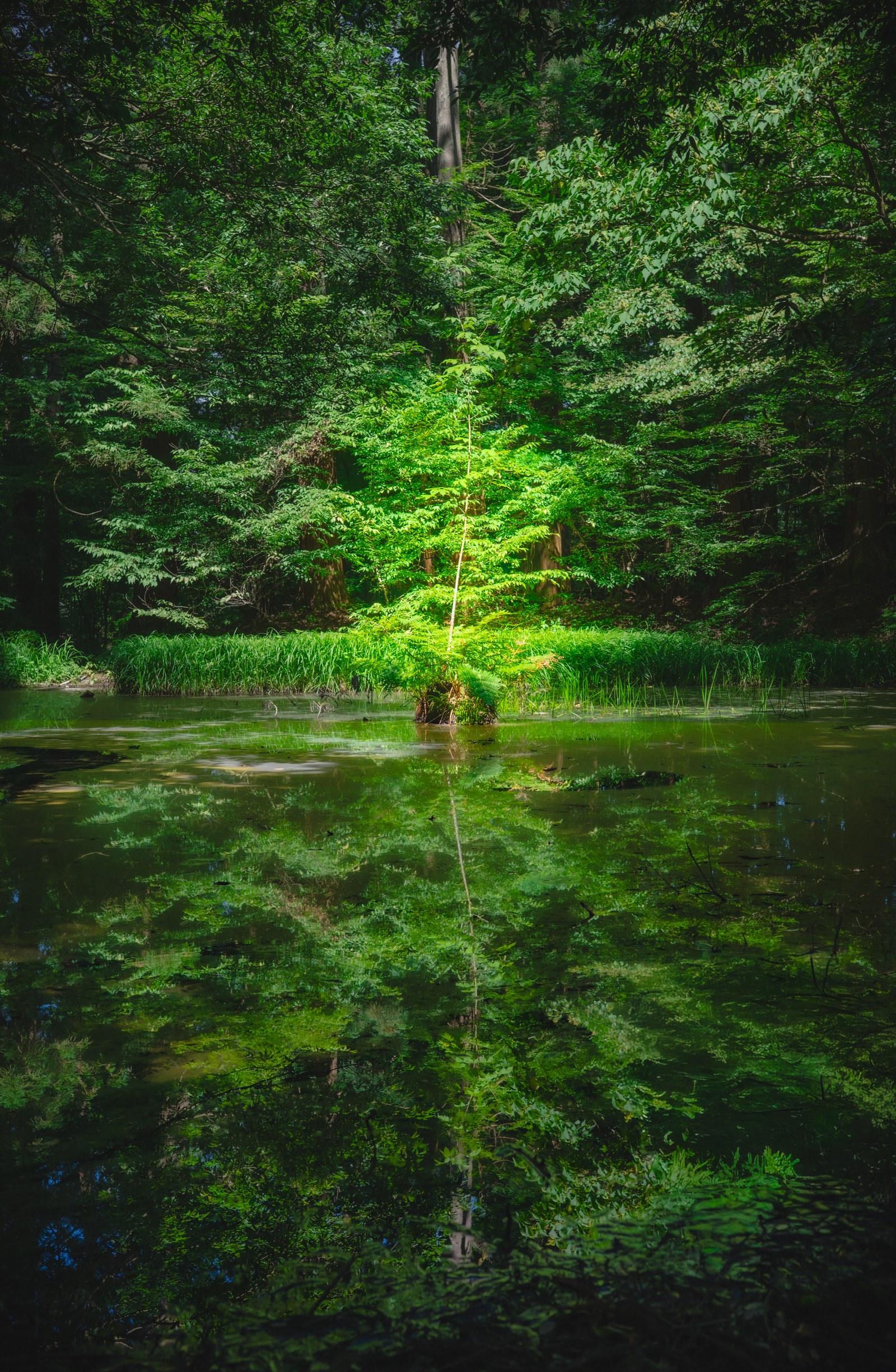
The stillness of Mitarashi Pond, as a silver-halide print on FUJICOLOR's finest photographic paper. The deep green of the moss and the transparency of the spring, brought to you as a finished work. We ship worldwide.
💾 A digital download is also available ($7.00 each). Bundles cost less: 3 for $17.84, 5 for $26.23 ($5.25 each) — mix any photographs you like.
View the print →