
PHOTO SPOT GUIDE
The Nemophila Hill — A Sky-Blue Sea at Hitachi Seaside Park
In Hitachinaka, Ibaraki, there is a season when a gentle hill takes on the colour of the sky entirely. This is "Miharashi Hill" at Hitachi Seaside Park. As spring draws to a close, some 5.3 million nemophila bloom across the whole slope, and the pale blue flowers and the blue sky lose their boundary and become a single blue. Stand at the top of the hill and everything, from your feet to the sky, is blue. It is a vista of blue that draws visitors from around the world.
A blue that melts into the sky
The greatest charm of the nemophila is that its blue appears to connect with the sky. Miharashi Hill is the highest hill in Hitachinaka, and at the top nothing interrupts the view. The pale blue flowers continue to the horizon, and beyond them the sky opens out. Where the flowers end and the sky begins becomes impossible to tell — that is the strange, lovely scene found here. The blue of a clear day is wonderful, of course, but on a lightly clouded day of soft light the colour photographs deep and tender.
A blue sea, swaying in the wind
When the wind crosses the hill, all 5.3 million nemophila sway at once, and the blue sea moves as if rippling. A single flower is tiny and delicate; gathered beyond counting, they become the great "mass" that is the hill. It is a soft, wide-open blue, utterly unlike the taut hours of the emergency room — a scene that makes you want to take one deep breath.
At the top of the hill, sky and flower become one;
a blue sea, swaying in the wind.
Planning your visit — season
A few notes for those hoping to see it in person.
The nemophila are usually at their best from mid-April to early May, with the peak around late April near Japan's "Golden Week" holidays. This period is very crowded, and admission changes (normally 450 yen for adults, but about 800 yen during the roughly 30 days of peak nemophila). Timing shifts with the weather each year, so check the park's official bloom updates before you go. The same hill is also famous for turning brilliant red with about 30,000 kochia in autumn.
Getting there
By public transport, take a bus from bus stop No. 2 at the east exit of Katsuta Station on the JR Jōban Line to the park's West Gate, about 15 minutes. You can also come by bus from Ajigaura Station on the Hitachinaka Seaside Railway. At the Katsuta Station window, a one-day Minato Line pass that includes park admission is also sold and good value. There is large parking by car, but in peak season congestion and full lots are likely on the surrounding roads, so an early arrival is best.
Tips for photographers
On Miharashi Hill, a wide lens that takes in the flower field and sky from near the top of the hill conveys the scale of blue stretching to the horizon. Shooting the flowers from a low position, looking up, melts the blue of sky and nemophila together all the more. Times with little wind, or lightly clouded days of soft light, bring out the colour well. It is crowded, so the early hours just after opening are your chance for a clean composition.
While you're in the area
Hitachi Seaside Park is vast, and beyond the nemophila its flowers change face with the seasons — tulips and daffodils, summer zinnias, autumn kochia and cosmos. Riding the park's cycling courses while touring the seasonal flowers is a fine way to spend the day.
Miharashi Hill ― changing with the season
The 'Miharashi Hill' at Hitachi Seaside Park, famous for its nemophila, changes its dress with the seasons. After spring's blue nemophila come summer's many-coloured zinnias, and in autumn the burning red of kochia. The colours of the seasons on one hill stay fresh however often you visit. For the basics, see how to photograph flower landscapes.
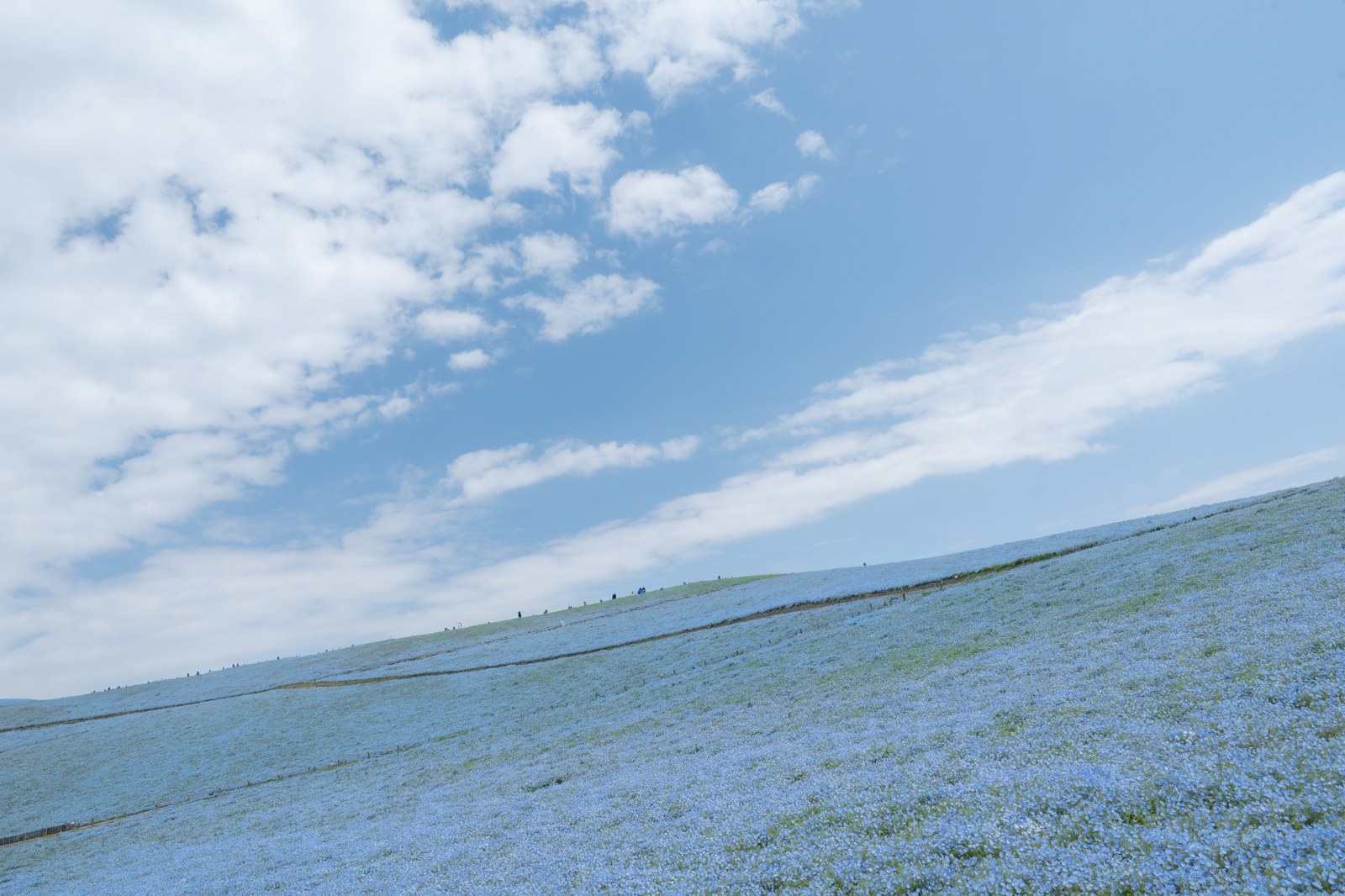
The nemophila of Miharashi Hill are available as fine-art silver-halide prints on premium FUJICOLOR paper, hand-printed in Japan and shipped worldwide.
💾 A digital download is also available ($7.00 each). Bundles cost less: 3 for $17.84, 5 for $26.23 ($5.25 each) — mix any photographs you like.
View the print →