
PHOTO SPOT GUIDE
Zinnia Field ― A Rainbow of Blossoms over the Summer Hill
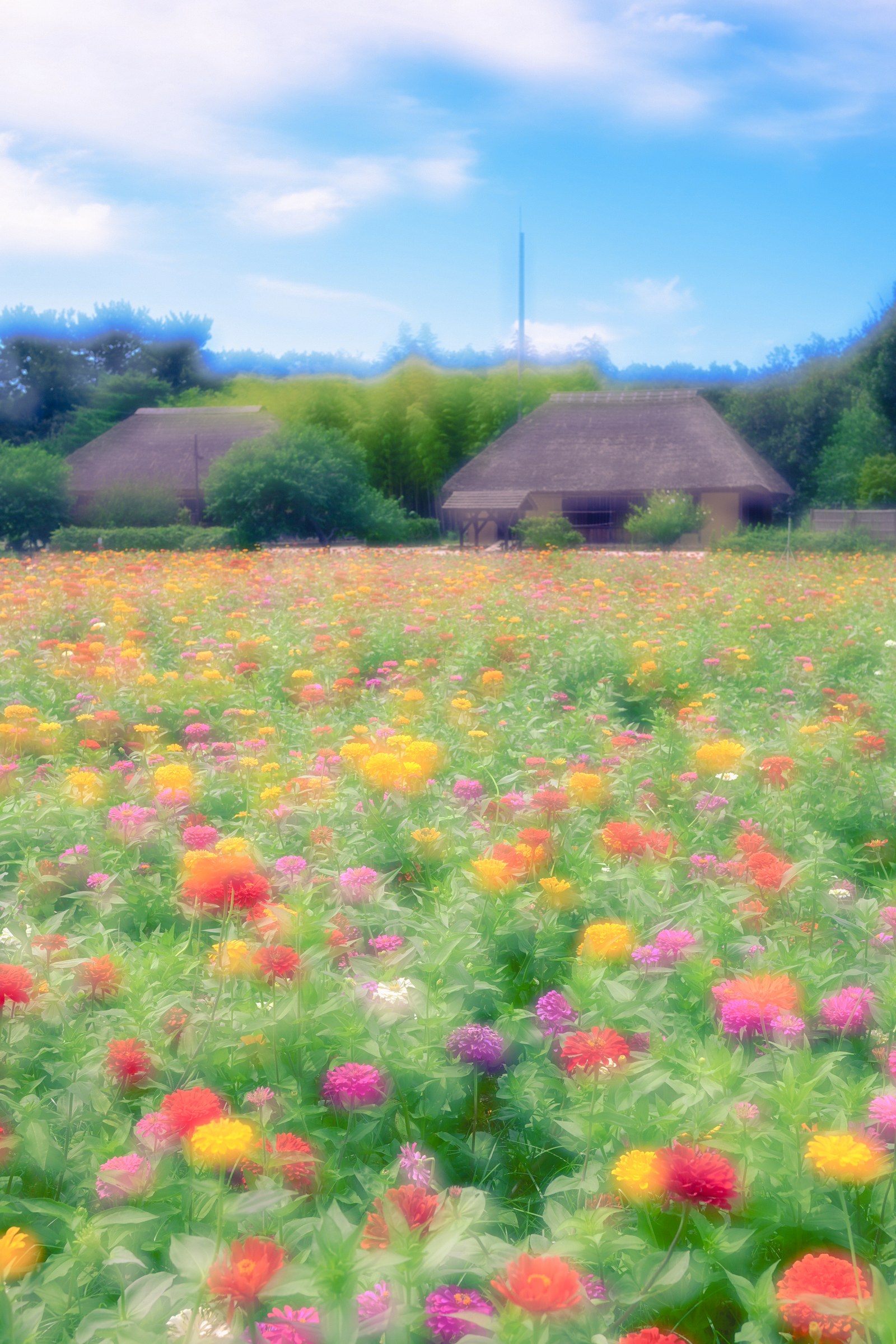
In Hitachinaka, Ibaraki, there is a hill that turns the colour of the sky in spring and burns crimson in autumn. For a few weeks of summer, it wears something else entirely. Red, pink, orange, yellow ― a field that seems to have gathered every colour there is, swaying beneath a summer sky. This is the season of the zinnia.
The same hill, waiting for its season
If the great blue sweep of the nemophila stays with you, the summer hill may puzzle you at first. Where has all that blue gone? But climb a little, and the answer opens out in front of you: in place of the blue, every colour of the rainbow is waiting. Zinnias bloom in wave after wave and last a remarkably long time ― which is why, in Japanese, they are called the hundred-day flower. True to the name, the hill keeps its colour all summer long.
What one hill shows across a single year
What I love about this hill is how many times it changes its clothes in a year. Spring brings the blue sea of nemophila. Summer lays down a carpet of zinnias in every shade. And in autumn the round mounds of kochia turn from green to deep scarlet. You stand in the very same spot, yet depending on the season you arrive, it can feel like a hill you have never seen before. I return again and again to keep that changing face, one frame at a time. A bloom at its peak never lasts long ― and so this summer colour belongs to this summer alone.
At the crest of the hill, every colour of summer comes together.
A rainbow of blossoms, swaying in the wind.
Planning your visit ― season
A few practical notes for those who would like to go. Figures and fees can change, so please check the park's official website for the latest information.
The zinnias are usually at their best from late summer into early autumn ― in an early year, in the heart of August; in a later one, into the first days of September. The flowers covering the slope are said to number around thirty thousand, and up close you can see how each single bloom wears its own expression. Admission is a few hundred yen for high-school age and above, free for younger children, with a senior rate as well. Note that a seasonal surcharge may apply during the nemophila and kochia peaks, so it is worth checking the fee for your dates before you set out.
Getting there
The nearest station is Katsuta on the JR Joban Line. From there it is a fifteen-to-twenty-minute bus ride to the West or South Gate. Services vary by time of day, so it pays to check the return times as well. By car, the park is just off the Hitachi Seaside Park interchange on the Joban Expressway, though the car parks fill up on summer weekends. Arriving for the first opening gives you the softest light, the fewest people, and the best hour for photographs.
Tips for photographers
The zinnia is a flower of strong colour, and for that very reason the soft, low light of morning and evening renders each bloom with far more depth than the hard light of midday. To make the most of the hill itself, get down low, place a few flowers as a soft foreground blur, and compose so the colour runs on up the slope ― that is how you convey the breadth of this sea of colour. If you include the sky, play the summer blue against the warm tones of the petals. On a breezy day, try a slightly slower shutter to keep a little of the swaying ― a frame that feels true to the season.
While you're in the area
The park is too large to walk in a single day, and beyond the zinnias, sunflowers and pampas grass colour the summer too. A little further afield, the Nakaminato fish market serves seafood landed that very morning, and a drive along the coast opens onto the Pacific horizon stretching as far as you can see. The hill of flowers, the sea, and the harbour town ― give yourself a whole day to wander through summer in Hitachinaka.
This zinnia field is offered as a silver-halide print on FUJICOLOR's finest photographic paper. Each print is finished with care and shipped worldwide.
💾 A digital download is also available ($7.00 each). Bundles cost less: 3 for $17.84, 5 for $26.23 ($5.25 each) — mix any photographs you like.
View the print →