
PHOTO SPOT GUIDE
Autumn at Korankei ― The Crimson of the Tomoe River
In the hills of Asuke, near Toyota in Aichi, there is a season when an entire valley turns to crimson and gold along the slender thread of the Tomoe River. Some four thousand maples cover the whole reach of the sky and fill the water itself with colour. Reckoned among the finest autumn scenes in the Tokai region, it was less a view to look at than an hour spent sinking quietly into colour.
When a Valley Becomes a Single Colour
Stand at the foot of the Taigetsu Bridge and the upper half of your field of vision is replaced, wholesale, by maples. The maples overhead, the maples racing up the far slope, and the maples reflected in the Tomoe River below your feet. The colour layers three deep, and for a while you can no longer tell where the sky ends and the water begins. Each leaf is small, yet gathered four thousand strong they make the valley itself look as if it is burning. What stirs the heart, I suspect, is not only the sheer scale. It is the fact that a display this vast was not made by nature alone, but planted by human hands and tended across long years — and that knowledge deepens every colour you look up to see.
A Single Priest, and Four Centuries of Autumn
The maples of Korankei are said to have begun around 1634, in the early Edo period, when the priest of Kojakuji temple on the slope of Mount Iimori planted cedars and maples, one by one, along the approach to the temple. In time the local people carried on the planting, and across nearly four centuries the valley as we know it took shape. When the evening illumination comes on at dusk, Mount Iimori glows a deep gold, the vermilion of the Taigetsu Bridge stands out, and the fallen light wavers on the surface of the river. It is a different night from the brilliance of the day — one that makes you hold your breath. After days spent chasing the clock in the emergency room, standing before a span of four hundred years made my own single day feel suddenly small, and somehow dear.
A tree planted four centuries ago
still turns the valley crimson today.
Planning your visit — season
The peak is brief, and in that one week the whole valley arrives at once.
Korankei's maples usually reach their peak from mid- to late November. Through most of November the Korankei Maple Festival is held, and during that period the whole of Mount Iimori is illuminated from sunset until around nine in the evening. The light catching the vermilion Taigetsu Bridge and the surface of the Tomoe River is something close to a dream, and being able to enjoy the gorge twice — by day and by night — is unique to this place. That said, the colour depends greatly on the year's temperatures. The peak dates and festival schedule can change, so please confirm the latest details through official sources such as the Asuke Tourism Association.
Getting there
By car, it is roughly fifteen to twenty minutes from the Toyota-Kampachi, Toyota-Matsudaira, or Kuragaike interchanges on the Tokai-Kanjo Expressway, via Route 153 and prefectural roads. Korankei has parking for several hundred cars, with a fee of around 1,000 yen per visit during the autumn season. By public transport, it is about fifty minutes by Meitetsu bus from Toyota-shi Station on the Meitetsu Mikawa and Toyota lines, or about seventy minutes from Higashi-Okazaki Station on the Meitetsu Main Line, alighting at the Korankei bus stop. Do note that on November weekends and holidays the surrounding roads grow extremely congested, and travel times can nearly double. If you can, an early morning or a weekday is the gentler choice.
Tips for photographers
By day, backlight or raking light that filters through the leaves brings out the maples far more vividly than flat front light. Two compositions reward the effort. The first makes the vermilion of the Taigetsu Bridge the lead, layering the valley of maples behind it. The second uses the Tomoe River for a reflection, caught in the moment the wind drops. When the surface turns to a mirror, the real scene and its reflection make the frame symmetrical top to bottom, and the density of colour leaps. The evening illumination is dim, so a tripod brings peace of mind. Stop down a little and hold the bridge and its light steady, and you will come away with a quiet frame, wholly unlike the day.
While you're in the area
Right beside Korankei lies the old townscape of Asuke, where Edo-period merchant houses and plaster-walled facades still line the streets — a district chosen for national preservation as an Important Preservation District for Groups of Traditional Buildings. Simply wandering its slopes and lanes deepens the feeling of a journey. Within the valley, at the Sanshu Asuke Yashiki, you can watch up close — or try your own hand at — the old crafts of mountain village life, from weaving and bamboo work to the smithy and the making of goheimochi rice cakes. Stop in between hours among the maples, and you will come a step closer to the memory of Asuke itself.
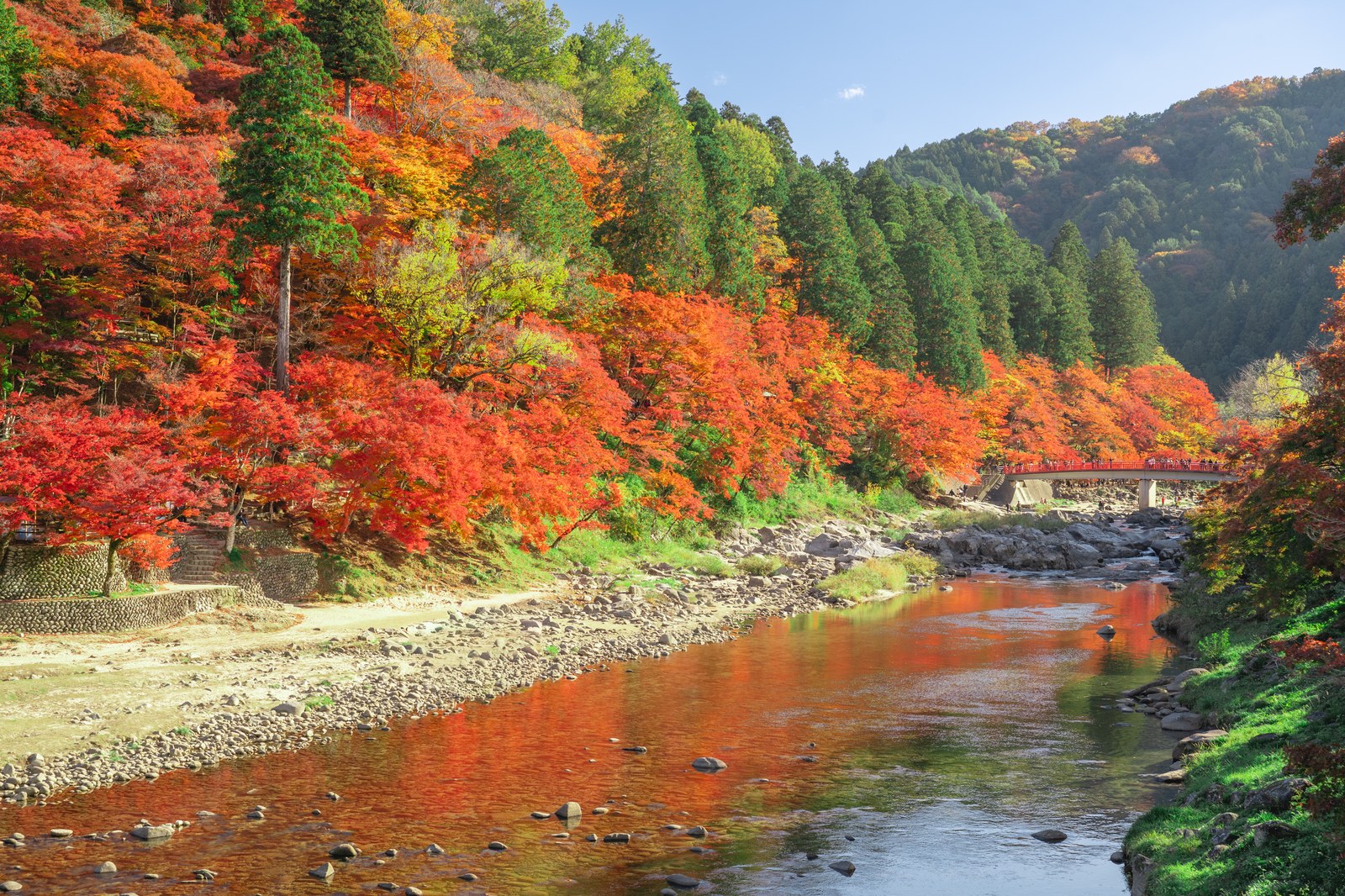
We deliver the maples of Korankei, grown across four centuries of time, as a true silver-halide print on FUJICOLOR's finest photographic paper. A single frame that holds the very depth of the colour, shipped anywhere in the world.
💾 A digital download is also available ($7.00 each). Bundles cost less: 3 for $17.84, 5 for $26.23 ($5.25 each) — mix any photographs you like.
View the print →