
PHOTO SPOT GUIDE
The Misotsuchi Icicles ― A Chichibu Winter, Frozen on the Riverbank
Deep in the mountains of Okuchichibu, Saitama, near the upper reaches of the Arakawa river, there is a place where the rock face along the bank turns entirely to ice in the coldest weeks of the year. Spring water seeps from the stone, freezes drop by drop through the night, and slowly builds into a wall of ice tens of metres wide. These are the Misotsuchi icicles ― not made by anyone, but assembled by cold, water, and time alone.
Where the Cold Takes Shape
The first time I saw the Misotsuchi icicles, it took me a while to believe they had formed entirely on their own. Along the bank of the Arakawa, countless icicles hang the length of the rock wall, the thickest of them broader than a grown man's arm and high enough to make you look up. As natural icicles formed by freezing spring water, this is the best known such place in Chichibu. Up close, the surface is polished smooth, with a faint blue held somewhere deep inside. They are cold enough to numb your fingertips at a touch, yet the whole scene feels strangely gentle ― as if the season of winter itself had risen up and stood before me.
Ice That Grows in the Night
An icicle is not finished in a single night. On the coldest evenings, spring water tracing the rock face freezes a little; by day it thaws a little; and at night it freezes again. That cycle repeats for weeks before the ice reaches such thickness ― growing quietly in the dark hours when no one is watching. On weekends during the season, the icicles are lit from dusk, and the wall that was white and clear by day takes on a sunken blue glow at night. Driving the snowy road after a night shift, when I caught that blue out of the darkness, I felt the tension the cold had drawn tight in me simply let go.
Frozen night by night, grown night by night.
On the Arakawa's bank, winter takes its form.
Planning your visit — season
The coldest season is the most beautiful one.
The icicles grow in the depths of winter, and the best viewing is roughly from mid-January to mid-February. During the season a small donation toward upkeep of the site is asked (typically around 300 yen for adults, about half that for primary-school children), and on weekend evenings the icicles are lit. That said, their condition depends heavily on each year's temperatures and weather, so please check the latest details with the Chichibu Tourism Association or another official source. The site is a riverbank where snow and ice are the norm: bring a heavy down jacket, waterproof non-slip boots, gloves and a hat, and a warm drink will be welcome too.
Getting there
By train, take the Seibu Chichibu Line to Seibu-Chichibu Station, then a Seibu Kanko bus on the Mitsumine-jinja route to the Misotsuchi stop, from where it is about a five-minute walk; the bus ride takes a little over forty minutes. By car, follow the Kan-etsu Expressway to the Hanazono interchange and head toward Chichibu. There is paid parking near the site, but roads in the winter mountains of Okuchichibu ice over easily and snow lingers in shaded spots even at midday ― treat snow tyres or chains as essential. If you are coming for the evening light-up, plan in extra time and remember you will be returning along a dark, snowy road.
Tips for photographers
By day, work with the clarity of the ice; by night, with the blue of the light-up. Mount a tripod and use a long exposure: the Arakawa flowing past your feet softens into silken threads, set against the stillness of the icicles. To honour the cold colour of the ice, set your white balance a touch low. Aligning the vertical lines of the rock wall with the fall of the icicles makes for a much quieter composition. But the ground is a frozen riverbed, and once it is dark you cannot see your footing ― spread the tripod legs firmly, mind your grip, carry a headlamp, and above all keep your footing safe rather than getting lost in the picture.
While you're in the area
Misotsuchi sits at the gateway to Otaki in Okuchichibu, the mountains that give rise to the Arakawa. A little further on, a dam lake, a gorge, and scattered hot springs wait to thaw a chilled body. Together with Onouchi and Ashigakubo, Misotsuchi forms what are called the Three Great Icicles of Chichibu, and each wears a different face ― Misotsuchi being the natural one. After the ice has chilled you to the core, soaking in a hot spring while watching the snow is a reward only a Chichibu winter can offer.
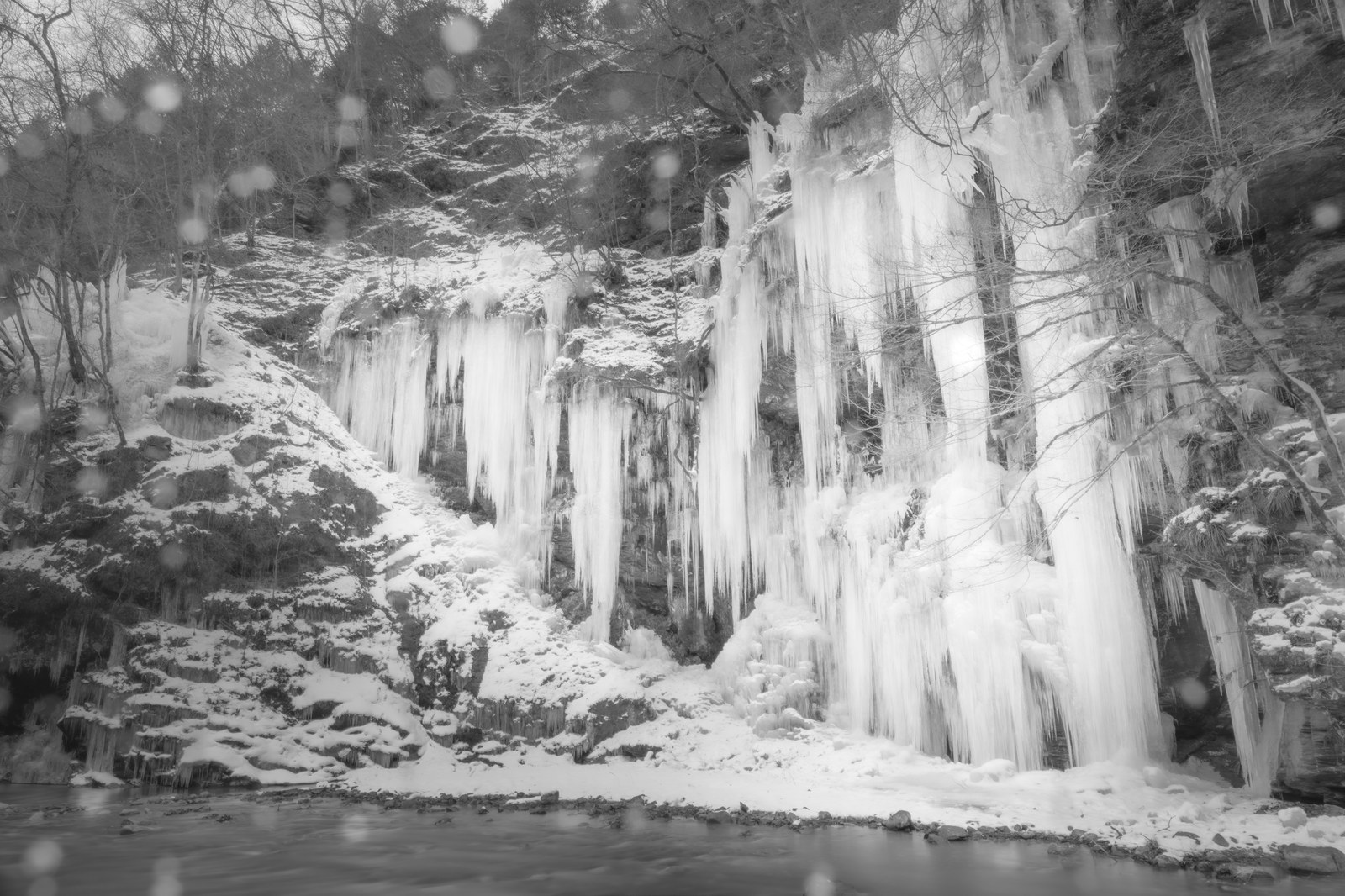
We offer the Misotsuchi icicles, sunk in their nighttime blue, as a silver-halide print on FUJICOLOR's finest photographic paper. Each is finished by hand, one at a time, and shipped worldwide.
💾 A digital download is also available ($7.00 each). Bundles cost less: 3 for $17.84, 5 for $26.23 ($5.25 each) — mix any photographs you like.
View the print →