
PHOTO SPOT GUIDE
Momoiro Toiki ― A Summer Sigh Across the Hill
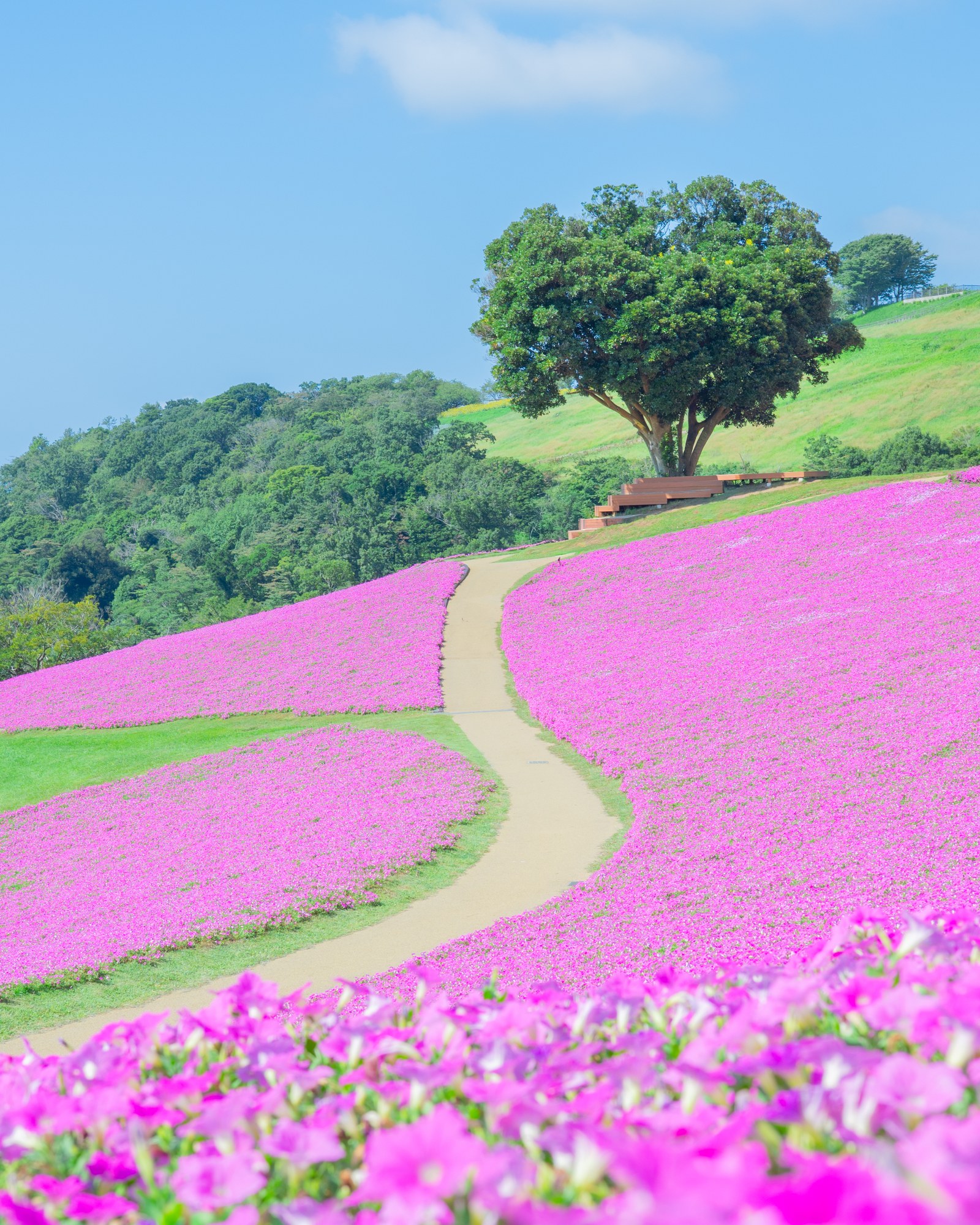
On the upland of Mount Kano in Futtsu, Chiba, there is a season when an entire gentle hillside takes on the colour of a soft pink sigh. This is Momoiro Toiki, blooming across the Valley of Flowers at Mother Farm, where countless petunias sway in the wind and spread summer's tender colour over a hill that looks out across Tokyo Bay.
A Whole Hillside of Soft Pink
Standing on that hill, I let out a quiet breath without meaning to. The slope was covered, edge to edge, in a colour too pale to call pink and too tinted to call white — a flower that lives up to its name, Momoiro Toiki, a sigh of rose. This new variety of petunia, born here in southern Boso, runs on and on with the rise and fall of the land, some twenty thousand plants in all. Up close, each single bloom; from a distance, one long gradation. Each time the wind crossed it, the whole hill seemed to ripple, gently.
Highland Wind, and Time That Does Not Hurry
Mother Farm sits high on an upland overlooking Tokyo Bay. Sea wind moves across the slope, and the pink field opens softly into the view. That sense of openness is something particular to this place. In my ordinary life I work in the emergency room, racing against the clock. When a long night ends and I find myself on a hill like this, I am always struck by how differently time flows here. The flowers do not hurry. They simply deepen their colour, quietly, as the wind allows. Just standing in that slower time, I felt the tension drain, slowly, from my shoulders.
A whole hillside, breathing out in pink.
With every gust, summer ripples gently across the slope.
Planning your visit — season
Even the loveliest field has its finest season.
Momoiro Toiki is usually at its best from around July to September. By early August in particular, the gaps between the plants all but disappear, and the hill is blanketed like a carpet of soft pink. Admission is roughly 1,800 yen for adults (junior-high age and up) and around 900 yen for children (ages four through sixth grade) as a guide — please check the official site for the latest. One note: these petunias close their petals at night and in rain to protect themselves, so a clear day, viewed in daylight, shows them at their most beautiful.
Getting there
By train, buses run from Sanuki-machi Station or Kimitsu Station on the JR Uchibo Line. From the south exit of Kimitsu Station, the bus to Mother Farm takes about 30 to 40 minutes; from Sanuki-machi Station, the Kanozan-line bus takes around 25 minutes. By car, it is about 20 minutes from the Kimitsu interchange on the Tateyama Expressway. Buses are infrequent, so do check the timetable before you set out.
Tips for photographers
This hill changes its expression entirely with the height of the light. The soft, low light of morning lets the pink turn translucent and breathes life into each petal. To make the most of the rolling slope, try shooting across it from the side, or looking up from below. Setting a summer sky or the distant glint of Tokyo Bay behind the flowers gives the frame that upland sense of openness. When the wind sends the blooms rippling, waiting a beat before you press the shutter brings a quiet motion to the whole image. Because the colour is so pale, dialing the exposure just slightly brighter draws you nearer to that sighing softness.
While you're in the area
Mother Farm is a full day in itself, with broad grounds where you can meet the sheep and alpacas. After the flowers, pause for fresh milk or soft-serve ice cream. A little farther on, the summit of Mount Nokogiri offers its own view across Tokyo Bay, and the sunset from Cape Futtsu is close at hand. Take your time with the sea and uplands of Boso, carrying that pink memory along with you.
We offer this soft pink gradation as a silver-halide print on FUJICOLOR's finest photographic paper. Worldwide shipping is available.
💾 A digital download is also available ($4.00 each). Bundles cost less: 3 for $10.20, 5 for $15.00 ($3.00 each) — mix any photographs you like.
View the print →