
PHOTO SPOT GUIDE
A Forest of Lupines — 40,000 Flower Spires in the Komorebi Field
On a hillside dappled with light through the trees, pastel spires of flowers stand tall and quiet. This is the "Komorebi Flower Field" in Musashi Kyuryo National Government Park, Saitama. As spring draws to a close, some 40,000 lupines come into bloom, and soft tones of pink, purple, white and yellow slowly wash across the wooded slope.
A hill of flower spires
Lupine is a tall flower whose flowering spike alone can reach 40 to 60 centimetres. With its shape resembling an upside-down wisteria, in Japanese it is also called noborifuji — "climbing wisteria." Each one points to the sky like a tower, and tens of thousands together become a forest of pastel. When the wind passes through, the many-coloured spikes sway all at once, and the whole field ripples gently.
In the dappled light
The greatest charm of this field is right there in its name — komorebi, the light that filters through the trees. Softened by the surrounding woodland, that light makes the lupines' pastel colours all the more delicate. Rather than harsh sun, a lightly clouded day or the hours in shade render the colours deeper and gentler. Amid days measured in seconds, this kind of waiting for soft light has a way of quietly loosening the heart.
Pastel towers, swaying in the wind —
a late-spring forest made of dappled light.
Planning your visit — season
A few notes for those hoping to see it in person.
The lupines are usually at their best from late April to mid-May. The Komorebi Flower Field is about a ten-minute walk from the park's Central Gate. Around the same time, tall, slender delphiniums also reach their peak, adding a duet of blue and purple. The exact timing shifts from year to year, so please check the official site before you go.
Getting there & admission
The venue is Musashi Kyuryo National Government Park in Saitama. By train, take a bus (bound for Rissho University / Kumagaya Sta. South Exit) from Shinrin-kōen Station on the Tōbu Tōjō Line, getting off at "Namegawa Chūgakkō" or "Shinrin-kōen Nishiguchi." The park is also accessible by car, with large parking lots (parking and admission are paid; please check current fees and opening hours on the official site). The grounds are vast, so comfortable walking shoes are recommended.
Tips for photographers
Because lupines are tall and vertical, a portrait composition also suits them well. Make a single spire your subject and let the field behind soften into a blur, and its tower-like form really stands out. A landscape (horizontal) composition works beautifully too, showing the full sweep of the slope like a forest of pastel. You can also use the patches of dappled light to catch the translucence of the petals. The flowers sway easily in the wind, so wait for the brief stillness before you release the shutter.
While you're in the area
The forest park is enormous and changes face with every season. After the lupines, there are cycling courses and seasonal flowers to wander among — an easy place to spend an unhurried day.
Light in the dappled field
The lupine's Japanese name, nobori-fuji ('climbing wisteria'), pictures it as a wisteria turned upward, its flower spires rising toward the sky. In the 'komorebi' (dappled-light) field at Musashi Kyuryo park, soft light filtering between the trees lights these towers of bloom, and petals glowing in backlight photograph especially well. For making the most of light, see how to photograph flower landscapes.
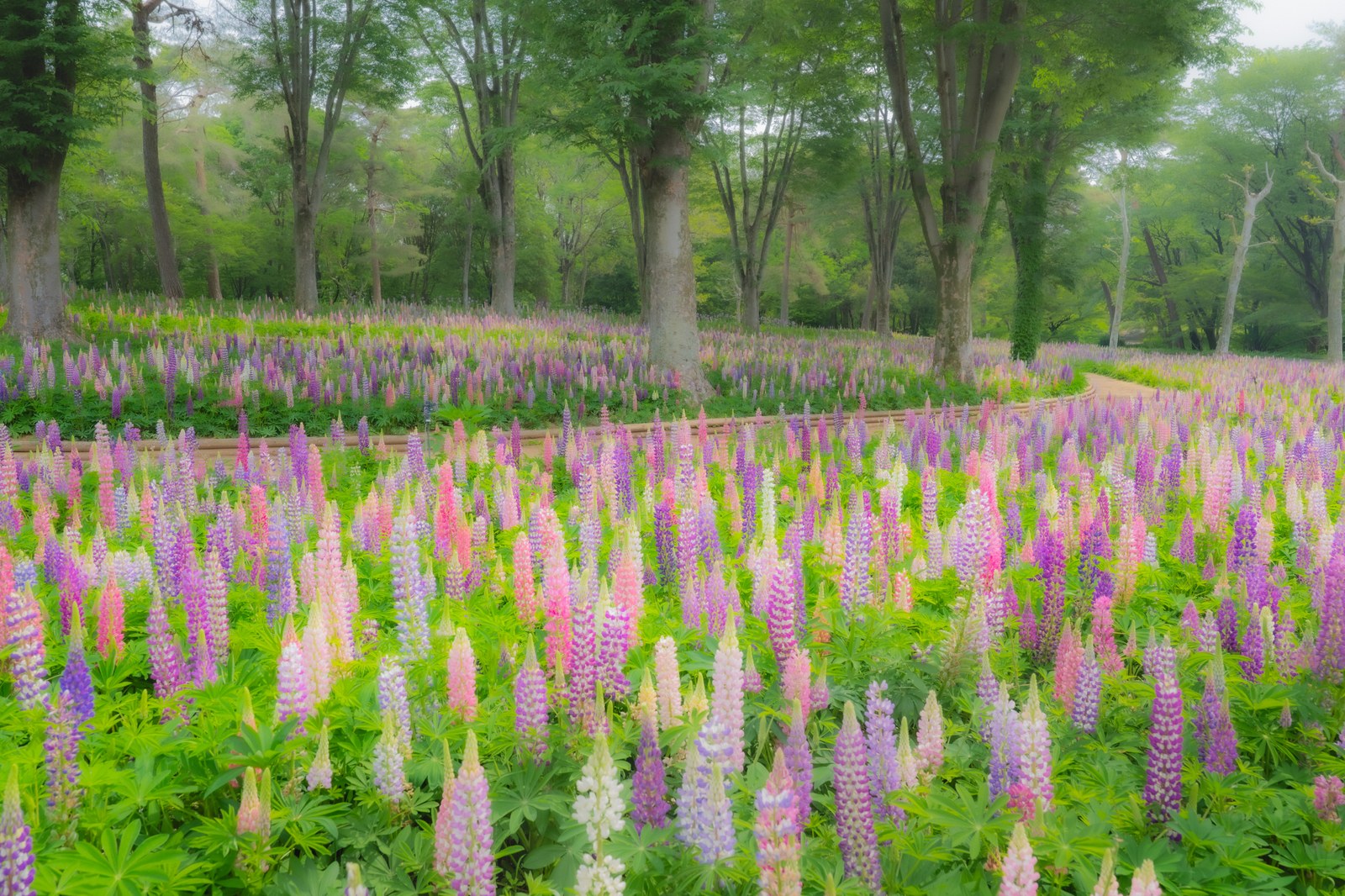
This scene is available as a fine-art silver-halide print on premium FUJICOLOR paper, hand-printed in Japan and shipped worldwide.
💾 A digital download is also available ($7.00 each). Bundles cost less: 3 for $17.84, 5 for $26.23 ($5.25 each) — mix any photographs you like.
View the print →