
PHOTO SPOT GUIDE
Autumn at Tofuku-ji — A Sea of Brocade from Tsutenkyo Bridge
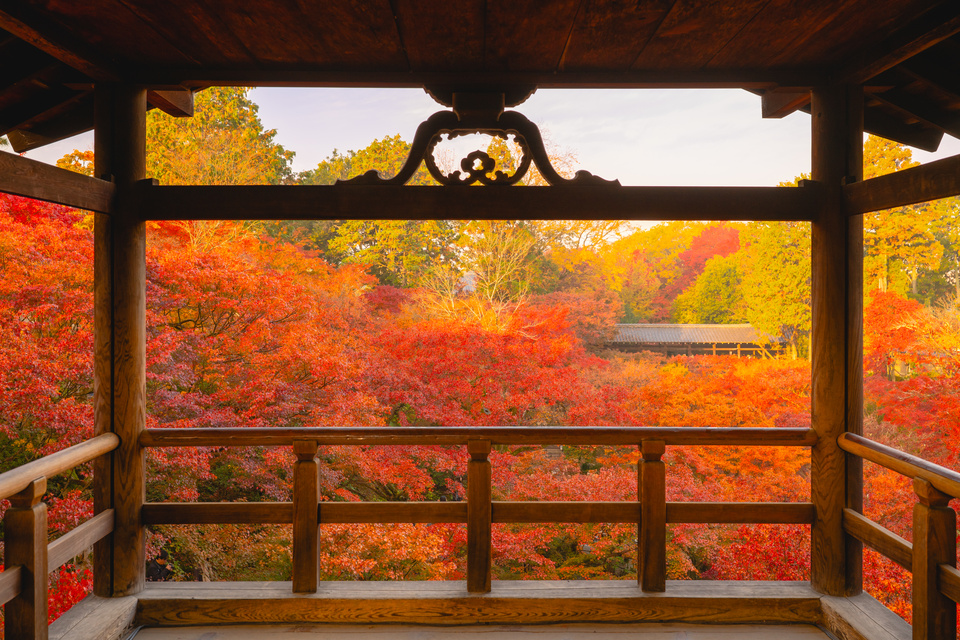
In the south of Kyoto, standing on the Tsutenkyo Bridge at Tofuku-ji, the valley below — the Sengyokukan ravine — is filled as far as the eye can see with autumn maples: a sea of brocade. Among Kyoto's many famous autumn temples, this Zen temple is known for its overwhelming scale. The borrowed scenery glimpsed through the bridge's old wooden lattice looks like a single painting set within a frame.
Looking down on a sea of brocade
The magic of Tsutenkyo is that you look down on the autumn colour from above. From the height of the bridge, the maples filling the valley spread out like an ocean, red, orange and yellow mingling into a true sea of brocade. When the wind crosses, the leaves sway all at once, and the colours shift moment by moment with the angle of the light. Look back toward Tsutenkyo from the facing Gaun-kyo bridge, and the bridge floating among the maples becomes a picture in its own right.
A frame of wooden lattice
What draws me most is the maples seen through the old wooden lattice of the Tsutenkyo. The aged grid becomes a frame, and within it the borrowed autumn fits exactly. Shakkei — "borrowed scenery," the idea of drawing distant views into one's own — is a principle Japanese gardens have long cherished, and here it turns the maples into a finished painting. It is the very opposite of a race against the second: a Kyoto autumn where time flows slowly.
A valley brimming with brocade;
a Kyoto autumn held in a wooden frame.
Planning your visit — season & admission
A few notes on season and admission.
The autumn colour usually peaks from mid-November to early December — which is also when the crowds peak. According to Tofuku-ji’s visiting guide (checked 27 September 2026), the autumn season runs from 14 November to 6 December. During it, the Tsutenkyo and Kaisan-dō are 1,000 yen for adults, and no combination ticket is sold. The Hōjō garden costs the same in every season: 500 yen for adults, rising to 600 yen from 1 November. Outside the autumn season, the Tsutenkyo and Kaisan-dō are 600 yen. Last entry is 16:00 and the gates close at 16:30; in the autumn season only the Tsutenkyo opens early, at 8:30. The autumn dates change every year, so confirm current fees and times in the Tofuku-ji, visiting guide (Japanese).
Getting there
It is about a 10-minute walk from Tofukuji Station on the JR Nara Line and the Keihan Main Line. From Kyoto Station it is just one stop, about 3 minutes, on the JR Nara Line, so the train is wonderfully convenient. Tofuku-ji closes its car parks during the autumn season, 25 October to 10 December (Tofuku-ji, access (Japanese)), so avoid coming by car and take the train. To beat the crowds, the early hours right after opening are best.
Tips for photographers
From the Tsutenkyo, a wide lens that takes in much of the ravine conveys the scale of the "sea." For the framed composition through the lattice, focus not on the grid but on the maples beyond, to bring out depth. Tofuku-ji officially asks visitors not to photograph with a tripod anywhere in the grounds, all year round, so mind a shutter speed safe for handheld shooting. After rain is a fine chance, when the colours of wet leaves and moss deepen quietly.
Photographing on the Tsutenkyo and Gaunkyo bridges in the autumn season. Tofuku-ji’s visiting guide says: “During the special autumn opening, very heavy crowds are expected. We may ask you to refrain from taking photographs on the Tsutenkyo and Gaunkyo bridges.” (Tofuku-ji, visiting guide (Japanese), checked 27 September 2026.) Go expecting that on some days you will not be able to stop on the bridge and compose through the lattice, and follow the staff on the day.
While you're in the area
The area around Tofuku-ji is home to some of Kyoto's finest Zen temples. You might wander the quiet gardens of its sub-temples, or pair a visit with the sights of Fushimi and Higashiyama a little further on, to savour a full day of Kyoto in autumn.
A tip ― avoiding the crowds
Tofuku-ji's autumn is among the most popular in Japan, and the Tsutenkyo bridge draws long queues at the peak. Aim for early morning, just after the gates open. The view from the Gaun-kyo bridge nearby is fine too, though photography there may be restricted when busy ― follow the on-site guidance. For more of Kyoto's autumn and its mirror-tables, see the guide to Japan's best autumn-leaf spots.
From my visit —
Notes from the day I, Ikebanadoctor, went to photograph this place for this guide. Shooting times come from the camera; everything else is from my own memory of the visit.
- Arrival
- I set out early and was already there when the sun, newly risen, began to reach into the temple. The photographs from this day were taken at 7:49 and 7:58 (from the camera).
- How I got in
- I had bought a ticket in advance for a paid special viewing that lets you in before the general opening and gives you the bridge ahead of everyone else until then (in 2025 Tofuku-ji ran it as an “early-morning private viewing”). It was well worth it.
- Where I stood
- On the ordinary visitor walkways. Both photographs in this guide — Tofukuji from Tsutenkyo Bridge and Tofukuji Tsutenkyo Autumn — were taken inside the grounds after I had gone in early on the special viewing.
- Crowds
- On the first-thing special viewing there were few people, and I could take my time waiting for the right moment. You may stay on after the general opening, but once the general visitors come in it fills up quickly.
- Weather and light
- It was overcast. I was disappointed at first, but cloudy weather has a mood of its own, different from the usual. I shot to convey that soft, dreamlike, painterly feeling across the whole scene.
- For your visit
- Many of Kyoto’s famous sights offer special viewings like this. They cost extra, but using them to make good photographs is an experience worth having.
Official information mentioned above: Tofuku-ji, early-morning private viewing 2025 (Japanese) (checked 2 October 2026)
More photographs from this spot
Dates and times come from the camera’s own record of each shot. Tap a photograph to open its print page.
The route over two days — Autumn colour in Kyoto (26–27 November 2025)
Each time is when the first photograph at that place was taken, from the camera’s own record.
- Yusaitei, Arashiyama
- Nanzen-in
- Toji
- Tofuku-ji (this article)
- Rurikoin
Questions photographers ask
Is there a way to photograph the Tsutenkyo bridge early in the morning, before general admission?
In autumn 2025, Tofuku-ji held an “early-morning private viewing”: 20 November to 8 December, 7:30–8:30 (last entry 8:00), with reception at the Nikka-mon gate and 510 places a day, booked in advance online through JR Central’s “EX Tabisaki Yoyaku” service. If you enter within the reception time you may stay on after general admission begins (no re-entry; the Hojo garden is charged separately). As of 2 October 2026, Tofuku-ji’s website has announced nothing about 2026. The two photographs in this guide were taken on 27 November 2025, when I went in on this early viewing.
Sources: Tofuku-ji, early-morning private viewing 2025 (Japanese); Tofuku-ji, news (Japanese) (both checked 2 October 2026)
Can I use a tripod or monopod on the early-morning viewing?
No. The 2025 early-morning viewing notice says that tripods, monopods, stepladders, selfie sticks and similar photographic aids are prohibited. Tofuku-ji’s visiting guide also asks visitors, all year round, not to eat or drink in the grounds or photograph with a tripod.
Sources: Tofuku-ji, early-morning private viewing 2025 (Japanese); Tofuku-ji, visiting guide (Japanese) (both checked 2 October 2026)
Can I take photographs on the Tsutenkyo bridge in the autumn season?
Not always. Tofuku-ji’s visiting guide says the autumn special opening is expected to be very crowded and that visitors may be asked to refrain from photography on the Tsutenkyo and Gaunkyo bridges. The 2025 early-morning viewing notice likewise says photography from the Tsutenkyo may be restricted for safety when crowded, and asks visitors to give way to one another. On the morning I went in early, there were few people and I could take my time, but it began to fill up as soon as the general visitors arrived.
Sources: Tofuku-ji, visiting guide (Japanese); Tofuku-ji, early-morning private viewing 2025 (Japanese) (both checked 2 October 2026)
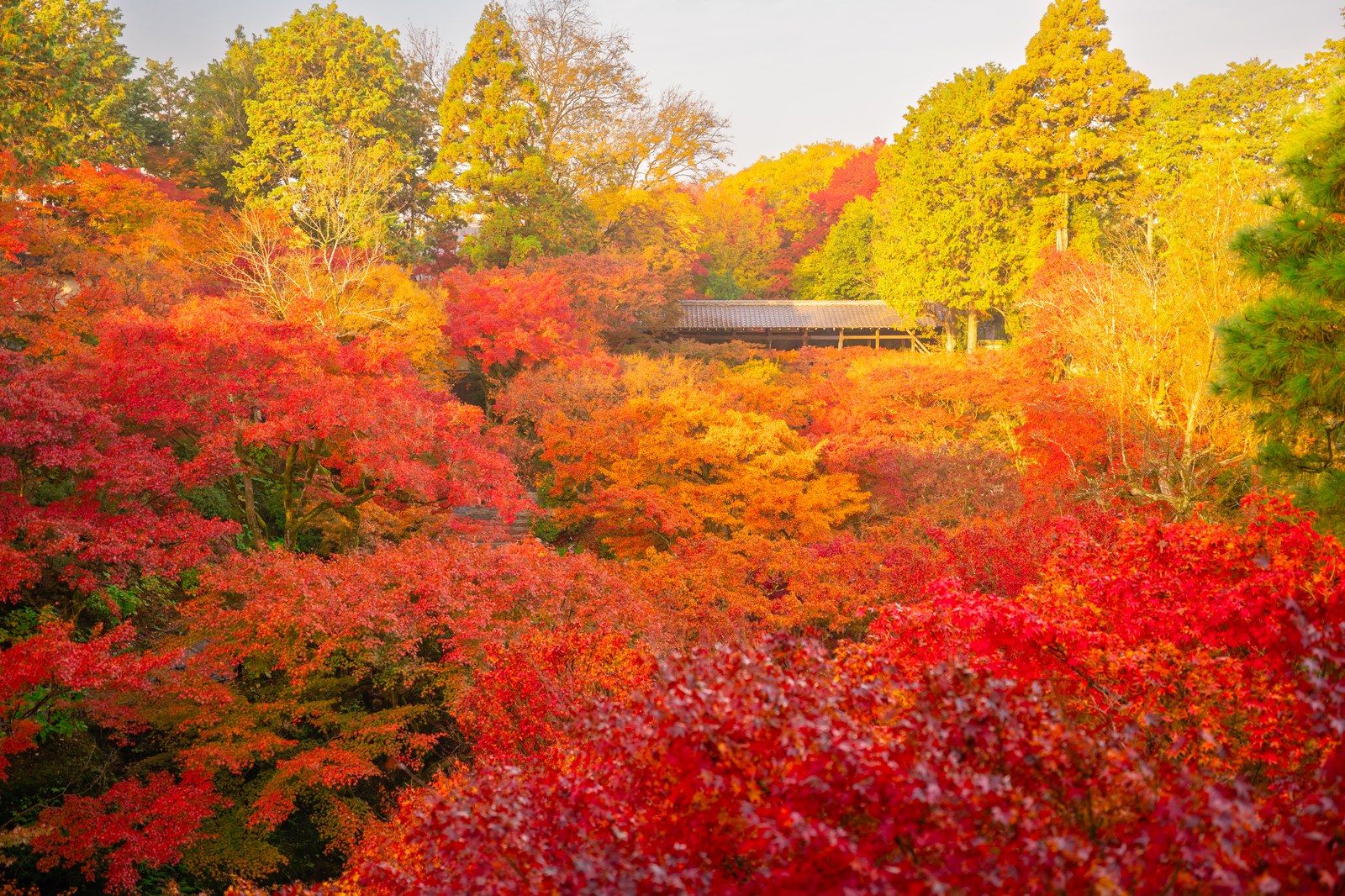
The autumn maples of Tofuku-ji's Tsutenkyo are available as fine-art silver-halide prints on premium FUJICOLOR paper, hand-printed in Japan and shipped worldwide.
💾 A digital download is also available ($4.00 each). Bundles cost less: 3 for $10.20, 5 for $15.00 ($3.00 each) — mix any photographs you like.
View the print →