
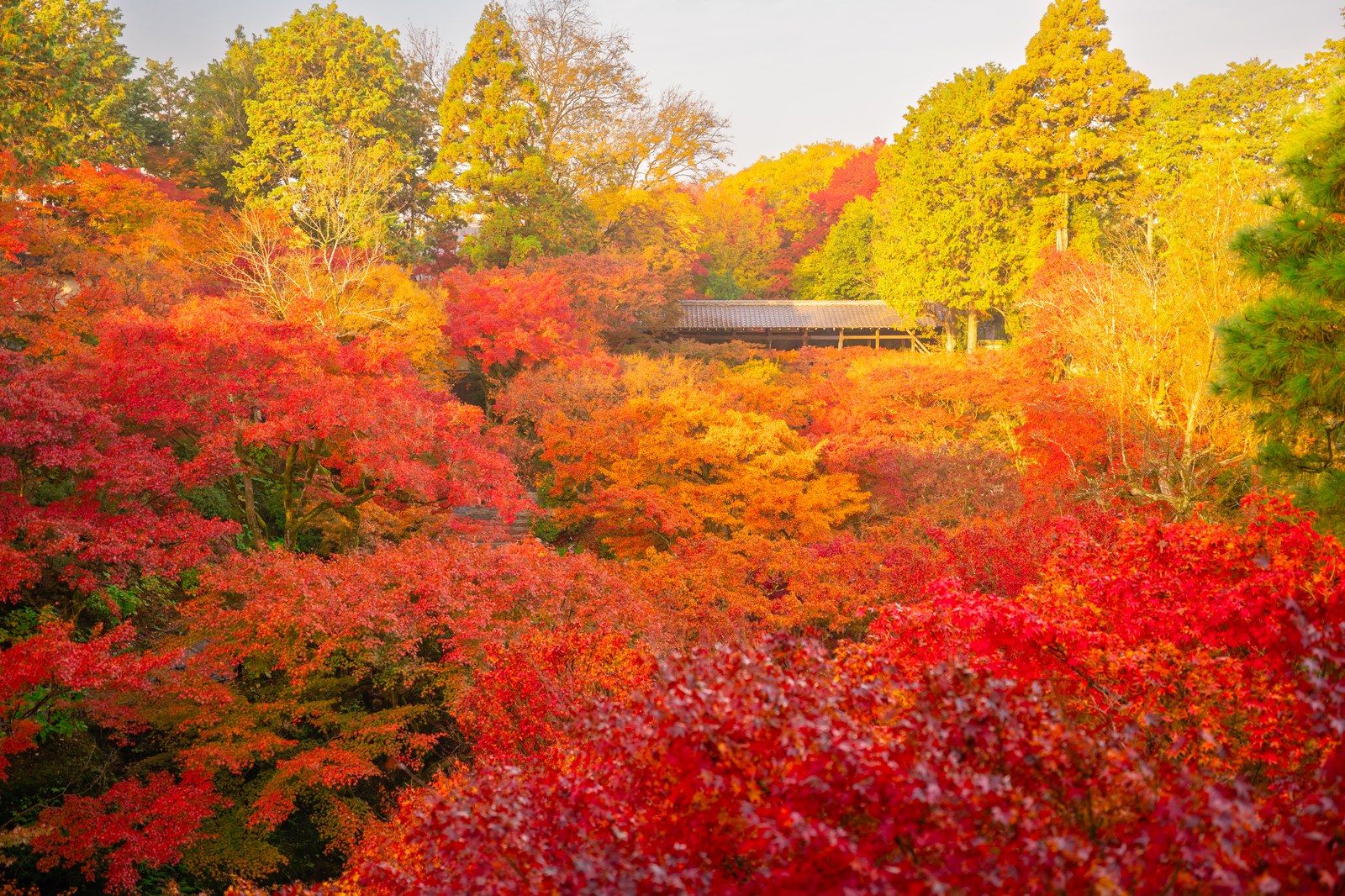
A sea of autumn maples seen from the Tsutenkyo bridge at Tofuku-ji

FEATURE

Japan's Best Autumn Leaf Spots ― From Kyoto's Temples to Highland Brocade

💠 Season: September to December 🗾 Across Japan

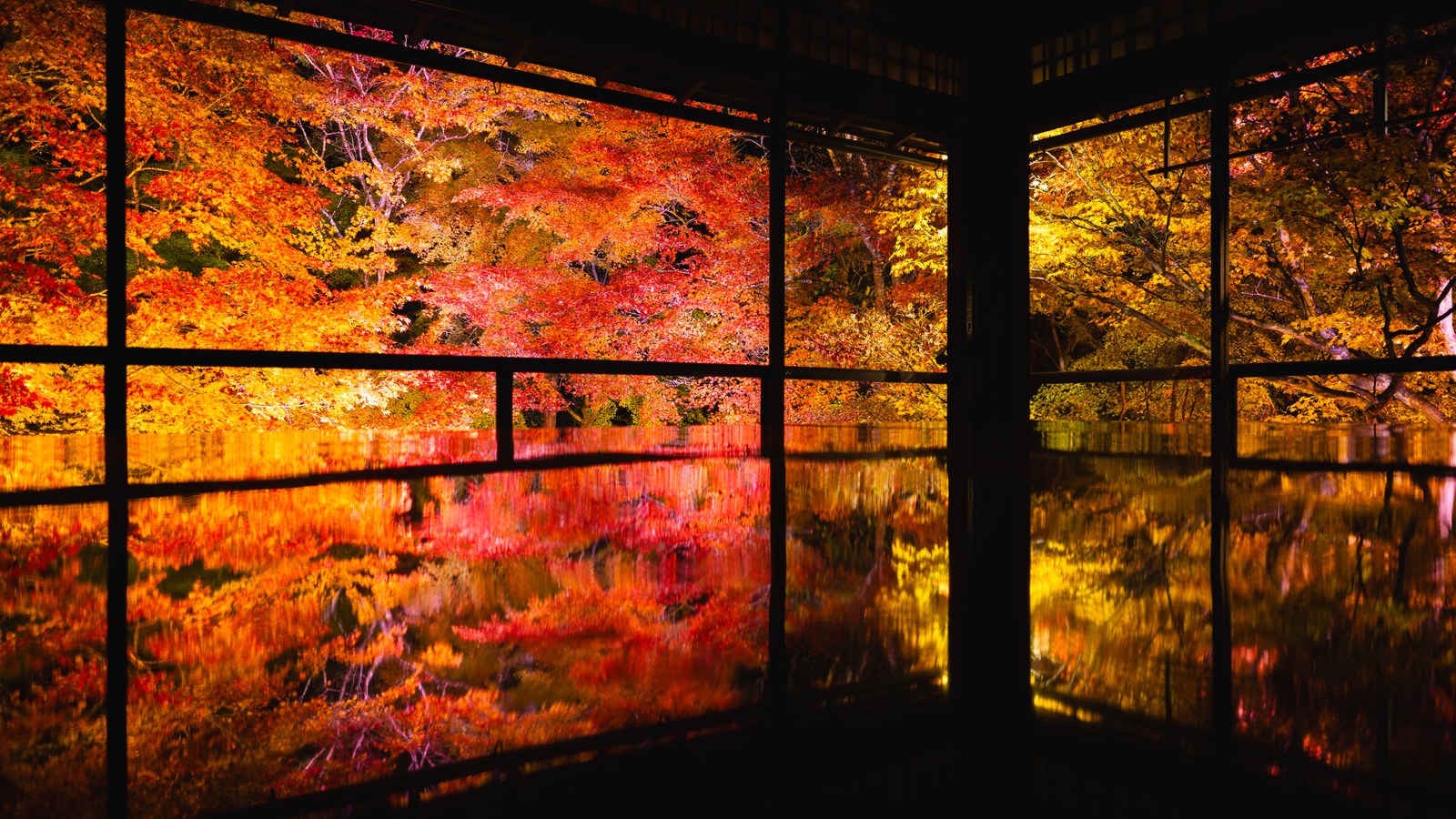
Autumn moves slowly across Japan, north to south, mountain to lowland, turning the land to brocade. Maples filling a gorge like a sea of cloud, a second autumn mirrored on a black table, night leaves beneath a five-storey pagoda ― autumn, too, tells a different story in every place. From my notes travelling through the season, here are the places that stayed with me, in order of their turning.

From highland to lowland ― following the colour

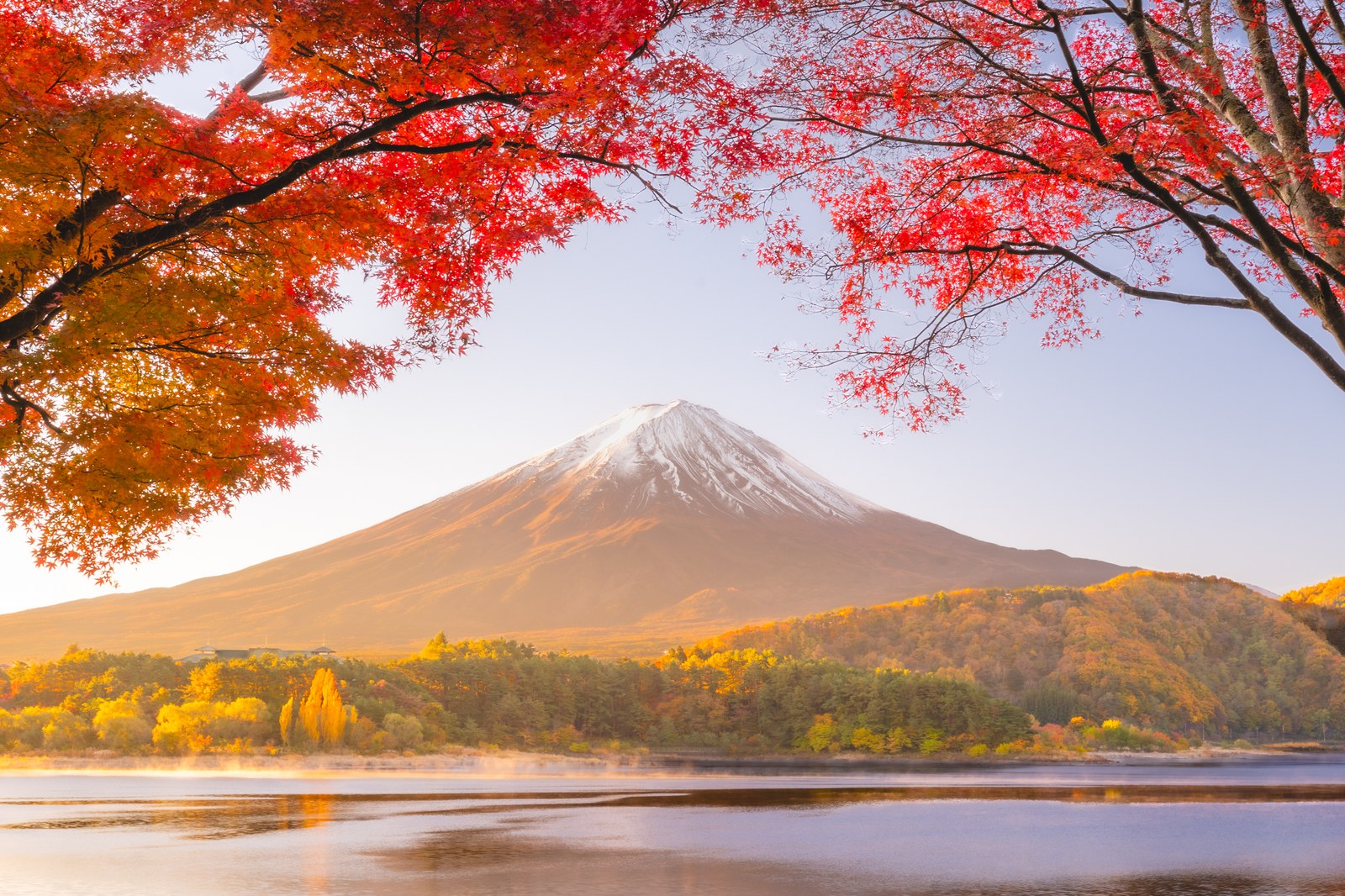
Autumn begins high in the mountains. From late September into October, at Oku-Nikko in Tochigi, Lake Chuzenji and Kegon Falls seen from Akechidaira, and the russet grasses of Senjogahara, show an early autumn. By November, at Lake Kawaguchi in Yamanashi, a corridor of maples over a century old turns colour while Mount Fuji rises beyond the water. Chasing the colour as it descends from highland to village is one of autumn's quiet pleasures.

Every place in this guide, at a glance

Thirteen locations, and no two of them peak in the same week. The table runs in the order the season itself takes ― the marsh grass at 1,400 metres first, the ginkgo outside Tokyo Station last ― so you can read down it and find where autumn will be on the week you can actually travel. Journey times are from the nearest station or bus stop. The last column says whether an official illumination has been announced, which is not the same as asking whether a place has lights.

↔ The table scrolls sideways on a narrow screen.

SpotPrefecturePeakFrom the nearest stationNight illumination
Senjogahara marshTochigiLate Sep – early Oct (grass foliage)Akanuma, about 70 min by Tobu bus from JR Nikko Sta.None announced
OdashirogaharaTochigiLate Sep – early Oct (grass) / late Oct (larch)Akanuma (about 1 hr by bus from Tobu-Nikko), then about 12 min by low-emission bus (¥500) or 35 min on footNone announced
Oku-Nikko (Akechidaira & Lake Chuzenji)TochigiEarly – late OctBus for Chuzenji Onsen from JR Nikko or Tobu Nikko Sta.None announced
Roppozawa gorgeTochigiLate Oct – early NovNo bus service; by car on the Kirifuri Highland RoadNone announced
Hangetsuyama observation deckTochigiLate Oct – early NovSeasonal Tobu bus from Chuzenji Onsen, then about 30 min up on foot from the car parkNone announced
Lake Kawaguchi Maple CorridorYamanashiEarly – mid NovAbout 20 min on the Red Line sightseeing bus from Kawaguchiko Sta., then 5 min on footYes — Autumn Leaves Festival (2026: 7–29 Nov, sunset to 21:00)
Korankei gorgeAichiMid – late NovAbout 50 min by Meitetsu bus from Toyotashi Sta.Yes — Momiji Festival, usually through November, sunset to 21:00 (2026 dates unannounced as of Aug 2026)
Tofuku-ji, Tsutenkyo bridgeKyotoMid Nov – early DecAbout 10 min on foot from Tofukuji Sta. (one JR stop from Kyoto Sta.)None announced
Nanzen-inKyotoMid – late NovAbout 10 min on foot from Keage Sta. (Tozai Line)None announced
Yusai-tei, ArashiyamaKyotoMid – late Nov (into early Dec some years)About 15–20 min on foot from Randen Arashiyama or JR Saga-Arashiyama Sta.None announced
RurikoinKyotoMid – late Nov (into early Dec some years)5–13 min on foot from Yase-Hieizanguchi Sta. (official figures disagree)None announced for autumn 2026
To-ji five-storey pagodaKyotoMid – late Nov (into early Dec some years)About 15 min on foot from JR Kyoto Sta. / about 10 min from Kintetsu Toji Sta.Yes — special evening viewing (2026: 31 Oct – 13 Dec, 18:00–21:30)
Gyoko-dori ginkgo avenueTokyoLate Nov – early Dec (peak about 1–2 weeks)Right outside the Marunouchi exit of Tokyo Sta.None announced

“None announced” means I could not find an official announcement of a foliage illumination — several of these places simply close at dusk. Peak weeks move with the year's temperatures, and festival and illumination dates are re-set every year, so read this as the shape of the season and confirm the current dates with each location before you travel.

Bring a scene from this guide home

Each is a real photograph from this guide’s season, printed in Japan on FUJICOLOR professional paper.
Sponsored

Kyoto's temples ― frames and water mirrors

For the height of autumn, there is Kyoto. The gorge seen from the Tsutenkyo bridge at Tofuku-ji fills with maples like a sea of cloud. At Rurikoin in Yase and Yusaitei in Arashiyama, polished black tables hold the maples in mirror reflection ― a second autumn. At Nanzen-in the study's pillars become a frame, cutting the pond's foliage like a hanging scroll. After dark, the five-storey pagoda of To-ji is lit, and the twelve-hundred-year-old tower floats with the maples on the surface of the pond.

A valley in scarlet ― the finest in Tokai

There are maples that turn a whole valley scarlet. At Korankei in Asuke, Toyota, Aichi, some four thousand maples fill the valley of the Tomoe River ― the finest autumn in the Tokai region. The vermilion Taigetsu Bridge and the foliage mirrored on the water make one of the region's defining images of the season.

The maples are loveliest as they fall.
Better not to hurry ― wait for that one day.

Oku-Nikko in five parts ― autumn walking down the mountain

Most autumn writing points at Kyoto, but the season actually begins three hundred kilometres north-east of it and about 1,400 metres up. At Senjogahara it is the grasses, not the trees, that turn: some four hundred hectares of marsh leaning into gold in the last days of September, with a boardwalk running the roughly five kilometres from Akanuma to Yutaki Falls — though the eastern section between Yutaki Falls and Kotaki is closed from 18 August 2026 until the end of March 2027, so check the current state of the route before you set out. A short ride away, at Odashirogahara, a lone white birch known as “the Lady” stands out of the morning mist; the grasses go gold in the same week, and the larches follow in late October.

From there autumn walks downhill. The Roppozawa bridge in the Kirifuri highlands ― 1,433 m up, 134 m above the valley floor ― looks straight down into the colour, and although it stands high, the Nikko City Tourist Association lists its peak later than Oku-Nikko's, in late October into early November. The same weeks bring the Hangetsuyama observation deck on the south shore of Lake Chuzenji, half an hour's climb up from the car park, where the sun drops behind the Ashio ridges. Only then does the colour reach the lake itself and the Irohazaka switchbacks ― the part of the mountain most people mean when they say Oku-Nikko.

Two practical notes for this stretch. Irohazaka jams badly in season, so an early start matters more here than anywhere else in this guide. And the Akechidaira ropeway is expected to be out of service for refurbishment from around January 2026 until the end of August 2027, which changes how you reach that viewpoint. Roppozawa has no bus at all: the Kirifuri Highland Road is a car road, and it closes for the winter.

The last of it ― a golden avenue outside Tokyo Station

Autumn's final act in this guide is neither a temple nor a mountain but a city street. Gyoko-dori, running from the red-brick Marunouchi front of Tokyo Station towards the Imperial Palace, holds four rows of ginkgo that turn together in late November and early December. The peak lasts roughly one to two weeks. There is no bus, no reservation and no admission ― the trees begin at the station exit. If Kyoto is an autumn of frames and mirrors, this is an autumn of straight lines.

These are also the weeks for autumn's flowers rather than its leaves. Those have their own guide in autumn flower photo spots, with the cosmos of Showa Kinen Park and the red spider lilies of Murakami Ryokuchi written up separately.

Tripods, reservations and admission ― what to settle before you leave

The single most useful thing to know before a Kyoto autumn trip is that a tripod is often not an option. Tofuku-ji, Nanzen-in (within the Nanzen-ji precincts), Yusai-tei and Rurikoin all state officially that tripods may not be used ― Rurikoin names monopods as well, and at Tofuku-ji the rule covers the whole grounds, not only the crowded bridge. Carry one to those four and it stays in the bag, which is exactly the situation a phone handles better than a camera. Oku-Nikko words it differently: the Ministry of the Environment's Nikko-Yumoto Visitor Center asks that at Senjogahara and Odashirogahara you photograph from the trail and use tripods with consideration for other walkers, and that on crowded days you keep to the right of the boardwalk and walk in single file.

Reservations are the other thing that catches people out. Rurikoin is closed for most of the year and opens only for special viewing periods; in the autumn period a reservation is required for the busiest stretch, while the opening and closing weeks are walk-in. Yusai-tei gives priority to visitors with reservations year-round and takes payment in advance during the foliage season, which makes booking compulsory in practice; it also sets entry restrictions ― no children aged 0 to 12, no wheelchairs, no pets. Neither place has any parking, so both are trips to make by train. Admission at those two is ¥2,000 each, To-ji charges separately for its evening viewing, and several of the highland places charge nothing at all.

None of this is fixed. Every festival date, illumination window and fee above is re-set each year, and where an official source stated nothing I have deliberately left the value out rather than guess at it. Two or three phone calls before a trip save an entire wasted morning.

Photographing the leaves ― season and mindset

Foliage peaks around late September to October in the highlands, and late November to early December in the lowlands and in Kyoto. The colour depends greatly on the year's temperatures ― the wider the gap between day and night, the more vivid the turn. After rain, leaves and moss lie damp and the colours sink in deep. Many of the mirror-table rooms and special viewings are by reservation and for limited periods, so always check the latest information before you go. For the craft, see how to photograph flower landscapes, and for autumn specifically, how to photograph autumn leaves.
💠 HighlandsUsually late Sept to October (higher areas such as Oku-Nikko)
💠 Lowlands / KyotoUsually late November to early December (varies by year)
📸 Best lightSoft light after rain; lit hours for night maples
🎫 Note on accessRurikoin, Yusaitei and others may be special, reserved or limited-period viewings
ℹ️ Before you goPlease check each location's official information for colour and viewing dates
Tofukuji Tsutenkyo Autumn (Kyoto — Premier Autumn Spot of Southern Kyoto)
🍁 An hour of autumn, kept as a single picture

From Tofuku-ji's sea of maples to the night leaves of To-ji, bring home the autumn that stays with you as a true silver-halide print on FUJICOLOR's finest professional paper. Deep tone, rich gradation, shipped worldwide.

💾 A digital download is also available ($7.00 each). Bundles cost less: 3 for $17.84, 5 for $26.23 ($5.25 each) — mix any photographs you like.

View the autumn-leaf prints →
Cover of the book Autumn Leaves in Kyoto and Nikko: 16 Photo Spots
📖 Sixteen spots, every detail checked against official sources

Everything on this page ― best weeks, access, opening hours, parking, admission and how each place handles tripods ― is gathered for sixteen locations in Autumn Leaves in Kyoto and Nikko: 16 Photo Spots, along with a twelve-month calendar and a week-by-week chart of the autumn. More than a few of these places have no mobile signal; the book is meant to be the thing you open on the boardwalk. Where an official source said nothing, it says so rather than filling the gap with a guess.

See the book (Kindle / paperback) →
Sponsored
← Back to Photo Spot Guides