
PHOTO SPOT GUIDE
The Pagoda of Toji — A Crescent Moon over Japan's Tallest Tower
A short walk west of Kyoto Station, along Hachijo-dori, a tall tower rises above the rooftops. It is the five-storey pagoda of Toji — about fifty-five metres high, and still the tallest wooden pagoda in Japan. On an autumn evening, as its outline sank into deepening blue, a thin crescent moon hung quietly at the highest point of the sky.
A pagoda against the evening moon
When the sun goes down, the pagoda loses its colour first. The layered tiles, every joint of the timber, become nothing but a black shape against the last embers of the sunset. And when a crescent moon happens to be out, something in me grows quietly still. The tower has stayed rooted in this earth for twelve hundred years, unmoving, while the moon crosses slowly but surely above its shoulder. The thing that does not move, and the thing that circles — I always find myself caught in the moment they share a single sky. Stripped of all ornament, the pagoda's silhouette is somehow more eloquent for it. The rhythm of roof upon stacked roof stands out crisply against the graded dusk, and the angle of one's lifted neck begins to resemble the posture of prayer. There is not a single bright colour in the scene, yet I know of no view of Toji that stays with me longer than that pagoda against the evening moon.
Light, water, and twelve centuries
On autumn nights, Toji lights its lamps. Some two hundred maples across the grounds are illuminated, and the Kondo and Kodo halls rise softly out of the darkness. Then, standing at the edge of Hyotan Pond, you find a second pagoda on the water. The calmer the night, the clearer the mirror: tower and maples are paired above and below, and the pond becomes a continuation of the night sky itself. In that unwavering reflection, twelve hundred years suddenly feels close at hand. Since Kukai first set his heart on this tower, it has burned four times and been rebuilt five — this is its fifth form. No number of human lifetimes laid end to end could span such a length. In the emergency room I am always counting seconds, working in a world where a single minute can change the outcome. Perhaps that is why the time I spend before this pagoda feels so particularly quiet, and so welcome.
The crescent crosses the still pagoda's shoulder.
Another twelve centuries waits in the water.
Planning your visit — season
Toji's autumn lets you enjoy two hours of the day at once — dusk and the full of night.
The maples usually peak from mid- to late November, and in some years a little colour lingers into early December. In autumn the temple holds a special evening viewing of the Kondo and Kodo halls with the grounds illuminated; in recent years this has run roughly from early November into mid-December, from around six in the evening until just after nine. Admission to the evening viewing has been about 1,000 yen for adults and 500 yen for children, separate from the daytime Kondo and Kodo admission (around 500 yen for adults). Dates, hours, and prices change from year to year, so please check Toji's official guidance for the latest information before you go.
Getting there
The simplest approach is on foot from JR Kyoto Station. Leave by the south, Hachijo, exit, walk west along Hachijo-dori, then turn south onto Aburanokoji-dori — the temple gate is about fifteen minutes away. If you prefer the train, the Kintetsu line takes you one stop from Kyoto Station to Toji Station, a further ten-minute walk. Because you can simply walk back to Kyoto Station afterwards, even the late return from an evening visit is reassuringly easy for first-time visitors.
Tips for photographers
To catch the crescent silhouette, the half hour either side of sunset is the decisive window. While the sky still holds some light, frame the tower and the moon together; placing the pagoda small and giving the sky plenty of room lets the sense of distance to the moon read honestly. Under the illumination, even with the lamps lit there is not much light to work with, so set up a tripod and treat a few-second exposure as your baseline. For the water mirror on Hyotan Pond, choose a night as windless as you can, and lower the camera until it almost grazes the surface — that is where the reflection pairs tower and maples most beautifully. Follow the staff's guidance on whether tripods are allowed and where to stand, and take care not to block the view of those around you.
While you're in the area
Toji sits just south of Kyoto Station, well within walking distance. After looking up at the pagoda, you might head back toward the station for a rest — or, if you care to walk a little further, visit the site of Rajomon, the great gate that once stood at the southern entrance of the ancient capital. Today only a stone marker remains, quiet within a small children's park; but to think that twelve hundred years ago a vermilion gate towered at the far southern end of this avenue makes the age of Toji's pagoda sink in all the more. A gate that was lost, and a tower that remains — in autumn, Kyoto lets you walk between the two.
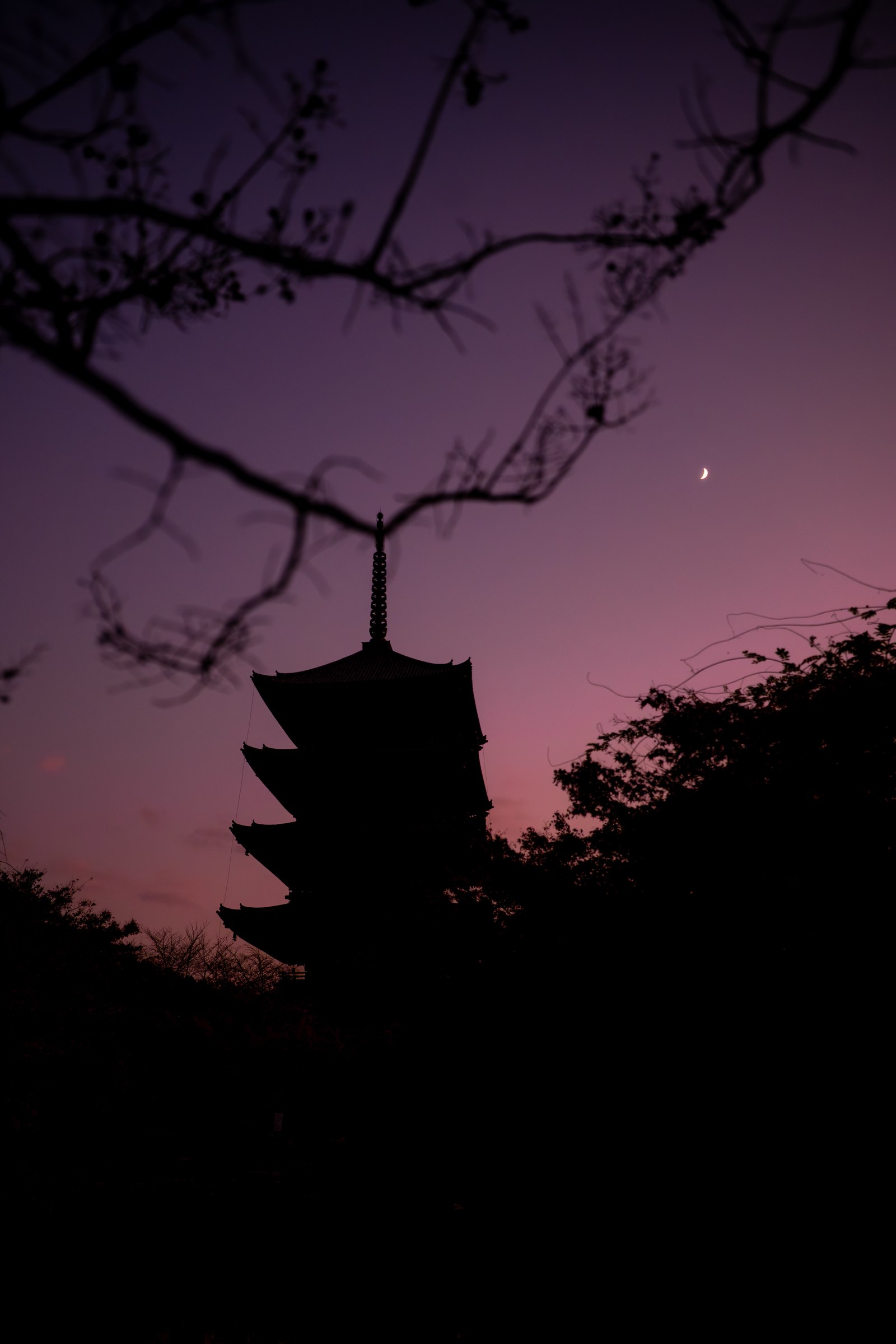
The pagoda's silhouette carrying the evening moon, and the night maples floating on the water mirror — delivered as a silver-halide print on FUJICOLOR's finest photographic paper. Of a quality made to be framed, and shipped worldwide.
💾 A digital download is also available ($7.00 each). Bundles cost less: 3 for $17.84, 5 for $26.23 ($5.25 each) — mix any photographs you like.
View the print →