
PHOTO SPOT GUIDE
The Cliffs of Tojinbo ― Columns of Stone Carved by the Sea of Japan
In Sakai, Fukui, there is a place where grey stone stands up like a wall against the Sea of Japan. Tojinbo. The waves unravel and break, and a low sound rises from beneath your feet. The rock, split into upright columns, drops straight down into the water. It was made by no human hand — only by a very long span of time — and it was simply there, quietly waiting.
The Sea, Carving the Stone
The rock at Tojinbo has a strange shape. Countless slender columns stand bundled together, their cross-sections cracked like the shell of a tortoise. This is columnar jointing, a form born when magma cools and hardens slowly. The Sea of Japan then spent an almost unimaginable span of years carving it out, raising it above the surface as a sheer wall some twenty-five metres high. Stand at the edge and the horizon lies before you with nothing in the way. The wind presses against your body, and the waves foam white below. There are not many places where you can feel the force of nature this closely. I was looking at the stone, yet it felt as though my own outline was being worn away a little too.
Sunset, and the Time the Stone Has Kept
In the evening the colour of the sky shifts slowly, and at last the sun sinks into the Sea of Japan. The grey rock turns to orange and to crimson, every wave catches the light, and the whole surface of the sea sways in gold. In winter the wind changes direction, and rough waves strike the cliffs like a wall. The face of the rock becomes another thing entirely with each season and hour. This stone, they say, was formed some twelve million years ago. My own work is in emergency medicine, where sometimes a single second matters. The time held in my hands, and the immense time the stone has gathered — here, the same word, time, stood with an entirely different weight.
The wave comes apart; the stone stands in silence.
One unbroken dusk, twelve million years long.
Planning your visit — season
It rewards a visit all year, though light and waves change its face completely.
Tojinbo can be visited throughout the year. Evening is especially fine: the sun setting into the Sea of Japan stains both rock and water, and it becomes a time hard to forget. Winter, when the rough seas collide against the cliffs, is when the raw power of nature is at its height. If you would like to look up at the cliffs from the water, a sightseeing boat carries you close to the foot of the rock, with a round trip of about thirty minutes; on days of high waves and in the winter season it may not run, so please check the schedule in advance. Note, too, that much of the cliff edge has little or no railing. On windy days or when the waves are high, do not press out toward the point — put your footing and your safety first, and take your time.
Getting there
By rail, the starting point is JR Awara-Onsen Station on the Hokuriku Main Line, or Awara-Yunomachi Station on the Echizen Railway. From Awara-Onsen Station, the Keifuku Bus Tojinbo line takes about forty minutes; get off at the last stop, walk toward the sea, and you soon reach the cliffs. Services are limited by time of day and day of the week, so it is wise to check the return times as well. If you come by car, there is parking nearby, and the cliffs are a short walk through the shopping street. Please confirm the latest timetables and fares through each operator's official information.
Tips for photographers
The finest moment is the evening light. As the sun drops lower, the shadows on the rock deepen and the texture of the columns rises into relief. Placing the golden path of light that stretches across the sea within your frame gives a sense of depth. To photograph the rough waves, a long exposure at a slightly slower shutter speed will let the breaking water flow like silk. A tripod, and weather-sealing to protect your lens, will set your mind at ease. Take in the whole line of cliffs with a wide lens, then move close to the texture of the columns with a telephoto: each change of composition reveals a different Tojinbo. Only, do not become so absorbed that you forget yourself — shoot from a safe footing, one step back from the edge.
While you're in the area
Close to Tojinbo lies the small island of Oshima, reached by a vermilion bridge and walked through old primeval woodland; its quietness stays with you. A few minutes by car, Echizen-Matsushima scatters moss-grown pines among curious rocks, offering a face of the sea quite different from Tojinbo. To end the day, it is good to warm yourself slowly at Awara Onsen. After looking upon so wild a sea, the hot water sinks in all the more deeply.
The route that day — Fukui (25 July 2025)
Each time is when the first photograph at that place was taken, from the camera’s own record.
- Heisenji Hakusan Shrine
- Tojinbo (this article)
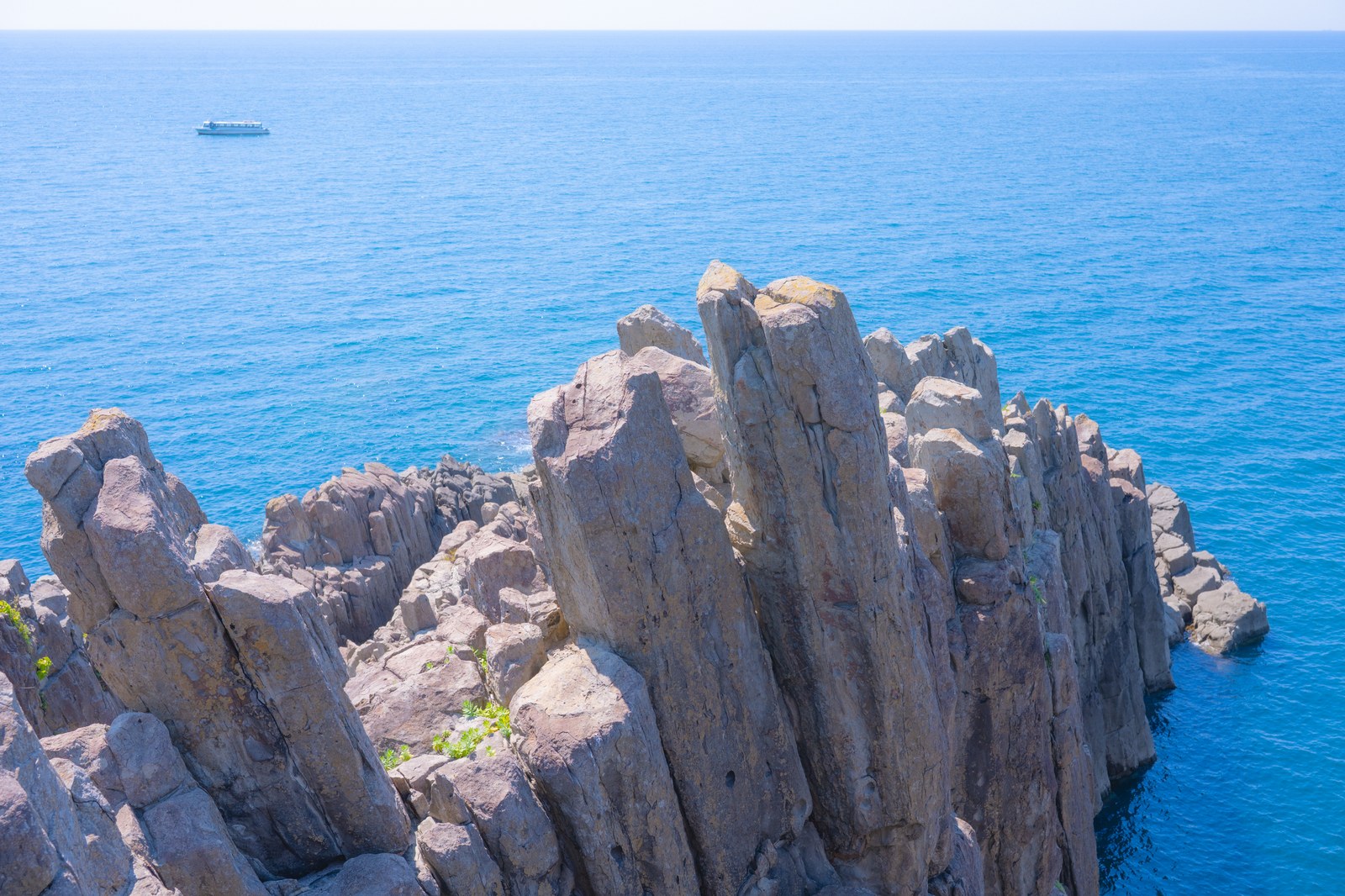
We deliver the cliffs of Tojinbo, glowing in the evening sun, as silver-halide prints on FUJICOLOR's finest photographic paper. Each is finished by hand, one at a time, and shipped worldwide.
💾 A digital download is also available ($4.00 each). Bundles cost less: 3 for $10.20, 5 for $15.00 ($3.00 each) — mix any photographs you like.
View the print →