
PHOTO SPOT GUIDE
The Ushijiro Mizume Cherry ― One Tree, Three Hundred Springs
In Kawane, Shizuoka, gentle tea-field slopes fold one over another along the course of the Oi River. In the very middle of that green sea, a single cherry tree stands, dressed in the palest rose. An Edohigan cherry said to be more than three hundred years old. Guarded by no one, it has watched three centuries of spring come and go, entirely alone.
A single tree in a sea of tea
The first time I saw it, I simply stopped walking. Neat rows of clipped tea bushes cover the whole slope, and at the crest of that green swell stands one cherry tree and nothing else. While the Edohigan on the surrounding hills bloom a pale white, this tree flushes a soft pink across its entire crown from the bud stage, and at full bloom its gentle rose seems to soak into the green of the fields. It is a tree that has never known how to grow in a crowd, quiet and yet unmistakably present. I kept asking myself why it moved me so much, and I think the answer is simply this: to stand before it is to brush against the sheer length of time it has stood here, alone.
Three faces, three hundred years
This cherry has many faces. Before dawn, morning mist rises from the valley and wraps the tree completely, softening its outline until it nearly dissolves. Then light breaks through a gap in the clouds, and shafts of it run through the mist. And after the mist clears, the tree stands alone on the slope with a solitude there is no other word for. The hours of my work in emergency medicine are often measured in seconds. Yet standing before this tree, I feel my own breathing slow to meet the immense scale of three hundred years. There is, here, a kind of time that does not hurry.
Three hundred springs, all on its own.
The mist lifts, and light traces the rose.
Planning your visit — season
The most beautiful season lasts only a brief while.
The best viewing is usually from late March to early April. In many years it begins to bloom a little earlier than the nearby Somei-yoshino cherries. Edohigan cherries move quickly from first bloom to full bloom and on to falling petals, so the window is never wide. The tea fields have not yet sent up their bright new shoots at this time of year, which means you can enjoy the contrast between the calm green of the clipped tea rows and the pale rose of the blossoms. Flowering shifts with the weather, so before you set out, please check the latest bloom status with the Shimada City Tourism Association or a similar source. In some years the tree is lit up after dark, and the night cherry glowing out of the blackness is something special in its own right.
Getting there
By public transport, it is about fifteen minutes by car from Iyeyama Station on the Oigawa Railway. By car, it is roughly thirty minutes from the Shimada-Kanaya interchange on the Shin-Tomei Expressway. The route runs along narrow mountain roads, so please take care with oncoming traffic. Parking arrangements can change and the number of spaces is limited; if you park on the roadside, please be very mindful not to block local residents or their work. Above all, this cherry and the tea fields around it are privately owned land. We are allowed to come close only through the owner's kindness, so please do not step between the rows or inside the fence, take care not to harm the tea bushes, and enjoy the scene quietly.
Tips for photographers
If you are after the best light, aim for dawn and the early morning. Mist gathers easily in the valley, and a cherry wrapped in it is wonderfully dreamlike. The mist shifts from frame to frame, so I waited patiently for each shutter. When light breaks through the clouds, you get backlight with shafts of light standing in the mist. Stopping the aperture down stretches the rays into a starburst; letting too much direct light strike the lens causes flare, so it helps to shade the lens by hand. For composition, bring the tea rows in large across the foreground and place the single cherry at the crest of the green swell to make its solitude stand out. Compressing the scene with a telephoto lens, the green fields as a backdrop, also makes a lovely frame.
While you're in the area
Kawane is tea country, where the Oigawa Railway still runs steam locomotives. Riding in a retro carriage as tea fields slide past the window is a small journey in itself. Iyeyama also has an avenue known as its cherry tunnel, and in spring the whole of Kawane is coloured with blossom. As an aside, the name mizume actually refers not to a cherry but to a birch-family tree called mizume, and why this lone cherry has been called by that name is, it seems, no longer clearly known. A small riddle held within three hundred years of time. Wandering the tea fields and pausing over a warm cup of the season's first tea while you turn that mystery over in your mind is a pleasure unique to this place.
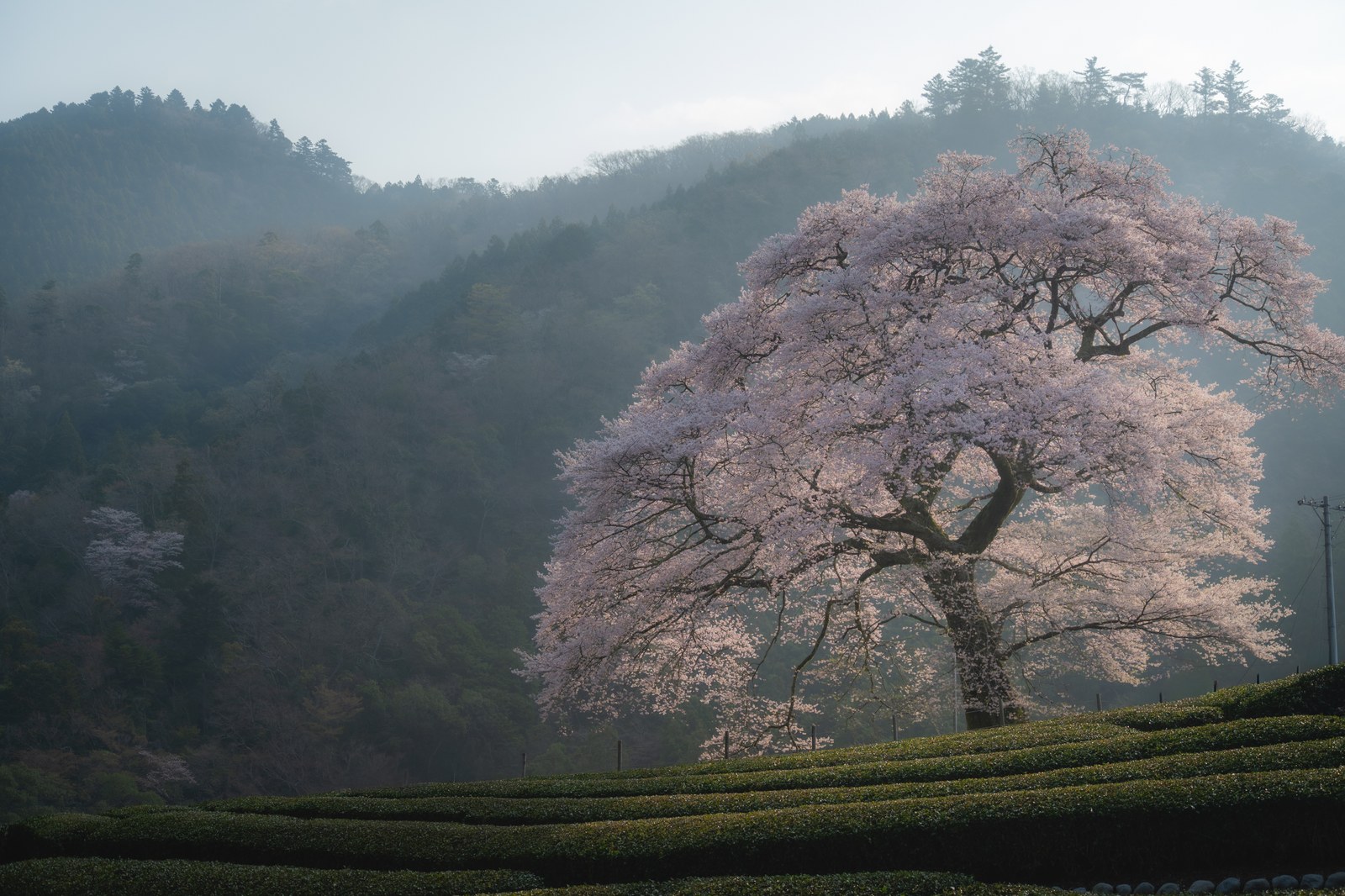
We deliver this scene of the Ushijiro Mizume cherry wrapped in morning mist as a silver-halide print on FUJICOLOR's finest photographic paper. Each print is finished with care and shipped worldwide.
💾 A digital download is also available ($7.00 each). Bundles cost less: 3 for $17.84, 5 for $26.23 ($5.25 each) — mix any photographs you like.
View the print →