
PHOTO SPOT GUIDE
Cherry Blossoms of Mount Yoshino — A Thousand Trees at a Glance
Mount Yoshino in Nara is perhaps Japan's most celebrated place for cherry blossoms — so celebrated that a single viewpoint is said to hold a thousand trees at once, a sight called hitome-senbon, "a thousand at a glance." Some 30,000 cherry trees of around 200 kinds clothe the whole mountain, blooming in waves from the lower slopes (Shimo-senbon) up through Naka, Kami and finally Oku-senbon. Cherry blossoms set among World Heritage shrines and temples here are history itself — a thousand years of people coming to love the flowers.
Blossoms climbing the mountain
What makes Yoshino unique is that the blooming time shifts with elevation. It begins at the lower Shimo-senbon and rises through the middle and upper slopes, so that even as the foot of the mountain begins to fall, the heights are only just coming into flower — and the season stays long. More than any single tree, it is the sheer scale of blossom blanketing the slopes that astonishes. Pale pink washes softly over the mountainside, and on a misty morning the scene floating in the haze can leave you without words.
Morning mist, and light through the petals
What captivates me most is the hour of dawn. Looking down the Nanamagari slope from the "Onodachi-ato" lookout at Shimo-senbon, mist drifts between the cherry trees, and the rising sun sends in one shaft of light, then another. In the emergency room everything is a race against the second; on this mountain, I simply wait — for the instant the mist clears, the instant light touches the blossom. What appears at the end of that waiting always exceeds what I imagined.
A whole mountain made of blossom;
a thousand years of prayer in the flowers.
Planning your visit — season
A few notes for those hoping to see it in person.
The blossoms are usually at their best across April, blooming in order from Shimo-senbon up to Oku-senbon — which is exactly why Yoshino's season is so long. Peak timing depends on the elevation you aim for, so check the Yoshinoyama Tourist Association's bloom updates before you go. Two views are not to be missed: the "hitome-senbon" seen from the World Heritage Yoshimizu Shrine at Naka-senbon, and the Nanamagari slope from the Onodachi-ato lookout at Shimo-senbon.
Getting there & parking
The gateway is Yoshino Station on the Kintetsu Yoshino Line. From there it is about a 3-minute ropeway ride, or a 20-minute walk up the Nanamagari slope, to reach Shimo-senbon. By car, traffic is restricted on the mountain during the blossom season and you park at lots such as Shimo-senbon; a parking cooperation fee (typically around ¥1,500–2,000) applies, and crowds are heavy, so public transport is recommended. The mountain has many slopes and stone steps, so wear comfortable shoes.
Tips for photographers
Yoshino is a mountain best shown as a mass, so a wide lens that takes in whole slopes of blossom conveys the "thousand at a glance" scale. In the early morning, when mist or a sea of cloud forms, a telephoto that lifts blossoms out of the haze feels dreamlike. At dusk, weeping cherries set against a violet sky make a lovely subject. Light and mist change minute by minute, so return to the same spot and keep releasing the shutter.
While you're in the area
Yoshino is also a sacred mountain, dotted with shrines and temples — including Kinpusen-ji and its Zaō-dō hall — that belong to the World Heritage "Sacred Sites and Pilgrimage Routes in the Kii Mountain Range." Walking the path where a thousand years of prayer still lingers, among the blossoms, is a pleasure found only here.
The four thousands ― a long bloom
Yoshino's cherries are named in bands up the mountain ― Shimo (lower), Naka (middle), Kami (upper) and Oku (inner) Senbon ― and the difference in altitude staggers their peak. That is Yoshino's particular charm: you can chase the blossom for some two weeks on a single mountain. For other cherry places and how to compare their timing, see the guide to Japan's best cherry spots.
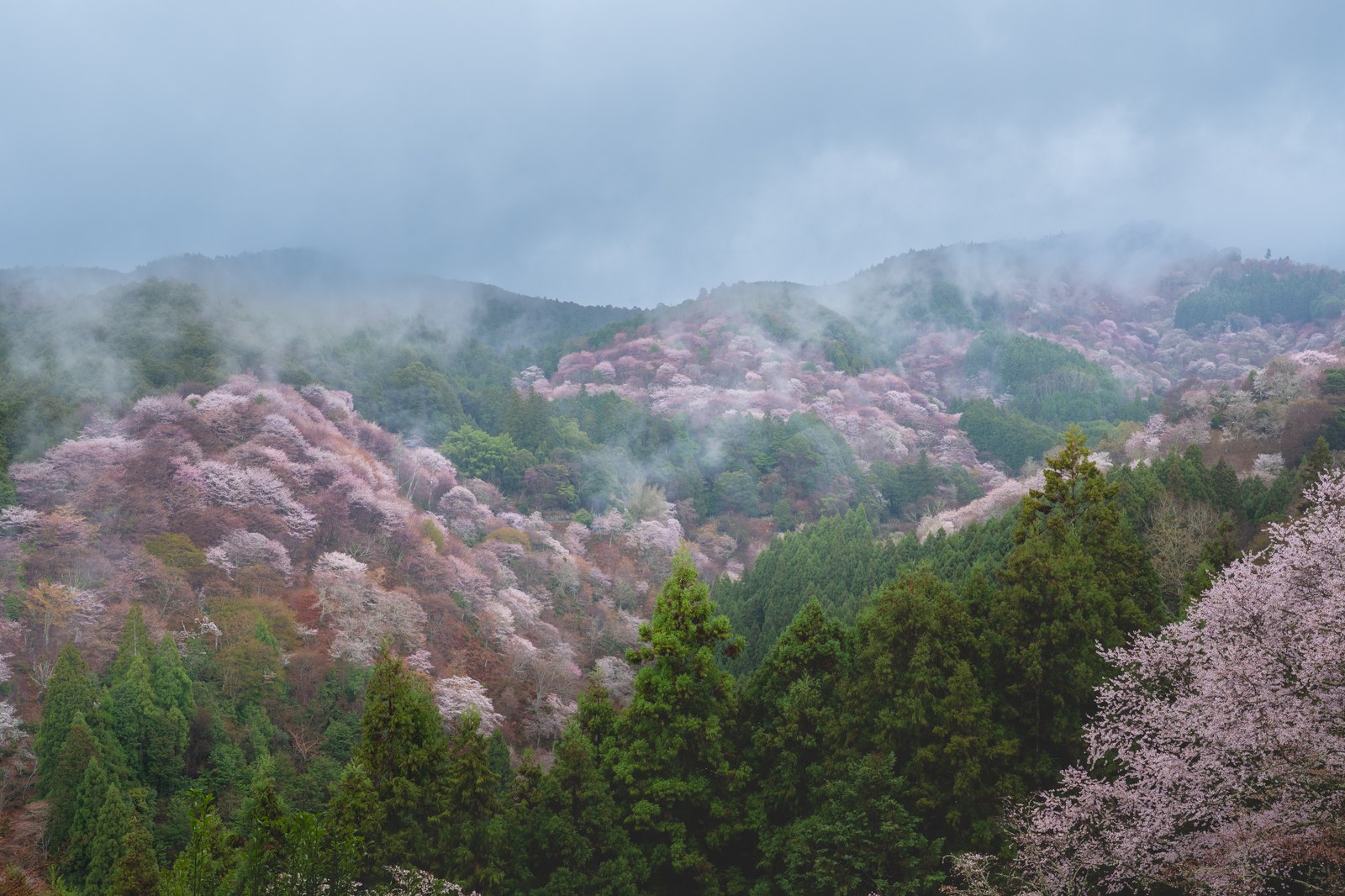
The cherry blossoms of World-Heritage Mount Yoshino are available as fine-art silver-halide prints on premium FUJICOLOR paper, hand-printed in Japan and shipped worldwide.
💾 A digital download is also available ($4.00 each). Bundles cost less: 3 for $10.20, 5 for $15.00 ($3.00 each) — mix any photographs you like.
View the print →