
HOW-TO
Turning Flowers into Paintings with ICM — the Choice to Move the Camera
A famous location nearly always has a correct photograph. Everyone stands in the same spot, frames it the same way and waits for the same light. That photograph is beautiful — and it already exists tens of thousands of times over. This article is about taking one more step past it: releasing the shutter while deliberately moving the camera. The name for it is ICM, intentional camera movement.
The same stone steps, two ways
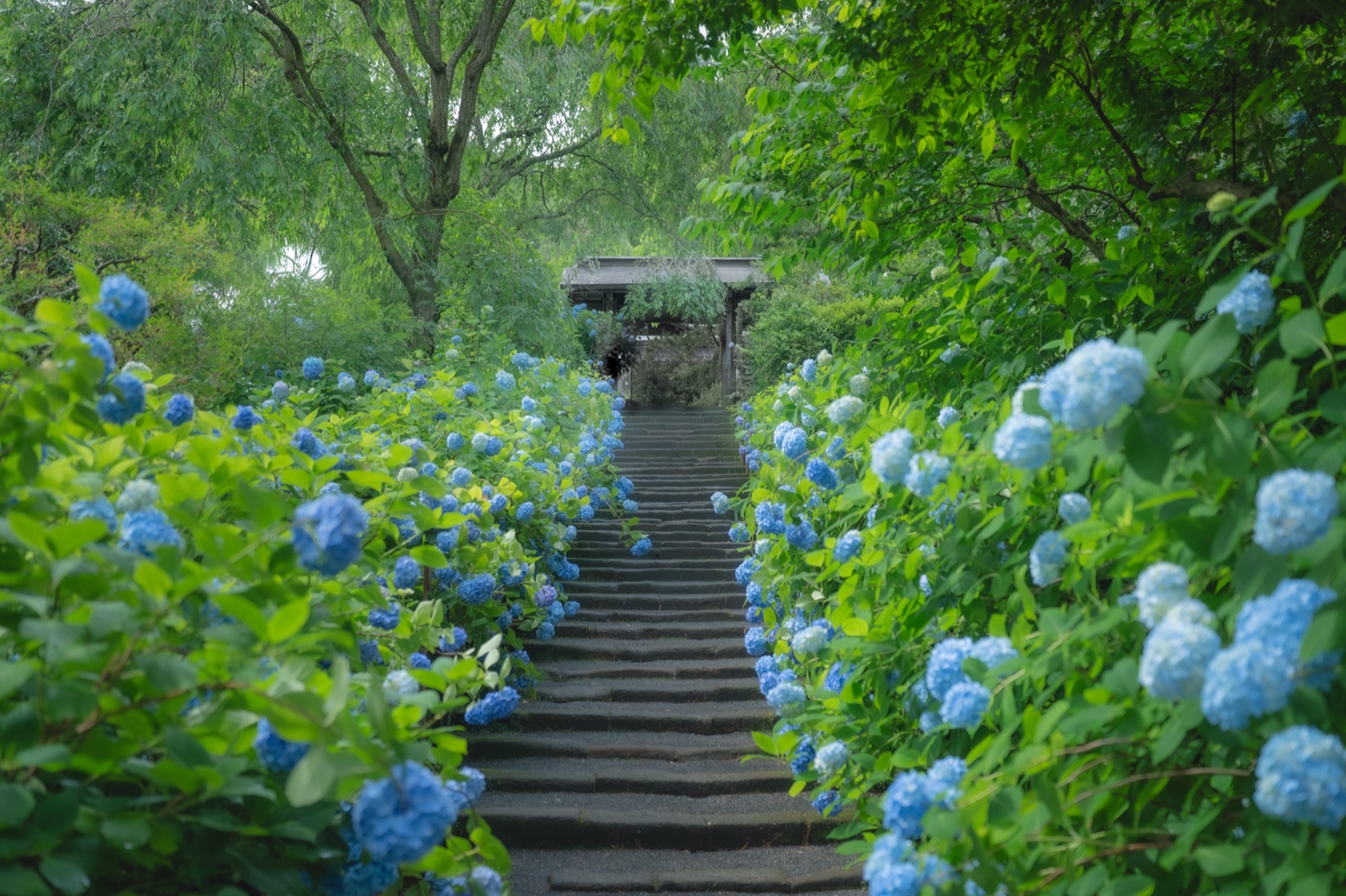
Meigetsuin, in Kita-Kamakura. The flight of stone steps on the approach to the temple — known here as the hydrangea temple — is, I think, one of the most photographed hydrangea scenes in Japan. I have photographed those steps two ways, and both frames are sold as prints.
The first is Hydrangea Steps of Meigetsuin: the orthodox frame, recorded step by step, with nothing allowed to bleed. Deep, clear Meigetsuin blue and the fresh green of early summer fill both sides of the steps rising to the gate, quietly. The soft light of the rainy season brings the blue up richly. It is the most famous sight this place has.
The second is Meigetsuin Blue — Watercolor Hydrangeas. The same steps, drawn with ICM as though the whole frame were a painting. Letting the outlines dissolve on purpose lets the blue and the green bleed into one another like watercolour. In place of accuracy as a record, what I kept was the air of the place, and the way my own mind was wavering as I stood looking at it.
The same place, the same blue.
All that changed was what I decided to keep.
Put the two side by side and it becomes clear what kind of tool ICM is. It does not change the subject; it changes your relationship with the subject. The steps are in both photographs. So are the hydrangeas. The only thing that changed is whether the information we call outline survives.
More on technique and gear
The same tools, the same light. Read on and the craft joins up.
What ICM is, and what it is not
ICM means moving the camera itself while the shutter is open. The subject stays still; the movement is on your side. The image is stretched along the path the camera travelled, and the outlines come undone. You could fairly say it is exactly the same event as camera shake, brought about on purpose.
Which is precisely why it is worth separating from the things it gets confused with.
That list is really a list of choices. Do you want softness, or do you want movement? For the first, a soft filter or an old lens; for the second, ICM. Both get called painterly, and they arrive somewhere quite different.
How far to let it dissolve
The hardest part of ICM is not releasing the shutter. It is knowing where to stop. The more you move, the further the outlines dissolve, and past a certain line the photograph becomes a band of colour nobody can identify. Occasionally that stands up as an abstract. Usually it is simply a failure.
Look at Meigetsuin Blue — Watercolor Hydrangeas and I think you will see where I draw that line. The outlines have certainly come undone, and yet the steps can still be counted, and the gate behind them still reads as a shape. The hydrangeas are still there as masses of flower. It has not been dissolved all the way. It looks like a painting, but you can tell which painting — that is roughly the position I am looking for.
Put another way, ICM is a technique for throwing information away. Throw away too much and nothing is left; throw away none and nothing changes. Deciding how much to discard is the photographer's job, and the answer differs with the subject. Something whose shape is strongly remembered, like a flight of steps, becomes a painting after very little dissolving. Dissolve a subject whose shape was weak to begin with and nothing at all remains.
What you can decide, and what you cannot
Honestly: ICM is not a way of shooting where you aim and land it first time. Swing twice with the same intention and two different things come back. So the working routine on location usually looks like this.
As for the hit rate, I have never counted, so I am not going to put a number on it. But this is a way of shooting that assumes volume, and that follows from the mechanism alone. If every frame comes back different, you cannot choose without a population to choose from. The reason to do it anyway is that some pictures only appear when it lands.
Of course the camera shakes and the framing drifts, because it is all over in an instant — but sometimes, inside what chance produces, an unexpected piece of art and beauty lies sleeping.
— IkebanadoctorI wrote that in the piece on shooting fireworks handheld, and it carries over to ICM unchanged. You deliberately leave room for what cannot be made on purpose to get in. It shares a root with the old-lens way of thinking, where flare and ghosting are kept as weapons rather than removed. A clean photograph and a photograph that moves you are not the same thing.
Subjects that suit it, subjects that do not
Having tried it a number of times, my sense is that the conditions which tend to land are fairly settled.
The point about the number of colours matters more than you would expect. Dissolving means mixing neighbouring colours, and as with paint, the more colours go in the closer you get to grey. Choose a landscape made of two or three colours and the colour survives the dissolving. Part of why the steps at Meigetsuin work as material is that they are a two-colour landscape: blue and green.
Standing again in a place you are tired of
The greatest use of ICM is, I think, not the technique itself but this: the number of places you go does not grow, and the number of things to photograph does. Without travelling far in search of some new view, you can stand in front of the same steps as last year. The same place becomes a place you have not photographed yet.
The method is very simple. Make the orthodox frame properly first. Set the tripod, work as you always do. Then take the camera off the tripod and shoot the same composition again, moving as you release. The order matters; reverse it and the orthodox frame is the one that gets careless. The two frames from Meigetsuin ended up as a pair — the precise one and the dissolved one. Neither is above the other. It is one place, seen two ways.
The dissolved frame, and the one left alone
A matched pair of the same stone steps at Meigetsuin in Kita-Kamakura, photographed two ways. Printed on FUJICOLOR professional silver-halide paper.
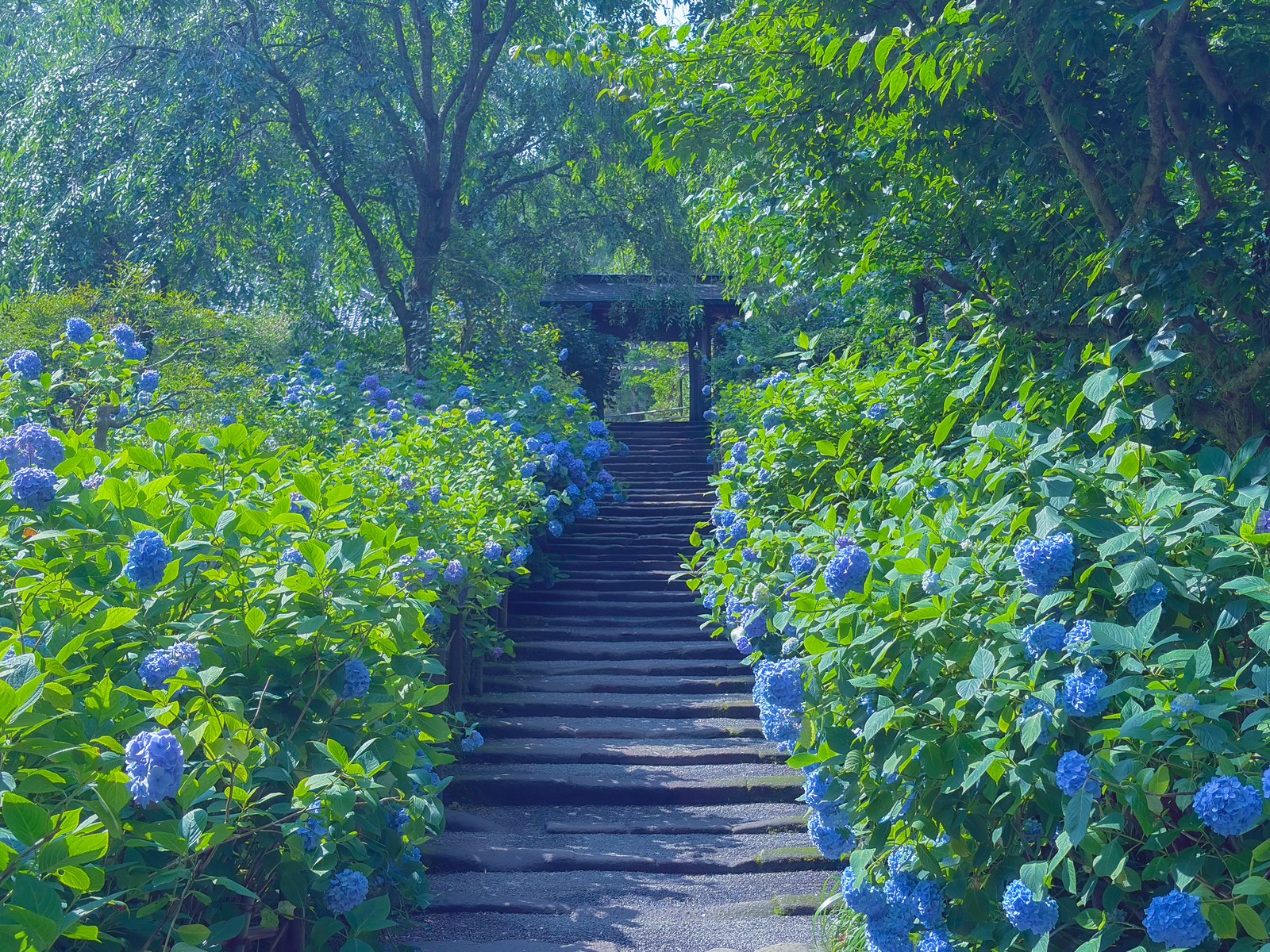
Peak season, access and the etiquette of visiting the temple these steps belong to are gathered in The Hydrangeas of Meigetsuin. For the other hydrangea sites in Kanto, see A Guide to Kanto's Hydrangeas.
Leave the tripod behind
One practical note to finish on. ICM is a way of shooting that does not use a tripod. Moving the camera is the point, so a tool for holding it still works directly against the purpose. It is the exact inverse of night and long-exposure work, where a tripod is indispensable (that subject is in Tripods and Night Photography).
Which also means you can try it without adding anything to the bag. The camera and lens you already own, starting today, with nothing bought. An approach that requires no purchase at all is not a common thing. If it does not work, the only thing you lose is time — so if you have begun to feel tired of the famous places, it is worth one attempt.
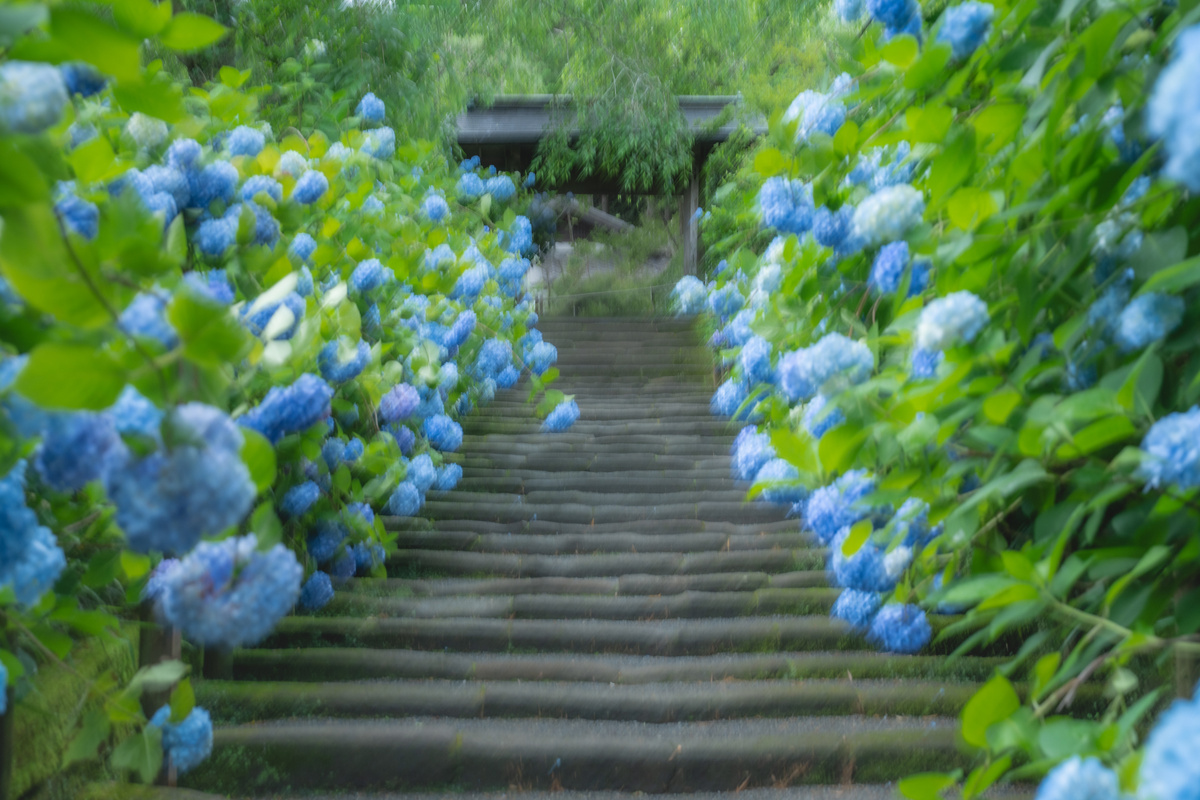
Meigetsuin Blue — Watercolor Hydrangeas, the very subject of this article, is a print made with ICM and currently for sale. The outlines come undone and the blue and the fresh green bleed together like watercolour. Printed on FUJICOLOR professional silver-halide paper.
🖼️ Choosing a frame (with inner and outer dimensions)
💾 A digital download is also available ($7.00 each). Bundles cost less: 3 for $17.84, 5 for $26.23 ($5.25 each) — mix any photographs you like.
See Meigetsuin Blue — Watercolor Hydrangeas →