
PHOTO SPOT GUIDE
Senjogahara — A Marsh Leaning into Gold, the Earliest Autumn
Oku-Nikko, in Tochigi. On a highland some 1,400 metres above sea level, autumn comes down earlier than anywhere else in Honshu. Across roughly 400 hectares of marsh, the grasses turn to gold. Each time the wind crosses, every seed head leans the same way at once, and beyond them Mt. Nantai stands quietly. It is an autumn nearly a month ahead of the lowlands.
Each time the wind crosses, the grasses lean as one
Autumn colour in Oku-Nikko has a slightly different character from the colour of the lowlands. The altitude sharpens the chill of morning and evening, and the trees change at a quick walk. Even among them, Senjogahara gives the lead role not to trees but to grass. The marsh grasses turn across the whole basin from russet-brown to gold, and each time the wind crosses, every seed head leans the same way at once. The wide highland looked as though it were breathing, like a single living thing.
Seen against the light, the scene becomes something else entirely. When the low sun of morning or evening passes through the seed heads, the surface of the marsh turns into one continuous film of gold. Lay the distant ridgeline of Mt. Nantai over that, and at last the frame settles. On the far side of days spent counting out seconds in the emergency room, mountain time goes on running slowly like this — and every year, on this highland, I remember it.
The field where gods are said to have fought over land
Senjogahara — "the field of battle" — is an alarming name, and it has an origin. According to Tochigi Prefecture's own account, it comes from a legend in which the god of Mt. Akagi and the god of Mt. Nantai once fought here over their territory. What lies in front of you now is simply a quiet field of grass. The memory of that fighting survives in the name alone, and everything else spreads out in unbroken calm — and the mismatch is what makes the place stay with you.
According to Nikko City, Senjogahara is a marsh formed when an eruption of Mt. Nantai dammed a river, and it holds every kind of wetland at once: raised bog where sphagnum moss has piled up thick, nutrient-rich low moor, and the intermediate fen that lies between them. On 8 November 2005, a combined 260.41 hectares — Lake Yunoko, the Yugawa river, Senjogahara and Odashirogahara — were registered under the Ramsar Convention as the "Wetlands of Oku-Nikko". The whole area is designated part of Nikko National Park and protected as a Special Protection Zone and a Special Zone.
Each time the wind crosses, the gold leans.
The earliest autumn of all begins here.
Planning your visit — season
Autumn in Oku-Nikko comes down a little at a time, following the elevation.
On the foliage calendar of the Ministry of the Environment's Nikko-Yumoto Visitor Center, Senjogahara is at its best from late September to early October, with the peak already past by the middle of October. The same calendar gives Ryuzu Falls as early to mid October, Lake Chuzenji as mid to late October, and Irohazaka as late October to early November. Which means the golden grasses of Senjogahara and the maples of Irohazaka or Lake Chuzenji cannot be had on the same day. Decide which of them is to be the lead, and then choose your date — that is the trick to this mountain. Larch gold is put at around late October.
The timing shifts from year to year. Please check the latest information from the Ministry of the Environment's Nikko-Yumoto Visitor Center before you set out. Mornings on the highland are properly cold, so I would bring one more layer than you think you need.
Getting there
The Nikko City Tourism Association gives about sixty-seven minutes from JR Nikko Station to Akanuma on the Tobu bus bound for Yumoto Onsen, or about forty minutes by car from the Kiyotaki interchange. For parking, the Ministry of the Environment's Nikko-Yumoto Visitor Center notes that the Akanuma car park charges a fee while the one at Sanbonmatsu is free. Tochigi Prefecture puts the Akanuma charge at 500 yen per ordinary car for a single day — a combined one-day ticket for the prefectural car parks of Oku-Nikko is 1,000 yen — with the first fifteen minutes after entry free.
For the walk itself, the Nikko-Yumoto Visitor Center describes the route from Akanuma to Yutaki Falls as about five kilometres, with roughly a hundred metres of elevation change, taking two and a half to three hours. A boardwalk runs the length of it, so the going is easy.
There are two things you must check before you set out. The first is the construction work. The Nikko-Yumoto Visitor Center has announced that the stretch of the Senjogahara circuit boardwalk between Yutaki Falls and Kotaki — the eastern section — is closed for boardwalk repairs from 18 August 2026 until the end of March 2027 (provisional). The section between the Yutaki Falls viewing platform and the diversion remains open, and it is still possible to pass through towards Senjogahara. The second thing is bears.
Tips for photographers
Photographed with the sun behind you, the golden marsh grass comes out surprisingly plain. What you want is backlight, or light coming in low from the side. In the moment when a low sun passes through the seed heads, the whole surface of the marsh lights up gold. Morning and evening light is the finest — but, as I set out below, early morning and evening are also the hours when bears are most active.
As for composition: do not give the sky too much. Standing before a highland this wide, you will want to take in a great deal of it, but resist that and put the weight of the frame on the gold instead, and the picture gains density. Place Mt. Nantai high up near the top edge and let the gold of the marsh fill the lower two-thirds — be that decisive about it, and the scale of the place comes through.
There is etiquette here that matters. The Eight Points of Etiquette for Senjogahara, issued by the Ministry of the Environment's Nikko Nature Conservation Office, asks visitors not to step off the boardwalk and not to occupy it for long periods. The boards are narrow and other people need to pass. When you set up a tripod, please take real care not to block the way. The same guidance states plainly that you should act so as not to meet a bear: avoid using the area in the early morning or the evening, and carry a bear bell. The Nikko-Yumoto Visitor Center publishes bear sighting reports, and sightings on the boardwalk itself and at close range have been recorded. The Center asks that if you do see a bear you leave the spot quietly, and that you absolutely do not photograph or observe it. The best light and the most dangerous hours are the same hours. Everything here comes down to the judgement not to push it.
While you're in the area
Odashirogahara, part of the same Ramsar wetland, lies just next door to Senjogahara. The single white birch standing alone in the grassland — "The Lady" — is at her most beautiful at dawn, when morning mist is likely, and you can reach her from Akanuma on the low-emission bus. Go down to Lake Chuzenji and you can look out over the autumn colour of Hatchojima from the Hangetsuyama observation deck, though there the season runs from late October into early November. Following an autumn that takes a whole month to come down the mountain, returning two or three times to catch it, is to my mind the most luxurious way to enjoy Oku-Nikko.
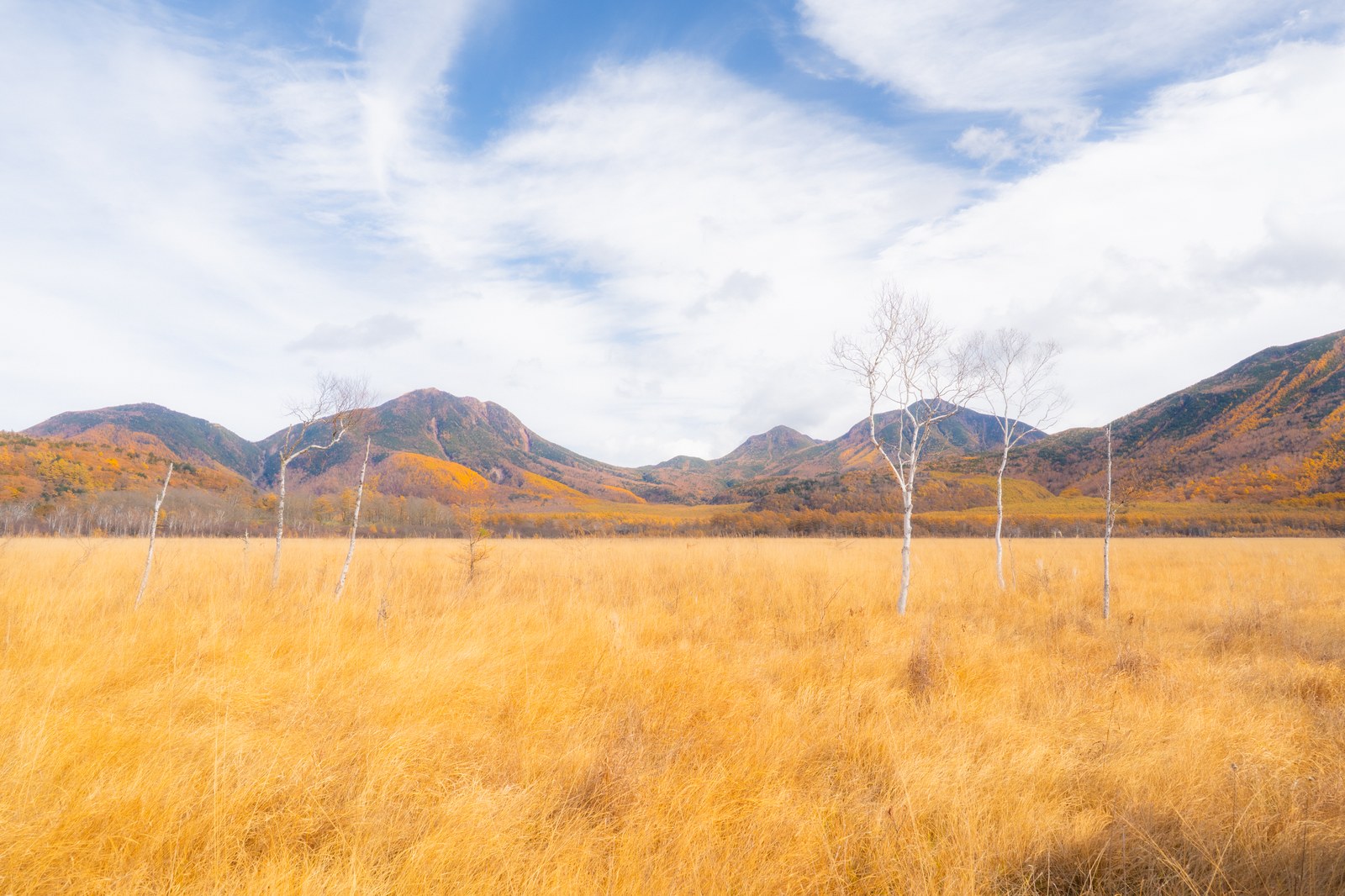
Golden marsh grass spread across a wetland 1,400 metres above the sea, with Mt. Nantai in the distance. We deliver this Japanese highland autumn as a silver-halide print on FUJICOLOR's finest photographic paper, shipped worldwide.
💾 A digital download is also available ($7.00 each). Bundles cost less: 3 for $17.84, 5 for $26.23 ($5.25 each) — mix any photographs you like.
View the print →