
PHOTO SPOT GUIDE
The Tower at Cape Futtsu — The Shape of a Pine, and a Winter Evening Sky
Cape Futtsu reaches out, thin and long, into Tokyo Bay. At the very tip of it stands a strange-looking structure: the Meiji Centennial Memorial Observation Tower, said to be shaped after a Japanese white pine. Its stairs double back on themselves again and again, like a three-dimensional maze. At dusk, when that frame sinks into the backlight and becomes black geometry, another silhouette rises across the bay. Mt. Fuji.
Geometry standing black against the evening sky
Photographed, the tower at Cape Futtsu looks less like a building than a sculpture. Chiba Prefecture describes it as an observation tower shaped after a Japanese white pine, with thirty-six seven-metre-square floor decks stacked up and a top deck 21.8 metres high. The way the stairs double back and pile upward is exactly that of a three-dimensional maze. Against a dusk sky shifting from wisteria to rose, that frame becomes a hard-edged shadow picture. There is no other hour in which concrete geometry looks this poetic.
And beyond it, far off across Tokyo Bay, Mt. Fuji stands quietly. Straight lines and angles made by people in the foreground; in the distance, the shape of a mountain nobody made. I released the shutter at the moment those two came into balance inside the frame. The figures walking hand in hand at the edge of the frame were chance. But because that chance came in, this stopped being merely a photograph of a fine view.
A sea that once kept watch over the capital
According to Chiba Prefecture's own records, after the war the prefecture bought most of what had been military land from the state; the park was fixed in the city plan in 1951, designated nationally as a Meiji Centennial Memorial Park, and opened in 1966 as the prefecture's first wide-area park. The tower is the commemorative structure raised on the occasion of that Meiji Centennial designation. From the top you take in Tokyo Bay, the far shore and the Boso Hills, along with the First and Second Sea Forts, built between the Meiji and Taisho eras to defend the capital.
The memory of an age that would build artificial islands out at sea to protect the capital is now simply part of a quiet evening view. Once I knew that, the same stretch of water looked a little different.
Beyond the straight lines people made,
a mountain nobody made.
Planning your visit — season
A winter evening with dry air is the best chance you will get.
Chiba Prefecture notes that on days when the air is clear you can see Mt. Fuji sharply, and that the place is popular for its sunsets. The City of Futtsu also mentions that it has been chosen for the Hundred Fuji Views of the Kanto Region. Whether Fuji appears at all depends on the air that day, so choose a clear winter day when the wind has settled.
One further note: the tower was closed entirely for repair work from November 2022 until the end of March 2023, reopening on 30 March 2023. Access has been restricted temporarily since then as well, for work such as repairs to the stairs at the top. This is a place people travel a long way to reach, so it is worth checking the latest notices on the official site of Chiba Prefectural Futtsu Park before you set out.
Getting there
The City of Futtsu gives the following for drivers: from the Kisarazu-minami interchange on the Tateyama Expressway, continue straight along National Route 16, then follow Prefectural Route 255 towards the tip of the cape, about twenty minutes. For parking it lists Futtsu Park Car Park No. 3, with space for a hundred cars and none for large vehicles. By rail, get off at Aobori Station on the JR Uchibo Line and take the bus for Futtsu Park. Different sources give different bus stops and walking times, so please confirm the route on the day with the City of Futtsu or the park's official information.
One caution: drones, including radio-controlled helicopters, may not be used in Chiba Prefectural Futtsu Park. Please bear that in mind if you were thinking of shooting from the air.
Tips for photographers
Backlight is the subject here. If you want the tower standing as a black silhouette, meter from the brightest part of the sky and go boldly darker. The thin lines of the stairs and railings will otherwise disappear, so not opening the aperture too far keeps the outline of the frame intact. When you want Fuji in the picture, walk sideways until you find a position where it does not overlap the tower. A few metres changes the way the distant mountain stands entirely.
Do not leave as soon as the sun is down. The dozen or so minutes in which the sky goes from wisteria to rose and finally sinks to indigo are the richest in colour. The cape is windy in winter and it feels far colder than the thermometer says. Dress warmly, and remember to keep one hand free to hold the tripod steady.
While you're in the area
Even along the same Tokyo Bay coast, each place wears its sunset differently. Go south into Minamiboso and there is Haraoka Pier, where Fuji stands at the end of a wooden jetty reaching out to sea. Come back north and there is Inage Seaside Park, where a boardwalk running ninety metres out over the water lights up at dusk. The wide bay looked down on from a tower on a cape, and the bay looked across from just above the water, make the same sunset seem like two different things. Covering two of them in a day is hard travelling, but visit them in different seasons and the depth of this bay gradually reveals itself.
Four evenings of winter sunsets on Tokyo Bay (28 December 2025 – 25 January 2026)
Each time is when the first photograph at that place was taken, from the camera’s own record.
- Cape Futtsu (this article)
- Haraoka Pier
- Inage Seaside Park
- Makuhari Beach
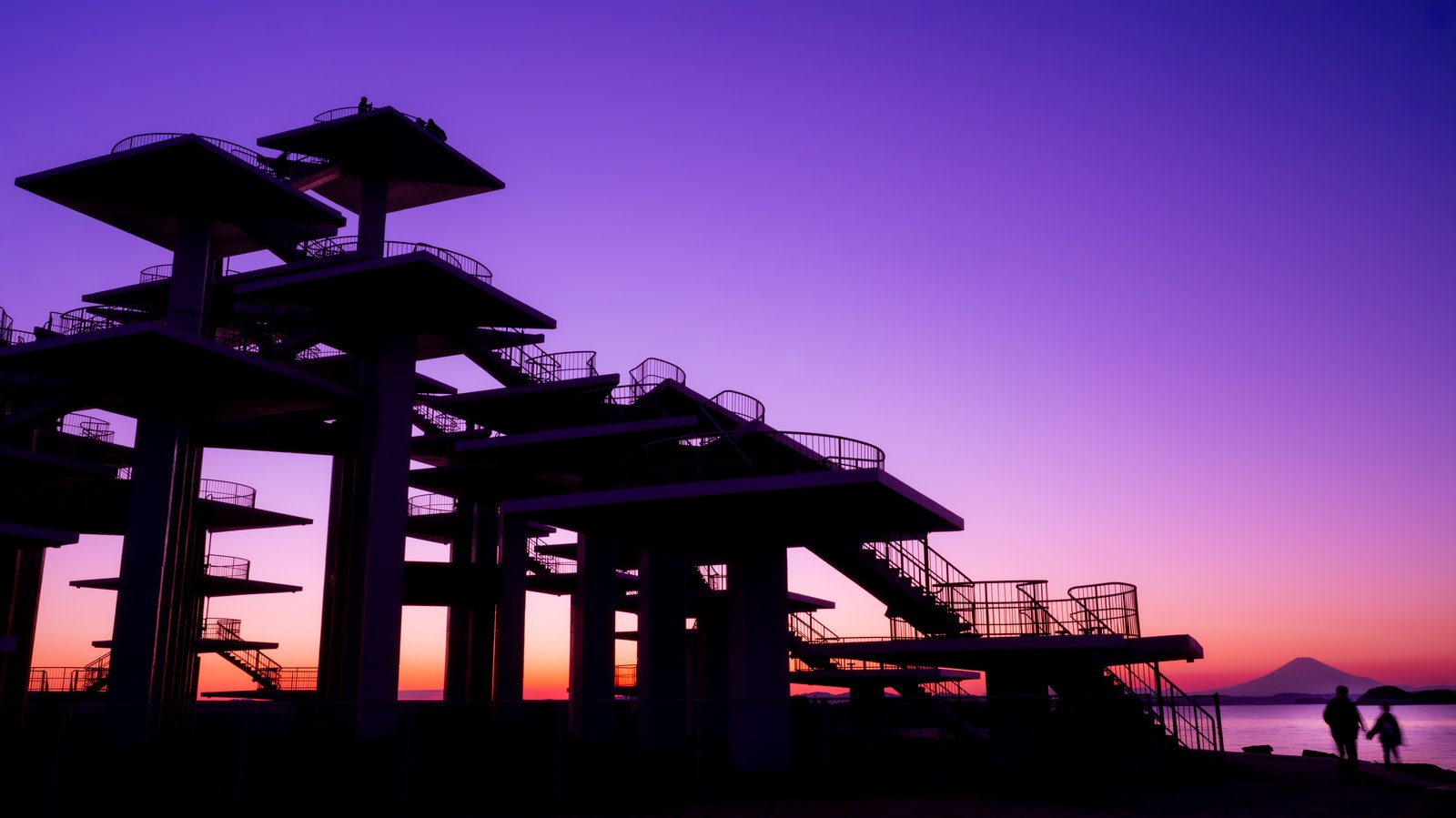
The tower standing black against a dusk sky, and Fuji beyond it. We deliver this photograph as a silver-halide print on FUJICOLOR's finest photographic paper — frame it for your room; we ship worldwide.
💾 A digital download is also available ($4.00 each). Bundles cost less: 3 for $10.20, 5 for $15.00 ($3.00 each) — mix any photographs you like.
View the print →