
FEATURE
12 Winter Photo Spots near Tokyo — Day Trips from December to March
This guide gathers twelve winter photo locations you can reach on a day trip from Tokyo, in order of their peak. It runs from December dusk through midwinter daffodils and peonies to the early cherries that start in late January and the plum blossom of March. Use the table to compare dates and access, then open each location's guide for the detail.
This guide at a glance
- Midwinter flowers — Ice tulips at Funabashi Andersen Park peak around December to January every year (Funabashi City), and Kyonan's daffodils can be seen from late December to early February (Kyonan Town). The winter peony garden at Ueno Toshogu opens from 1 January to late February.
- Winter sunsets — Haraoka Pier, Cape Futtsu, Inage Seaside Park and Marunouchi. None has an official season, though the Futtsu tourism association says Fuji stands out clearly in the clear air of winter.
- Early cherries and plum — The Atami cherry usually peaks from late January to early February and the Kawazu cherry from early February to early March. The Kyu-Nakagawa and Iwai Weir follow from late February to mid-March, and the Mito Plum Festival runs from mid-February to late March every year.
- Fees — Admission could be confirmed for three places: Ueno Toshogu Peony Garden (¥1,000 for adults), Funabashi Andersen Park (¥900 for adults) and Kairakuen's main garden (¥320 for adults, ¥500 during the Mito Plum Festival).
The 12 spots, in peak order
The spots run in order of their peak. The four sunset locations have no official season, so they sit in the order the sample photographs were taken. The peak column follows each official source, and "usually" or "every year" appears only where the source says so. "Photo date" is the day the photograph in each guide was taken. The tripod column repeats what the official source says; "Not stated officially" does not mean tripods are allowed.
↔ The table scrolls sideways.
| Spot | Peak | Photo date | From the station | Cost | Tripods (official wording) | Official source, date checked |
|---|---|---|---|---|---|---|
| Tokyo Tower from MarunouchiTokyo — Chiyoda | No season stated officially. Tokyo Tower's winter lighting starts on an evening in early October each year | 12 Dec 2025 | Marunouchi Building: directly connected to JR Tokyo Sta. | Marunouchi Building terrace: not stated officially | Not stated officially | Marunouchi Building, Marunouchi.com, Tokyo TowerChecked 1 Nov 2026 |
| Ice tulipsChiba — Funabashi | Around December to January every year (Funabashi City)The 2026 festival ran 2–31 January. 2027 not yet published | 7 Jan 2026 | 12 min by bus from Misaki Sta. (Keisei Matsudo Line) / 38 min by bus from JR Funabashi Sta. north exit, then 1 min on foot from the Andersen Park stop | Admission ¥900 for adults (Funabashi Andersen Park) | Not stated officially | Funabashi Andersen Park, Funabashi CityChecked 1 Nov 2026 |
| Kyonan daffodilsChiba — Kyonan | Usually mid-December to the end of January (Chiba's tourism site, Ezuki Daffodil Road) / to be seen from late December to early February (Kyonan Town)Festival: 5 Dec 2026 to 31 Jan 2027 | 11 Jan 2026 | A town road is closed as of 30 Oct 2026. Please check with Kyonan Town whether the Ezuki Daffodil Road can be walkedOkuzure: about 25 min by town circular bus from JR Hota Sta.For the Uchibo Line, see the note below the table | Not stated officially | Not stated officially | Kyonan Town, road closures (Kyonan Town), Chiba tourism siteChecked 1 Nov 2026 |
| The tower at Cape FuttsuChiba — Futtsu | No season stated officially. Fuji stands out clearly in the clear air of winter (Futtsu tourism association) | 28 Dec 2025 | About 15 min by bus from JR Aobori Sta., then about 20 min on foot from the last stop to the towerFor the Uchibo Line, see the note below the table | Parking: free / Tower: not stated officially | Not stated officially | Futtsu City, Futtsu tourism association, Futtsu ParkChecked 1 Nov 2026 |
| Haraoka PierChiba — Minamiboso | No season stated officially. The guide suggests clear winter evenings | 11 Jan 2026 | About 15 min on foot from JR Tomiura Sta.For the Uchibo Line, see the note below the table | Parking: free (10 cars) / Pier: not stated officially | Not stated officially | Chiba tourism site, Minamiboso CityChecked 1 Nov 2026 |
| Inage Seaside ParkChiba — Chiba City | No season stated officially. Lit from sunset until 22:00 (Chiba City) | 15 Jan 2026 | Bus from JR Inagekaigan Sta. south exit stop 2 to the last stop, then 5 min on foot / bus from JR Inage Sta. west exit stop 2 (for Inage Beach, get off at Hana no Bijutsukan) | Park entry: not stated officially / Parking: ¥400 for up to 3 hours, then ¥100 per 30 min, up to ¥1,000 a day (summer: ¥1,000 per visit) | Not stated officially | Chiba City, Sunset Beach Park InageChecked 1 Nov 2026 |
| Winter peonies at Ueno ToshoguTokyo — Ueno | Open 1 January to late February (official; no year given)In 2026, to 23 February | 7 Jan 2026 | 5 min on foot from JR Ueno Sta. Park Exit | Admission ¥1,000 for adults (junior high age and over), free for elementary-school age and under | Not stated officially | Ueno Toshogu Peony GardenChecked 1 Nov 2026 |
| Atami cherry blossomsShizuoka — Atami | Usually late January to early February (Atami City)Festival: 9 Jan to 7 Feb 2027 | 29 Jan 2026 | About 20 min on foot from JR Atami Sta. / about 10 min by bus to the Ginza stop | Open to all | Not stated officially | Atami City, Atami tourism associationChecked 1 Nov 2026 |
| Kawazu cherry blossomsShizuoka — Kawazu | Usually early February to early March (Shizuoka's official tourism site)37th festival: 6 Feb to 7 Mar 2027 | 18 Feb 2026 | A short walk from Kawazu Sta. (Izukyu Line) | Entry: not stated officially (parking is charged during the festival) | Not stated officially | Shizuoka tourism guide Hello Navi, Kawazu Town tourism site, English pageChecked 1 Nov 2026 |
| Plum blossoms at KairakuenIbaraki — Mito | No peak range stated officially. Flowering: early varieties mid-January to mid-February, mid-season early February to mid-March, late varieties early to late March (Ibaraki Prefecture)Mito Plum Festival: mid-February to late March every year | 5 Mar 2026 | About 20 min by bus from JR Mito Sta. north exit | Main garden: ¥320 for adults, ¥500 during the Mito Plum Festival | "Please refrain from using tripods inside the building" (Kobuntei pavilion) / Garden: not stated officially | Kairakuen (English), fee revision, Ibaraki PrefectureChecked 1 Nov 2026 |
| Kawazu cherries on the Kyu-NakagawaTokyo — Edogawa | Late February to mid-March every year (Edogawa Ward) | 4 Mar 2026 | 13 min on foot from Hirai Sta. (JR Sobu Line) | Not stated officially | Not stated officially | Edogawa WardChecked 1 Nov 2026 |
| Iwai WeirChiba — Asahi | Late February to mid-March (Asahi City) | 4 Mar 2026 | About 5 min on foot from the Iwai-Fudoshita stop, Unakami route, Asahi community bus | Not stated officially | Not stated officially | Asahi CityChecked 1 Nov 2026 |
Dates, fees and access were checked against each official source on 1 November 2026, and most of those pages are in Japanese. This does not cover train services; for the JR Uchibo Line, see the next note. Details can change, so please confirm them before you set out. "Not stated officially" and "not yet published" mean the information could not be found on that date.
JR Uchibo Line (checked 2 November 2026): By train, Kyonan, Cape Futtsu and Haraoka Pier are all reached on the JR Uchibo Line. According to Futtsu City (in Japanese; posted 26 October 2026), services on the section between Anegasaki and Nagaura, suspended after Typhoon No. 25, are expected to resume with the first trains on Monday 9 November. All Sazanami limited express services are also due to return from that day. According to Kisarazu City (in Japanese; updated 23 October 2026), trains between Anegasaki and Kisarazu will not run at all on Sunday 8 November, for reasons including preparations for the restart. Please check JR East for the latest service before you set out.
Midwinter flowers
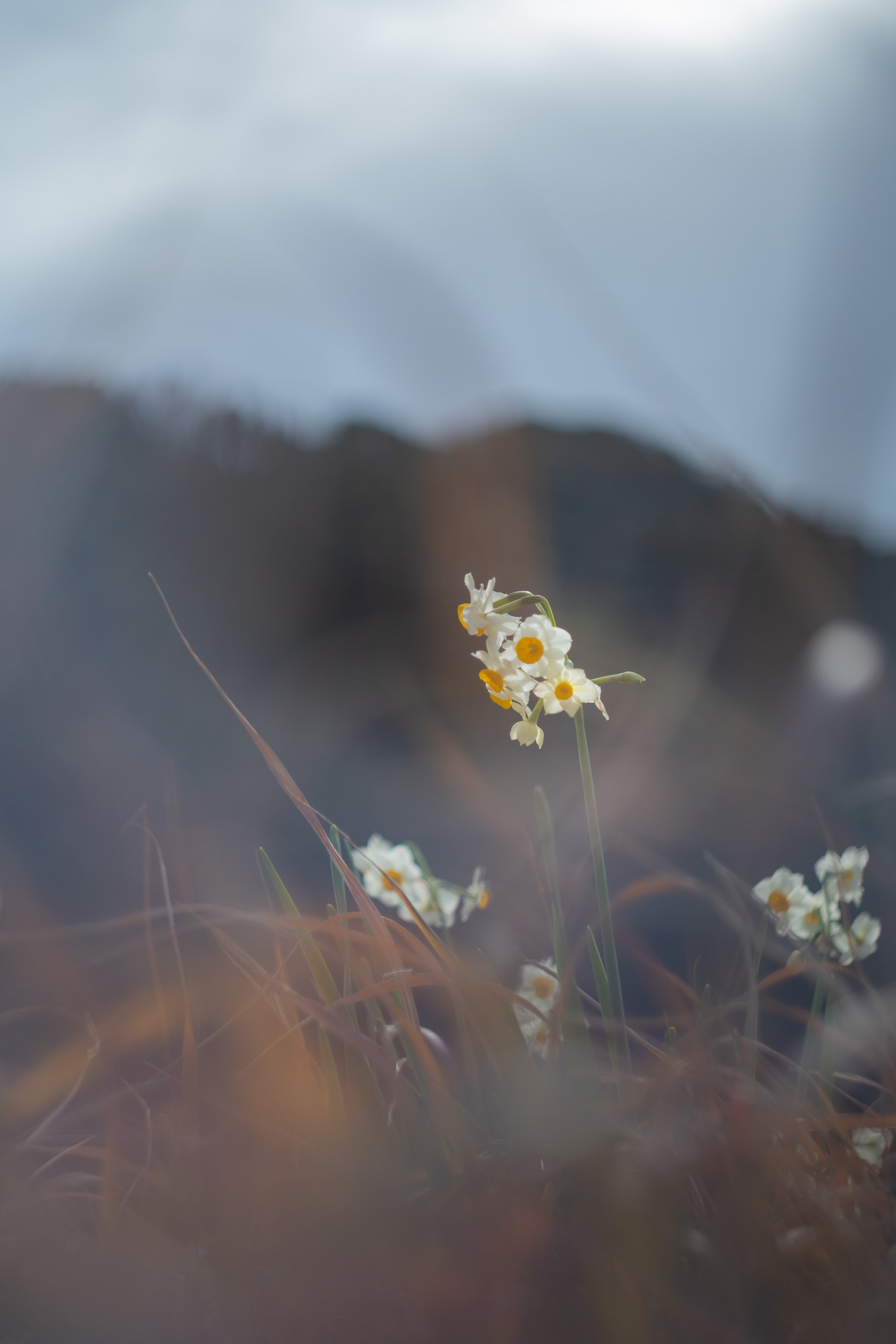
Kyonan, in southern Chiba, is one of Japan's three great daffodil areas. The town says its daffodils can be seen from late December to early February, while Chiba's tourism site gives the usual peak on the Ezuki Daffodil Road as mid-December to the end of January. The 2026–27 festival runs from 5 December 2026 to 31 January 2027. The town's road closure page (in Japanese; as of 30 October 2026) lists a town road in the Ezuki area as closed by a landslide, so please check with the town whether the Ezuki Daffodil Road can be walked before you set out.
Ice tulips grow from bulbs imported from the southern hemisphere, kept cold and planted outdoors in autumn so that they flower in midwinter (Funabashi City). At Funabashi Andersen Park they peak around December to January every year. The 2026 Tulip Festival ran from 2 to 31 January; no 2027 dates were posted on the official site as of 1 November. The park usually closes on Mondays, and it has other closed days around the New Year.
Winter peonies at Ueno Toshogu are brought into flower in winter by holding back their growth. Forty varieties and 160 plants bloom inside warabocchi, straw shelters against the frost. The garden opens from 1 January to late February (the official page names no year); in 2026 it stayed open to 23 February, and no notice for 2027 had been posted as of 1 November.
Light in the flowerless months
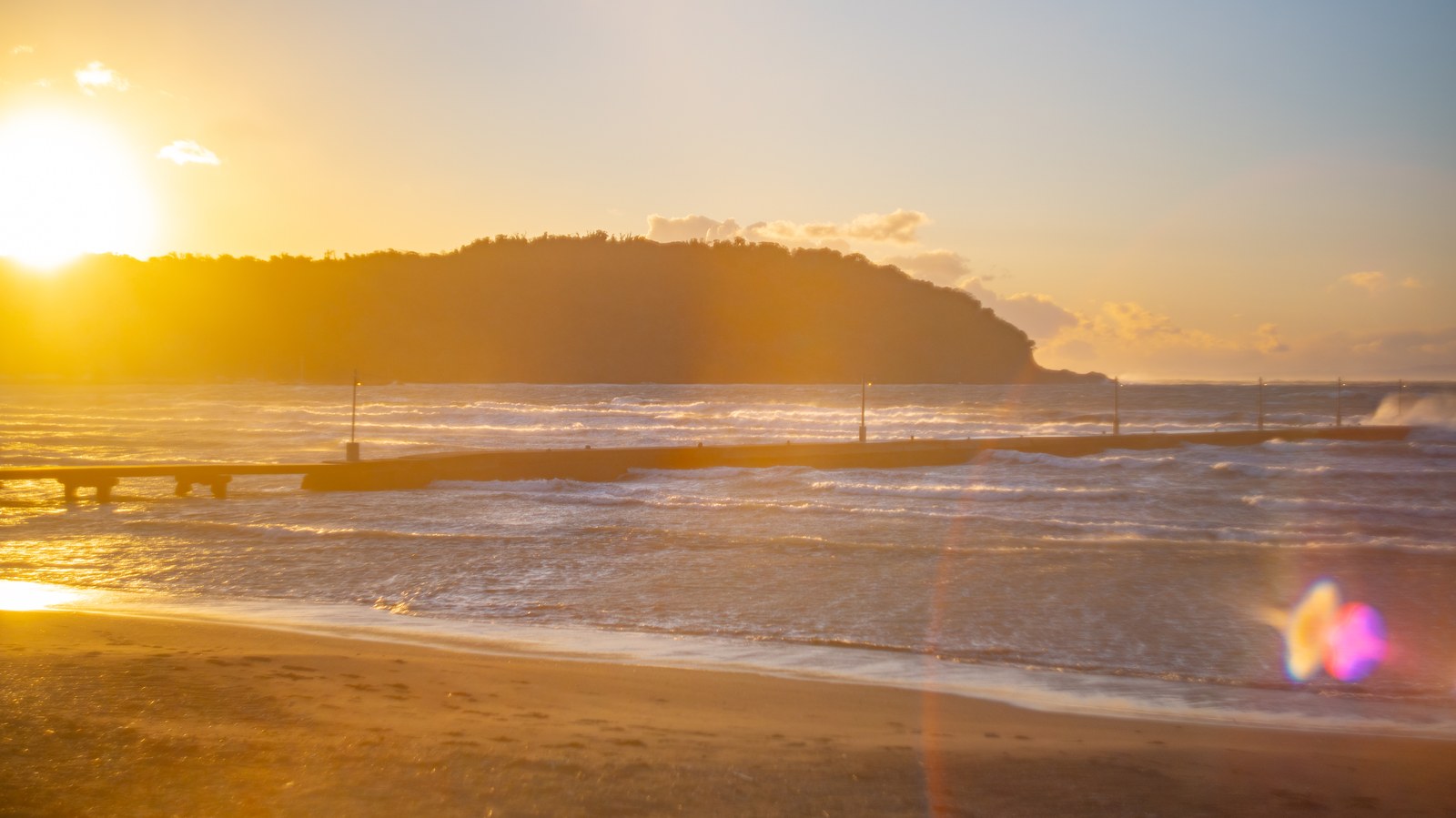
Haraoka Pier is one of Japan's few wooden sea piers, built for fishing in 1921. Haraoka Beach is one of the Hundred Fuji Views of the Kanto Region, and the selectors praise the sight of Fuji floating on the horizon beyond a blue sea. The roads around the pier are narrow residential streets, so if you drive, please use the detour that Minamiboso City recommends.
The Meiji Centennial Memorial Observation Tower at Cape Futtsu is shaped after a Japanese white pine and looks like a three-dimensional maze (Chiba Prefecture). The local tourism association notes that Fuji stands out clearly in the clear air of winter. The tower is inside Futtsu Park, where drones may not be used.
The boardwalk at Inage Seaside Park runs for 90 m, 47 m of it over the sea, and is lit from sunset until 22:00 (Chiba City). Shooting as a hobby needs no advance procedure, but drone flying and filming by private individuals is, as a rule, not permitted.
Tokyo Tower from Marunouchi is a city dusk: the tower standing at the far end of a canyon of high-rises. The sample photograph was taken from the observation terrace of the Marunouchi Building. Tokyo Tower's Landmark Light changes to its warm orange winter version on an evening in early October each year.
To compare the four Chiba shores and choose one, see Chiba's Sunset Coast.
Early cherries and plum from late January
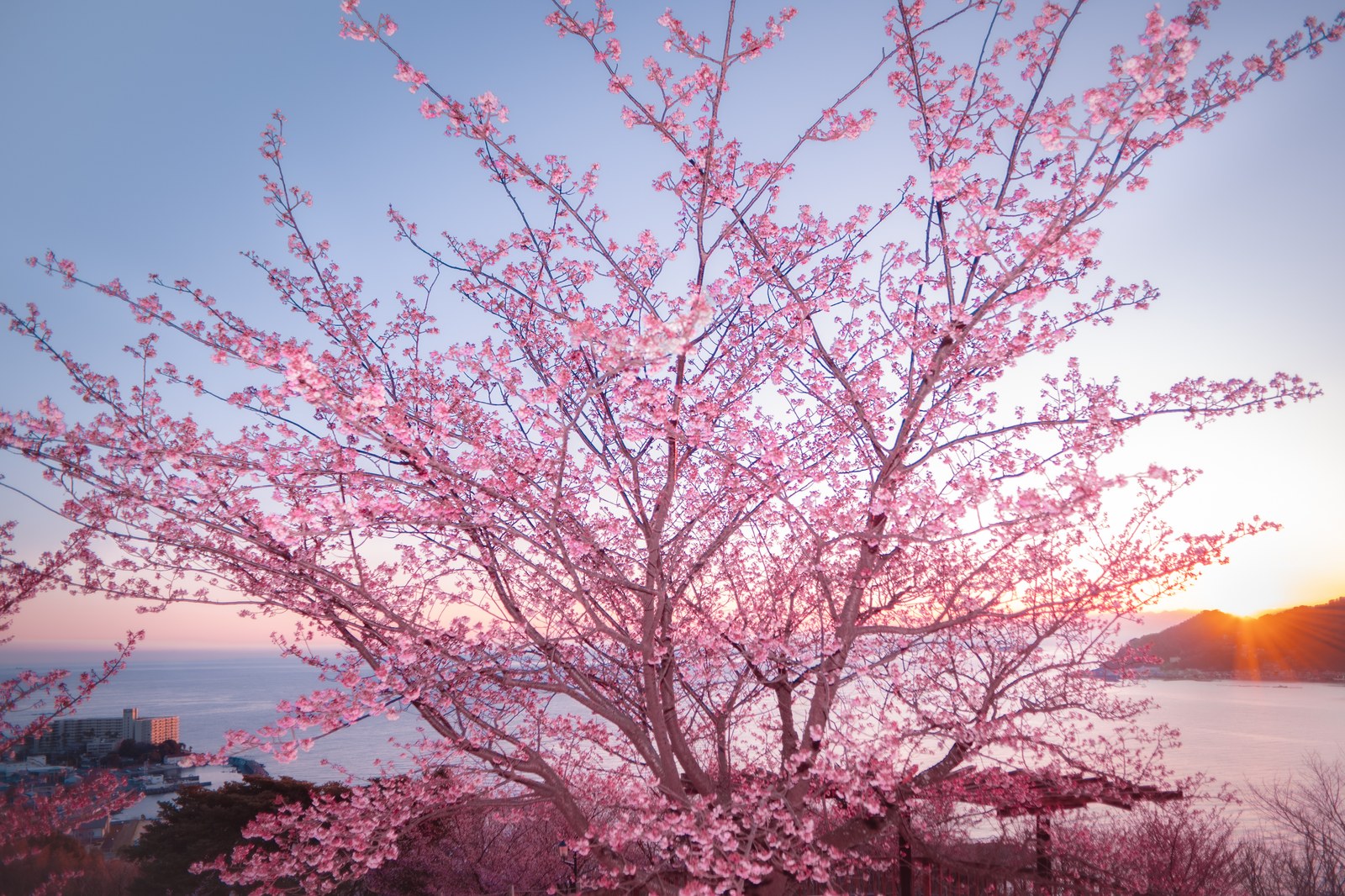
The Atami cherry, which the local tourism association calls Japan's earliest-blooming cherry, has 58 trees along the Itokawa promenade and usually peaks from late January to early February (Atami City). The 2027 Itokawa festival runs from 9 January to 7 February; in 2026 the trees were lit from 16:30 to 23:00. There is no parking on site, so use the paid car parks nearby.
Kawazu cherries usually peak from early February to early March (Shizuoka's official tourism site), along an avenue of about 4 km beside the Kawazu River. The 37th Kawazu Sakura Festival runs from 6 February to 7 March 2027; the 36th festival's light-up ran from 18:00 to 21:00. The direct Odoriko limited express takes about 2 hours 40 minutes from Tokyo Station.
Kairakuen holds about 3,000 plum trees of some 100 varieties. Ibaraki Prefecture gives their flowering as mid-January to mid-February for early varieties, early February to mid-March for mid-season ones, and early to late March for late ones. The Mito Plum Festival runs from mid-February to late March every year; in 2026 it ran from 11 February to 22 March, and no formal 2027 announcement had been posted as of 1 November. A fee revision announced on 28 October 2026 sets main-garden admission at ¥320 for adults, or ¥500 during the festival.
In the old downriver districts of Tokyo, the Kyu-Nakagawa has 36 Kawazu cherries on its riverbank. They start to open around the beginning of February every year and peak from late February to mid-March (Edogawa Ward). The area around the JR Sobu Line railway bridge is the spot named for photographing the blossom against Tokyo Skytree.
At Iwai Weir in Asahi, Chiba, the Kawazu cherries and rape flowers peak from late February to mid-March (Asahi City). The city asks visitors to stay out of the rape field, not to pick flowers or break branches, and never to enter the reservoir pond nearby.
To compare Kawazu cherries and the Skytree at three waterside locations, see Kawazu Cherries and Skytree.
Bring a scene from this guide home
Each is a real photograph from this guide’s season, printed in Japan on FUJICOLOR professional paper.
When to go — how to check the peak
Peak dates move from year to year. Atami City's bloom survey found the Itokawa cherries almost in full bloom on 20 January in 2026, while in 2025 they were recorded in full bloom on 17 February. The Kawazu festival's peak declaration fell on 12 February at the 34th festival and on 28 February at the 35th. Treat the dates in this guide as a starting point, and check each official bloom report and schedule before you set out.
To follow the flowers month by month beyond winter, see the flower and foliage calendar.
Questions photographers ask
What flowers can I photograph near Tokyo from December to February?
Ice tulips at Funabashi Andersen Park peak around December to January every year (Funabashi City), and Kyonan's daffodils can be seen from late December to early February; Chiba's tourism site gives the usual peak on the Ezuki Daffodil Road as mid-December to the end of January. The winter peony garden at Ueno Toshogu opens from 1 January to late February, and in 2026 it stayed open to 23 February. From late January the Atami cherry joins them, usually peaking from late January to early February.
Sources: Funabashi City: FUNABASHI Style; Kyonan Town: Suisen Road hiking course; Chiba tourism site: Ezuki Daffodil Road; Ueno Toshogu Peony Garden: winter peonies; Atami City: Itokawa promenade Atami cherry (all checked 1 November 2026)
Where can I photograph the sun setting over Tokyo Bay?
This guide covers three places: Haraoka Pier in Minamiboso, Cape Futtsu in Futtsu, and Inage Seaside Park in Chiba City. Haraoka Beach is one of the Hundred Fuji Views of the Kanto Region, and the Futtsu tourism association says Fuji stands out clearly in the clear air of winter and that the Cape Futtsu tower is on the same list. The boardwalk at Inage Seaside Park is lit from sunset until 22:00.
Sources: Kanto Regional Development Bureau: Fuji from Tomiura, Boso Peninsula; Futtsu tourism association: Meiji Centennial Tower; Chiba City: Inage Seaside Park boardwalk (all checked 1 November 2026)
Where and when can I photograph Kawazu cherry blossoms?
Along the Kawazu River in Shizuoka they usually peak from early February to early March (Shizuoka's official tourism site), and the 37th Kawazu Sakura Festival runs from 6 February to 7 March 2027. On the Kyu-Nakagawa in Tokyo they peak from late February to mid-March every year (Edogawa Ward), and at Iwai Weir in Asahi, Chiba, from late February to mid-March (Asahi City).
Sources: Shizuoka tourism guide Hello Navi: early cherry spots; Kawazu tourism site: 37th festival notice; Edogawa Ward: Kyu-Nakagawa Kawazu cherries; Asahi City: cherry blossom spots (all checked 1 November 2026)
Which of these places charge admission?
Fees could be confirmed for three places. Ueno Toshogu Peony Garden charges ¥1,000 for adults (junior high age and over) and is free for elementary-school age and under. Funabashi Andersen Park charges ¥900 for adults. Kairakuen's main garden charges adults ¥320, or ¥500 during the Mito Plum Festival period (mid-February to around the end of March every year). The Itokawa promenade is open to all. No admission fee is stated officially for the other places, so please check each official source before you set out.
Sources: Ueno Toshogu Peony Garden: winter peonies; Funabashi Andersen Park: visitor guide; Kairakuen: Mito Plum Festival admission revision; Atami News: Itokawa cherry festival (all checked 1 November 2026)
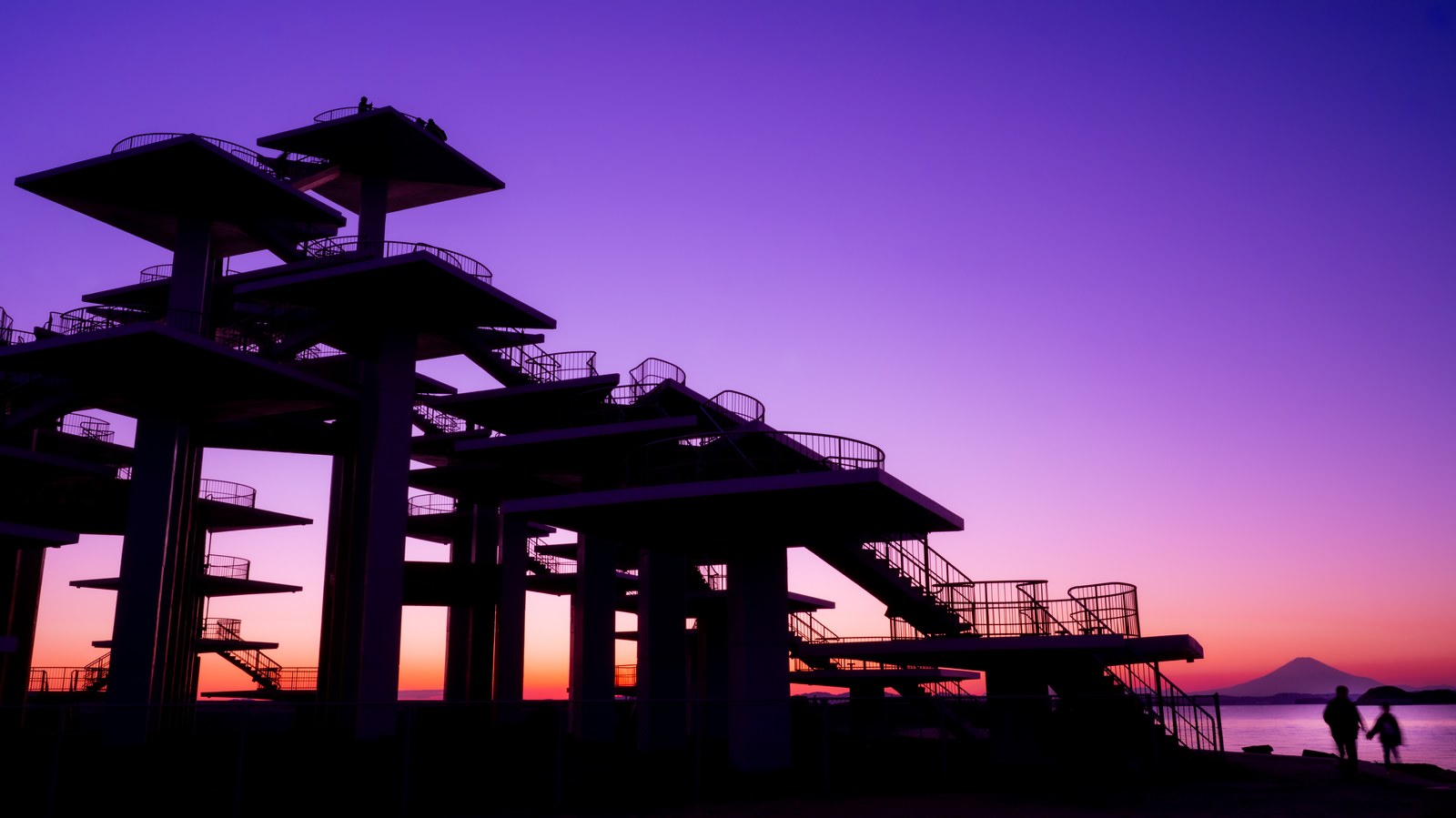
The tower standing black against a dusk sky, and Fuji beyond it across Tokyo Bay. We deliver this photograph as a silver-halide print on FUJICOLOR's finest photographic paper — frame it for your room; we ship worldwide.
💾 A digital download is also available ($4.00 each). Bundles cost less: 3 for $10.20, 5 for $15.00 ($3.00 each) — mix any photographs you like.
View the print →