
PHOTO SPOT GUIDE
The Daffodils of Kyonan — White Lamps in the Heart of Winter
Kyonan, in southern Chiba. Near the tip of the Boso Peninsula, in the hills just back from the sea, there is a season still coloured in winter brown. Yet as you draw closer to the slopes, a sweet fragrance rises around your feet, and you notice that small white flowers are blooming everywhere. Japanese daffodils — the flower that opens most quietly, just as the cold reaches its deepest.
Blooming Whitest on the Coldest Day of Winter
There are plants that go to the trouble of flowering in the year's darkest, least generous season. The Japanese daffodil lights one white blossom after another across the winter hills, while every other flower is sleeping. Seen in the cold, clear air, that white is somehow dignified, yet never strained. The little flowers, blooming slightly downturned, look less like they are enduring the cold than quietly keeping it company. Perhaps that is why they move us. In a season when nothing should be blooming, something is blooming all the same. In the depth of winter, that simple fact can feel like a very large thing.
The Fragrance First, the Flowers After
Walking through the daffodil country of Kyonan, you notice the scent before you ever see a flower. Sweet, faintly cold and clear, it travels on the wind to well below the slopes. Along the Ezuki Daffodil Road, daffodils run beside the town lane, and at Okuzure the white flowers cover an entire hillside. On the way home from a long night on the emergency ward, walking slowly through this fragrance, I can feel something tightly held begin to loosen, little by little. The flowers bloom with no regard for our circumstances — and that indifference is, strangely, a kind of gentleness.
White flowers bloom in a whisper.
Only their fragrance announces the coming spring.
When to go — daffodil season and the festival
Deep winter is the finest time. The colder the day, the deeper the fragrance.
The Town of Kyonan says the Japanese daffodils can be seen from late December to early February. Chiba Prefecture's official tourism site puts the best time on the Ezuki Daffodil Road at mid-December to the end of January in a typical year, and at Okuzure from mid-December through January, so the guides differ a little. The Daffodil Festival starts in early December each year, according to the Kyonan Tourism Association, and the prefecture's site lists the 2026–27 festival as December 5, 2026 to January 31, 2027 (checked 1 November 2026). During the festival, local produce and cut daffodils are sold along the Ezuki Daffodil Road. At certain times of the season, the daffodils at Sakuma Dam Park are lit up from 5 pm to 8 pm. Because blooming depends on the weather, please check the latest conditions through official sources before you set out.
Getting there: check road closures and trains first
Typhoon No. 25 is still affecting the area. The Town of Kyonan's road closure page (in Japanese; as of 30 October 2026, checked 1 November) lists two town roads as closed by landslides, 江月〜赤伏 in the Ezuki area and 権現橋〜鋸南病院 near Kyonan Hospital, with no reopening date for either. The town adds that there may be closures it has not listed. That page alone does not show whether the Ezuki Daffodil Road or the town's Daffodil Road hiking course (Awa-Katsuyama Station to Hota Station) can be walked. Before you set out, please ask the Hota Station tourist information office (0470-55-1683) or the town.
National Route 127 is also closed to through traffic at Kanaya in Futtsu, where a slope collapsed, and no reopening date has been set (same page). As an alternative, the Futtsu-Tateyama Road is free until the closure ends if you use it only between the Futtsu-Takeoka or Futtsu-Kanaya interchange and the Kyonan-Hota interchange.
The nearest stations are Hota and Awa-Katsuyama on the JR Uchibo Line. For Okuzure, take the town circular bus (Blue Bus) from Hota Station for about 25 minutes and get off at Okuzure (大崩). The same bus also runs from Awa-Katsuyama Station, and Sakuma Dam Iriguchi is the stop for Sakuma Dam Park. The bus makes five trips a day, but the first and last trips do not run on weekends, national holidays or over the New Year. Extra buses run on weekends and holidays during the flower festival season, from early January to early March. From Tokyo, some highway buses on the Tokyo–Kamogawa route (アクシー号) stop at Michi-no-Eki Hota Shogakko, about 1 hour 20 minutes from Tokyo Station. Car parks are around Sakuma Dam Park and in front of the Okuzure community hall (300 yen). The Ezuki Daffodil Road is narrow, so you cannot drive along it. The neighbouring Hamakanaya Station is the gateway to Mount Nokogiri. Do bring comfortable shoes and warm winter clothing.
How to photograph white daffodils
White flowers are a subject to handle with care for brightness. Under the clear light of midwinter, the blossoms easily blow out to pure white, so dialling the exposure down a little — keeping the shadows and texture of the petals — gives a finer result. The soft light of an overcast day also suits daffodils well. You cannot photograph the fragrance itself, but by using the depth of the massed flowers and leaning gently in toward a single bloom in the foreground, you can convey the quiet density of the air. These are hillside slopes near the sea, so try changing the angle and time of the light, and gather the gradations of white with patience.
While you're in the area
From Hamakanaya, next to Kyonan, you can climb Mount Nokogiri. The old quarry faces near the summit and the cliff-top views over Tokyo Bay offer a winter scene quite different from the daffodil fields. Go down to the coast at Hota, or further on into Minamiboso, and you will find the sea's bounty for which warm Boso is known, even in winter. The scent of white flowers, and the wind off the winter sea — here in the south of the peninsula, even in deep winter, time flows softly, as if spring had already been quietly let in early.
The route that day — Daffodils and sunset on the Boso Peninsula (11 January 2026)
Each time is when the first photograph at that place was taken, from the camera’s own record.
- The daffodils of Kyonan (this article)
- Haraoka Pier
Questions photographers ask
When are the daffodils at their best in Kyonan?
The Town of Kyonan says the daffodils can be seen from late December to early February. Chiba Prefecture's official tourism site gives the best time as mid-December to the end of January on the Ezuki Daffodil Road in a typical year, and mid-December through January at Okuzure.
Sources: Town of Kyonan, daffodil road hiking course (in Japanese); Chiba Prefecture tourism site, Ezuki Daffodil Road (in Japanese); Chiba Prefecture tourism site, Okuzure (in Japanese) (all checked 1 November 2026)
When is the Kyonan Daffodil Festival?
The Kyonan Tourism Association says the festival starts in early December each year. Chiba Prefecture's official tourism site lists the 2026–27 festival as December 5, 2026 to January 31, 2027.
Sources: Kyonan Tourism Association, daffodils (in English); Chiba Prefecture tourism site, Daffodil Festival (in Japanese) (both checked 1 November 2026)
How do I get to the daffodil areas?
For Okuzure, take the town circular bus (Blue Bus) from Hota Station on the JR Uchibo Line for about 25 minutes and get off at Okuzure (大崩). The bus makes five trips a day, but the first and last do not run on weekends, national holidays or over the New Year. A town road near the Ezuki Daffodil Road is closed as of 30 October 2026, so please check with the town whether it can be walked.
Sources: Town of Kyonan, road closures (in Japanese); Chiba Prefecture tourism site, Okuzure (in Japanese); Town of Kyonan, circular bus (in Japanese) (all checked 1 November 2026)
Where can I check how the daffodils are blooming?
Chiba Prefecture's tourism site lists the Hota Station tourist information office (0470-55-1683) for the Ezuki Daffodil Road and the Okuzure tourism office (0470-55-8040) for Okuzure. Festival information is on the Kyonan Tourism Association's site.
Sources: Chiba Prefecture tourism site, Daffodil Festival (in Japanese); Kyonan Tourism Association, daffodils (in English) (both checked 1 November 2026)
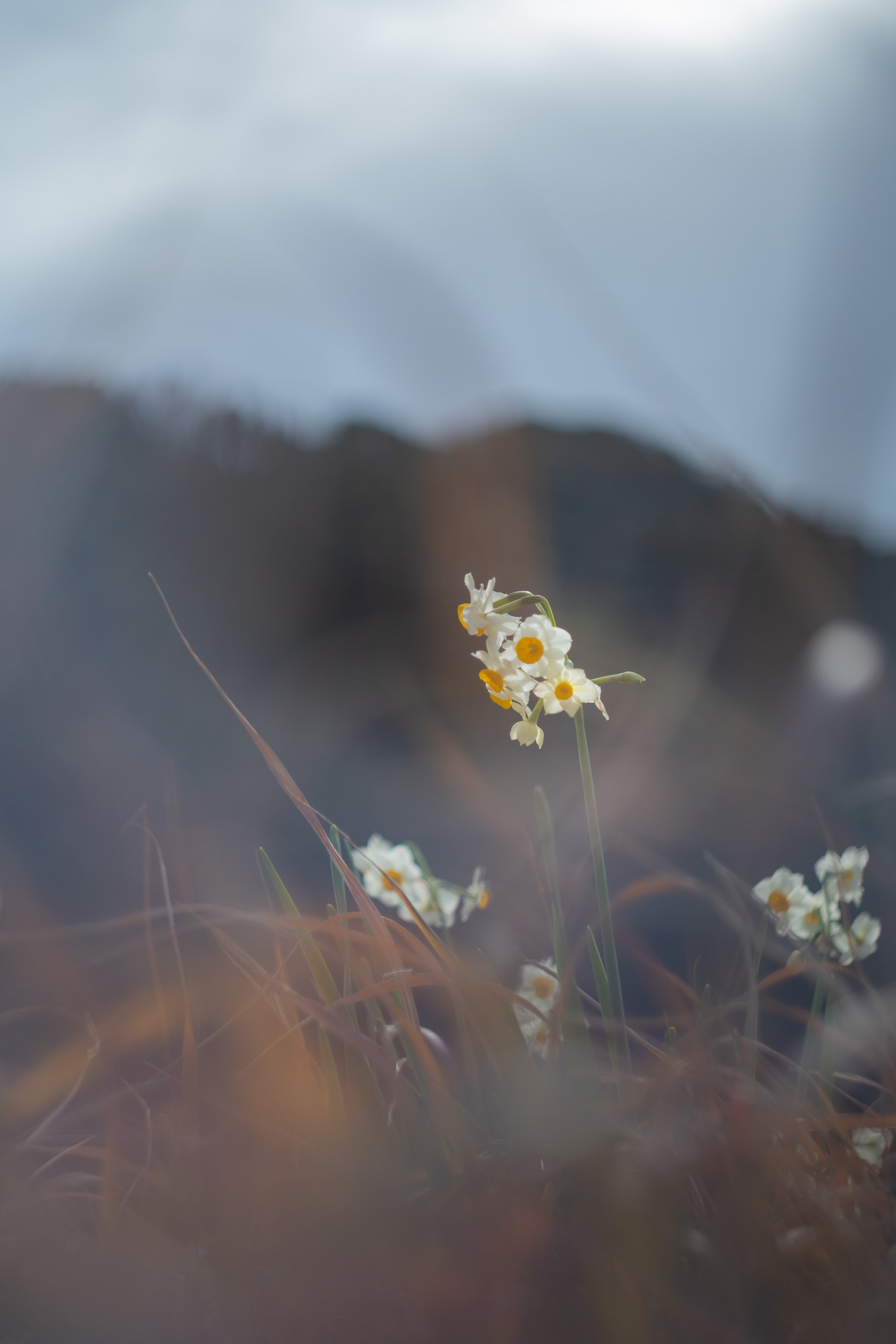
We deliver this winter scene of Kyonan as a silver-halide print on FUJICOLOR's finest photographic paper. Each one is carefully finished and shipped worldwide.
💾 A digital download is also available ($4.00 each). Bundles cost less: 3 for $10.20, 5 for $15.00 ($3.00 each) — mix any photographs you like.
View the print →