
PHOTO SPOT GUIDE
Nagaoka Fireworks — Prayers Opening over the Shinano River
Nagaoka, in Niigata. On the wide riverbed of the Shinano, there are two nights each summer when what feels like the whole city gathers. This is the Nagaoka Fireworks Festival: the shosanshakudama, opening some 650 metres across, and the Phoenix, running about two kilometres along the water. Yet what moves you here is not the scale. Every one of these lights carries the memory of a night when this city lost everything, and all the years it has spent living again since.
So Large You Can Only Look Up
The shosanshakudama is a shell roughly 90 centimetres across, weighing around 300 kilograms. It climbs beyond 600 metres before opening into a flower some 650 metres wide. The numbers sound abstract, but standing on the riverbed something much simpler happens: it will not fit inside your field of view. Tilt your head all the way back and you still cannot find the edges. Golden rays cover the entire sky, and countless threads of fire come down slowly, like rain. The sound arrives a moment after the light, low in your chest. Nagaoka first succeeded in launching this shell in 1926 — which means 2026 marked exactly one hundred years.
Light in the Shape of a Prayer
On the night of August 1, 1945, Nagaoka was bombed. From 10:30pm, B-29s struck the city for about an hour and forty minutes; roughly eighty percent of the old town burned, and 1,486 people were killed. The following year, on August 1, 1946, the town held a recovery festival — and that festival is the direct ancestor of today's Nagaoka Matsuri. The order has never changed: August 1 is the day of remembrance, and the second and third are the nights of fire. After the Chuetsu earthquake of 2004, the Phoenix was added, a firework launched in hope of recovery, stretching about two kilometres along the river. Watching that light spread, I remember something I have felt many times in emergency medicine. What is lost does not come back. And still, the people who remain begin again the next morning. I think these fireworks take that "and still" and hand it back to the sky in the most beautiful form they can find.
It opens at its widest in order to vanish.
This city sends that instant up so as not to forget.
Planning your visit — season
The date never moves. Whatever day of the week it falls on: August 2 and 3, every year.
The Nagaoka Fireworks Festival runs over two evenings, August 2 and 3. Launches generally begin around 7:20pm and continue until about 9:25pm. Both nights follow largely the same programme, and both the shosanshakudama and the Phoenix are launched on each. In 2026, for the first time in three years, the Niagara cascade from Chosei Bridge was once again launched together with the shosanshakudama. Paid viewing seats are usually set out along the riverbed, but seat types, prices, and how and when to apply change from year to year — please check the official site for the current details.
Getting there
The fireworks are launched from the banks of the Shinano River as it runs through central Nagaoka, around the stretch between Chosei Bridge and Ote Bridge, and can be watched from both sides of the water. JR Nagaoka Station on the Joetsu Shinkansen is within walking distance of the site, and on the night a steady current of people flows from the station down to the river. Traffic restrictions cover much of the city across both days, and the station and the bridges are extremely crowded once the show ends. Accommodation fills early, and arrangements for parking and extra trains differ each year, so settle your travel both ways in advance using the latest official guidance.
Tips for photographers
Begin with a tripod and a cable release. Fireworks are shot on bulb: hold the shutter open from the moment the shell opens until the last threads of fire have fallen, capturing one burst whole. Keep ISO low, start somewhere between f/8 and f/11, then close down if it is too bright and open up if it is too dark, adjusting shell by shell. Assume the shosanshakudama will not fit your frame — go wide, and leave generous room for sky. The thing most worth reading is the wind. Stand on the side the smoke drifts away from and you will still have clear air for the later shells; get it wrong and everything turns milky white. Then decide whether to include the lights of the far bank: keep them and you show the city's relationship with the fireworks; crop them out and the light becomes pure. The two frames from this night went both ways — one looking up, with paper lanterns and the silhouettes of the crowd; the other keeping only a sky drowned in crimson smoke. Even from the same spot, that is the choice to make.
All of the above is the orthodox method. The two frames from this night, though, were made with no tripod and no bulb — handheld, in burst. Without legs planted you can turn your whole body the instant a shell climbs, and the angle that results is one only you could have taken from exactly there. The trade is real: shake happens, and the framing drifts. For a first attempt at fireworks the orthodox route is the one to take; handheld is a second road, not a better one. Both are set out in How to Photograph Fireworks.
While you're in the area
Nagaoka is a city built on the plain the Shinano River made. When the morning after the fireworks comes, the riverbed that held all that light the night before has gone back to being a quiet river, as though nothing had happened. That contrast alone is worth an early walk along the bank. Summer in Niigata is also the season of its rice and its sake, and both the sea and the mountains are within easy reach. Since August 2 and 3 never move, the surest way to plan is to place those two nights first and build the rest of your summer around them.
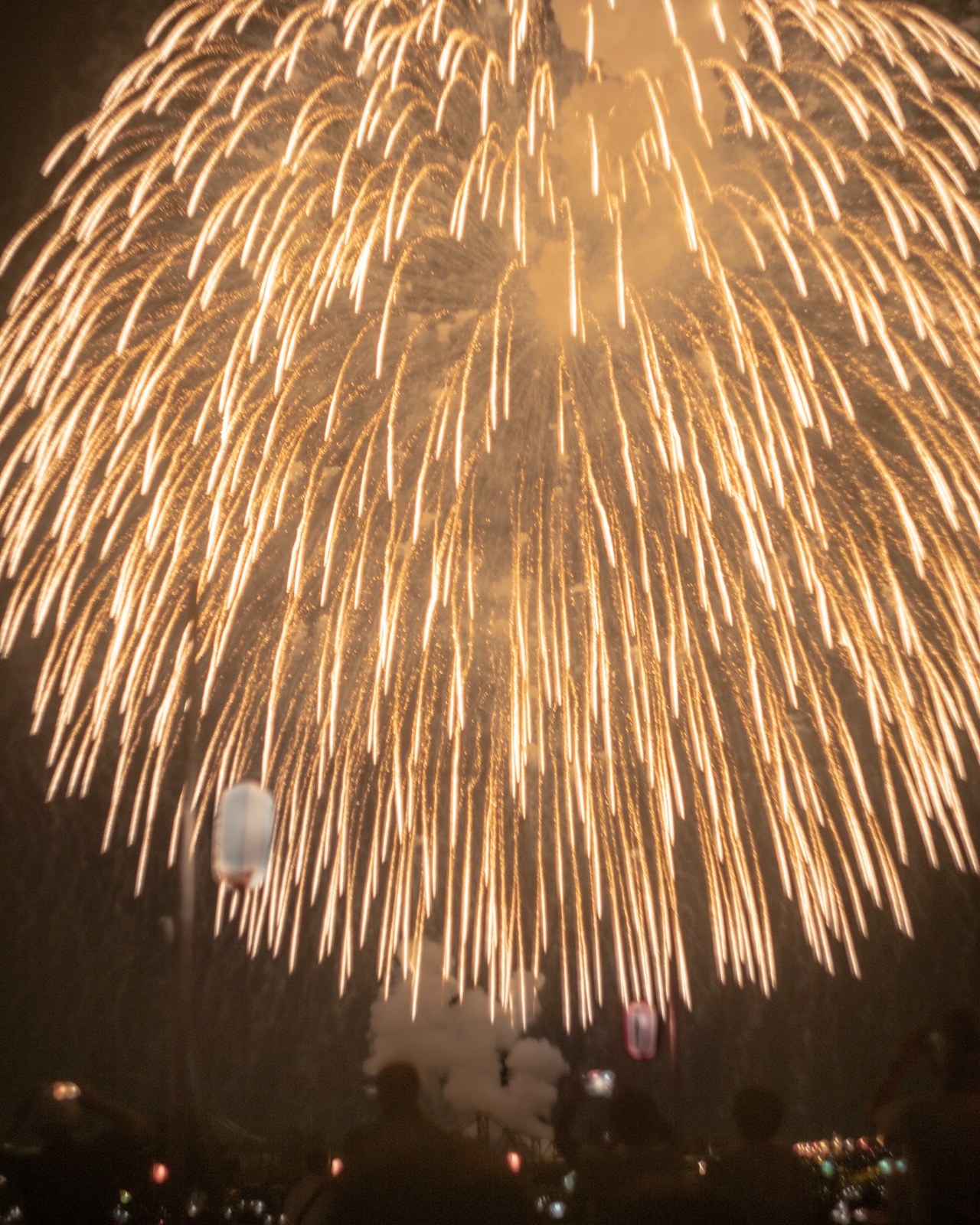
We deliver this night in Nagaoka as a silver-halide print on FUJICOLOR's finest photographic paper. Each one is carefully finished and shipped worldwide.
💾 A digital download is also available ($7.00 each). Bundles cost less: 3 for $17.84, 5 for $26.23 ($5.25 each) — mix any photographs you like.
View the print →