
PHOTO SPOT GUIDE
The Sunflowers of Zama — One Tree at the Far End of the Field
Zama, in Kanagawa. Around the Zakaeibashi bridge over the Sagami River, a yellow sea appears for a few weeks each summer. Counting the Zama and Yotsuya sections together, there are some 550,000 sunflowers here, one of the largest gatherings anywhere near Tokyo. And far off at the back of the field, a single broad, round-crowned tree stands as though quietly keeping watch over all of them.
Half a Million Yellow Faces, and One Tree
In most sunflower fields, the endless yellow is the whole story. Zama has a second character. At the far end of the planting stands one solitary tree with a soft, rounded crown, a tree that local people affectionately call "the Totoro tree", and photographing it together with the flowers has become the thing to do here. The blooms come up to about head height, so walking between the rows feels a little like wading through a yellow surface with only your face above it. Look up, and the tree is always there in the same place. It is probably the reason nobody gets lost in a field this wide.
The Short Hour Before the Sun Goes Down
Sunflowers belong to the sun. At midday the field is dazzling, energetic, almost noisy. But once the light begins to slant, everything suddenly grows quiet. The flowers stay turned the way they have turned, unmoving, and only the sound of the wind is left. Working in emergency medicine, you spend your life believing there is never enough time. Perhaps that is why the last short hour before sunset, with the light draining away minute by minute, always stops me where I stand. Summer should be at its height, and yet an evening in a sunflower field already carries the scent of an ending. I want to carry that faintly lonely air home with me too.
The yellow settles quietly into the dark.
At the back of the field, only the tree still watches the sky.
Planning your visit — season
Midsummer, at its hottest, is the finest time to come.
The sunflowers of Zama are usually at their best around the middle of August. The Zama Sunflower Festival is timed to the season; in 2026 it ran from 14 to 16 August, from 9:30 to 17:00. The main stage is the Zama and Yotsuya sections spreading north and south of the Zakaeibashi bridge, and this is where the roughly 550,000 flowers grow. The fields themselves are open all day, so visiting just before or just after the festival, when the crowds have thinned, is a fine option too. The city also has a separate planting at Kurihara, some 100,000 flowers that come into bloom at a different time. Because the season shifts with the weather each year, please check the latest bloom report on the Zama City Tourism Association website before you set out.
Getting there
The Odakyu Line is the easiest approach. During the festival, direct shuttle buses run from Sobudaimae Station to the site, at 260 yen one way and roughly every 15 to 20 minutes. Outside the festival period, take the local bus bound for Zama Yotsuya from Zama Station and get off at Himawari-batake Iriguchi, about a 10-minute walk from the fields, or at Shindenjuku Minami, about 9 minutes on foot. There is almost no shade among the flowers, so bring a hat and more water than you think you need, and plan on walking slowly toward the evening. Bus services and timetables change from year to year, so do check the current information before you go.
Tips for photographers
The photograph that belongs to this field is the one that pairs the sunflowers with the tree behind them. That rounded crown works from almost any angle, but if you move until it clears the nearest row of flowers, its shape reads cleanly against the sky. The print titled The Tree That Waits for Dusk was made in the last minutes before sunset, when only the sky was still burning orange. The exposure is deliberately held down. I did not want the cheerful sunflowers of a bright noon, but the quiet, faintly lonely, faintly nostalgic air of a field settling into the end of its day. Focus sits on the distant tree, with the near flowers thrown well out of focus, so that the yellow sinks back and the eye travels naturally toward the trunk. Evening light changes within minutes, so choose your standing position about half an hour before sunset and simply wait.
While you're in the area
Within the same city, the sunflowers at Kurihara bloom on a different schedule. In some years they are still to come once the main fields are over, so it is worth checking if your dates did not quite work out. The Sagami River runs right beside the planting; climb up onto the embankment and the evening water carries the colour of the sky, a stillness quite unlike the one down among the flowers. Walking a little longer into a late-summer dusk is never wasted time.
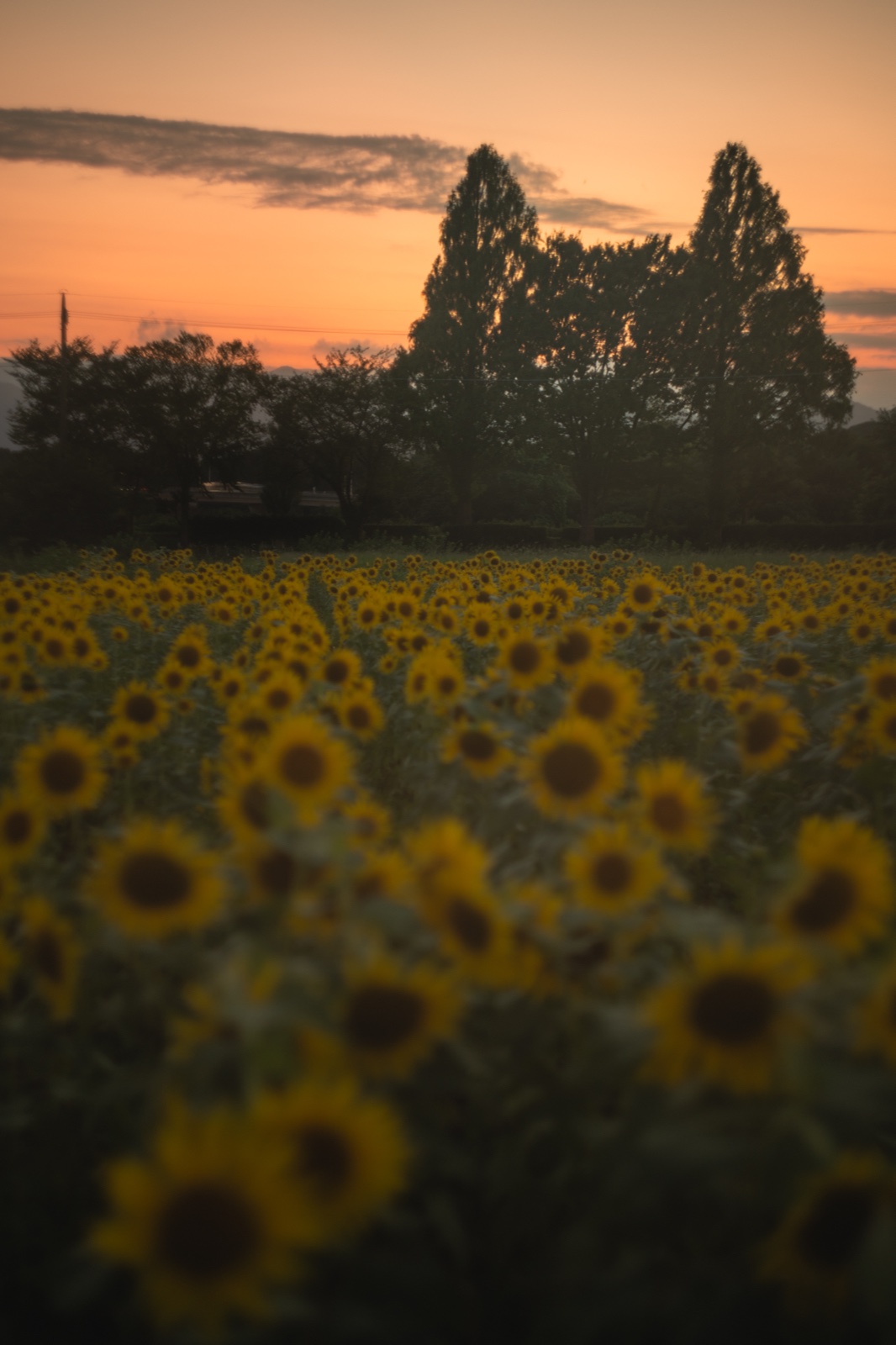
We deliver the last light over the sunflower fields of Zama as a silver-halide print on FUJICOLOR's finest photographic paper. Each one is carefully finished and shipped worldwide.
💾 A digital download is also available ($7.00 each). Bundles cost less: 3 for $17.84, 5 for $26.23 ($5.25 each) — mix any photographs you like.
View the print →