
FEATURE · REFERENCE
Tripod & Photography Rules at Japan’s Autumn-Leaf Spots (2026)
Whether you may put up a tripod changes from one autumn-leaf spot to the next. Even within Kyoto, one temple declines tripods across its whole precincts while another says nothing at all — and the rules are usually posted only in Japanese. This reference covers 18 autumn-leaf spots: for each, it quotes what the temple, venue, local government or park authority says on its own website, with an English translation, a link to the source and the date it was checked. Where the official pages say nothing, the table says “not stated” rather than guessing.
The short version
- Many Kyoto temples decline tripods. Tofuku-ji (whole precincts, all year), the Nanzen-ji precincts (including Nanzen-in; monopods too) and Yusai-tei (all year) officially decline tripods. Rurikoin does not allow tripods or monopods either (confirmed on its official visiting page on 27 September). To-ji says nothing officially.
- Oku-Nikko’s marshes: from the trail, with consideration. For Senjogahara and Odashirogahara, the Ministry of the Environment’s visitor center asks you to photograph from the trail and to use tripods with consideration for other walkers.
- Tokyo’s gardens and parks each word it differently. Showa Kinen Park does not ban tripods but asks you not to use them on narrow paths. Hama-rikyu’s Japanese rules do not mention tripods, while the English version of the same page limits visitors to snapshots with smartphones or small hand-held cameras.
- No drones at Hama-rikyu or Showa Kinen Park. In Oku-Nikko, the Ministry of the Environment asks you not to fly over marshes and similar places, and Tochigi Prefecture asks for a notification before flights over its roads and rivers.
- “Not stated” does not mean “allowed”. Signs on site and the staff’s instructions always take precedence over this table.
How to read the symbols
- ⛔ Not permittedThe official site prohibits it or asks you to refrain (scope and period noted)
- 📅 Period or placeA restriction for a set period or place has been officially announced
- ⚠️ Conditions / check firstThe official site mentions it with conditions, or its wording differs between versions, so ask first
- ― Not statedWe checked the official pages and found nothing on this point. This is not permission
- ? Not recheckedWe could not check the official page this time (where the previous check found a rule, it is given with its date)
The table — 18 places at a glance
Grouped by region (Kanto, Chubu, Kansai). Each name links to our location guide; “Wording & sources” jumps to the full quotes below. The bracketed numbers link to the official pages for that row. Official wording is in Japanese; the translations are ours unless marked as official English.
↔ The table scrolls sideways on a narrow screen.
Tripod column: ⛔ not permitted (official) 4 / ⚠️ conditions / check first 4 / ― not stated officially 10 (18 spots)
| Spot | Tripod | Monopod / selfie stick | Drone | Commercial shoots / photo sessions | Night / illumination | Place & period limits | Checked · sources |
|---|---|---|---|---|---|---|---|
| Kanto | |||||||
| OdashirogaharaOku-Nikko, TochigiWording & sources ↓ | From the trail, with consideration for other walkers | Not stated | Asked not to fly over marshes and similar places | Not stated | Not stated | Stay on the trail (not into the marsh or forest); single file on the right when crowded | [1] [2] |
| SenjogaharaOku-Nikko, TochigiWording & sources ↓ | From the trail, with consideration for other walkers | Not stated | Asked not to fly over marshes and similar places | Not stated | Not stated | Stay on the trail (not into the marsh or forest); single file on the right when crowded | [1] [2] |
| Sanbonmatsu rest area (Senjogahara viewpoint)Oku-Nikko, TochigiWording & sources ↓ | Nothing for the rest area itself (the Senjogahara trail rule is above) | Not stated | Asked not to fly around rest areas and trails | Not stated | Not stated | Not stated | [1] [2] [3] |
| Oku-Nikko (Ryuzu Falls, Lake Chuzenji, Irohazaka)Nikko, TochigiWording & sources ↓ | Not stated | Not stated | Notify the prefecture before flying over Irohazaka (road), Lake Chuzenji or Ryuzu Falls (river) | Not stated | Not stated | Not stated | [1] [2] |
| RoppozawaKirifuri Highlands, TochigiWording & sources ↓ | Not stated | Not stated | Not stated | Not stated | Not stated | Not stated | [1] |
| Hangetsuyama observation deckSouth shore of Lake Chuzenji, TochigiWording & sources ↓ | Not stated | Not stated | Notify the prefecture before flying over the prefectural road | Not stated | The road is closed to everyone, walkers included, 17:00–07:00 | Not stated | [1] [2] [3] |
| Murakami Ryokuchi ParkYachiyo, ChibaWording & sources ↓ | Not stated | Not stated | Not stated | Not stated | Not stated | Not stated | [1] [2] [3] |
| Hama-rikyu GardensChuo, TokyoWording & sources ↓ | Not in the Japanese list of prohibitions; the English version limits visitors to souvenir snaps with phones or small hand-held cameras — ask first | As for tripods (English version: hand-held cameras only) | Not permitted (listed among things you cannot do) | Portrait-centred shoots need an application; no model photo sessions; applications closed 1–4 Oct and 17 Oct–6 Dec | No photography rule given (open until 21:00 on 21–23 Oct and 30 Oct–3 Nov) | Not stated | [1] [2] [3] |
| Showa Kinen Park (Katarai ginkgo avenue)Tachikawa, TokyoWording & sources ↓ | Not a prohibited item; not in narrow paths or where it blocks passage | Not stated | Not permitted (a prohibited item; filming too) | Location shoots need prior permission; please don’t sell photos through stock services | Not stated | Stay outside fences and ropes; no long sessions — share the spot | [1] [2] |
| Gyoko-dori ginkgo avenueMarunouchi, Tokyo (public road)Wording & sources ↓ | Nothing for the avenue itself (the adjoining Kokyo Gaien asks you not to bring tripods for portrait shoots in busy seasons) | Not stated | Not stated | Location shoots and photo sessions on the road need a road-use permit if they seriously affect traffic | Not stated | Not stated | [1] [2] [3] |
| Chubu | |||||||
| Hananomiyako Park, Lake YamanakaYamanakako, YamanashiWording & sources ↓ | Not stated | Not stated | Not stated | Not stated | Not stated | Not stated | [1] [2] |
| Lake Kawaguchi Maple CorridorFujikawaguchiko, YamanashiWording & sources ↓ | Not stated | Not stated | Not stated | Not stated | No photography rule given (illumination 7–29 Nov, sunset–21:00) | Not stated | [1] [2] |
| KorankeiToyota, AichiWording & sources ↓ | Not stated | Not stated | Not stated | Not stated | Illumination 1–30 Nov, sunset–21:00; the three routes to the Iimoriyama summit are closed at night | Not stated | [1] |
| Kansai (Kyoto) | |||||||
| Tofuku-ji (Tsutenkyo bridge)Higashiyama, KyotoWording & sources ↓ | Not permitted (whole precincts, all year) | Not stated | Not stated | No commercial photography without permission | Not stated | During the autumn opening, photography on Tsutenkyo and Gaunkyo may be refused | [1] |
| Nanzen-in (Nanzen-ji precincts)Sakyo, KyotoWording & sources ↓ | Not permitted (monopods too) | Monopods not permitted (selfie sticks not mentioned) | Not stated | Not permitted (commercial work without permission, professionals, media, model shoots, group sessions) | Not stated | Nanzen-in closed to visitors until spring 2027 | [1] [2] |
| Yusai-teiArashiyama, KyotoWording & sources ↓ | Not permitted (all year) | Not named (the site says “tripods and similar equipment”) | Not stated | Not stated | Not stated | 6 Nov–6 Dec: no portrait photography in some rooms when crowded; staff may ask you to move on | [1] |
| RurikoinYase, KyotoWording & sources ↓ | Not permitted (tripods and monopods) | Not permitted (as for tripods) | Official page not rechecked (nothing in Kyoto Travel Navi’s autumn listing) | As of 24 Aug: no photo sessions or unauthorized commercial shoots | Official page not rechecked (nothing in Kyoto Travel Navi’s autumn listing) | Autumn opening 1 Oct–13 Dec (10:00–17:00); reservations 13 Nov–6 Dec | [1] [2] |
| To-ji (five-storey pagoda)Minami, KyotoWording & sources ↓ | Not stated (admission page, 17-question FAQ, autumn opening page) | Not stated | Not stated | Not stated | No photography rule given (evening viewing 31 Oct–13 Dec, 18:00–21:30) | Not stated | [1] [2] [3] |
The date is the day the official sources for that row were read. Rules change from year to year and season to season, so open the sources before you travel. Drones are also subject to Japan’s aviation rules, separately from anything in this table (Ministry of Land, Infrastructure, Transport and Tourism, in Japanese).
Restrictions for set periods, from now to the end of the year
Photography restrictions officially announced for a limited period (as of 27 September 2026).
- 1–4 Oct Hama-rikyu Gardens: Photography applications not accepted (portrait-centred shoots and the like need one) (Tokyo Metropolitan Park Association — Hama-rikyu rules and photography)
- 17 Oct – 6 Dec Hama-rikyu Gardens: Photography applications not accepted (as above) (Tokyo Metropolitan Park Association — Hama-rikyu rules and photography)
- Autumn 2026 (festival notice, 1–30 Nov) Korankei: The three routes to the Iimoriyama summit are closed at night (Asuke Tourism Association — 71st Korankei Maple Festival)
- 6 Nov – 6 Dec Yusai-tei: When crowded: one-way route, and no portrait photography in the Kawabata Yasunari Room and the Round Windows Room (Arashiyama Yusai-tei — visiting and reservations)
- The autumn special opening (the same page gives the autumn season as 14 Nov – 6 Dec) Tofuku-ji (Tsutenkyo bridge): Photography on the Tsutenkyo and Gaunkyo bridges may be refused (Tofuku-ji — visitor information)
Place by place — official wording and sources
Official wording is quoted in its original Japanese inside 「」, followed by our translation (or the site’s own English, where it has one). The bracketed number after each quote is its source. For “not stated” items, the pages we checked are listed as sources.
OdashirogaharaOku-Nikko, Tochigi
- Tripod From the trail, with consideration for other walkers
「写真も歩道から撮影し、三脚は他の歩行者に配慮して使い」 — our translation: “Photograph from the trail as well, and use tripods with consideration for other walkers” [1] - Drone Asked not to fly over marshes and similar places
「なお落下したドローンやその回収作業等により、高山植物群落や湿原などの景観や生態系に悪影響を及ぼすおそれのある場所での使用は控えてください。」 — our translation: “Do not use drones in places such as alpine plant communities and marshes, where a fallen drone or the work to recover it could harm the landscape or the ecosystem.” [2] - Place & period limits Stay on the trail (not into the marsh or forest); single file on the right when crowded
「戦場ヶ原や小田代原では歩道上を歩き、湿原や森林には踏み入らないで下さい。」 — our translation: “At Senjogahara and Odashirogahara, walk on the trails and do not step into the marsh or the forest.” [1]
「混雑時は、木道の右側を一列で通行するようにして下さい。」 — our translation: “When it is crowded, please keep to the right side of the boardwalk and walk in single file.” [1] - Not stated officially Monopod / selfie stick, Commercial shoots, Night / illumination
Sources (date checked): [1] Ministry of the Environment, Nikko Yumoto Visitor Center — “Before you go” (2026-09-27) [2] Ministry of the Environment, Nikko National Park Office — drone use in the park (2026-09-27)
SenjogaharaOku-Nikko, Tochigi
- Tripod From the trail, with consideration for other walkers
「写真も歩道から撮影し、三脚は他の歩行者に配慮して使い」 — our translation: “Photograph from the trail as well, and use tripods with consideration for other walkers” [1] - Drone Asked not to fly over marshes and similar places
「なお落下したドローンやその回収作業等により、高山植物群落や湿原などの景観や生態系に悪影響を及ぼすおそれのある場所での使用は控えてください。」 — our translation: “Do not use drones in places such as alpine plant communities and marshes, where a fallen drone or the work to recover it could harm the landscape or the ecosystem.” [2] - Place & period limits Stay on the trail (not into the marsh or forest); single file on the right when crowded
「戦場ヶ原や小田代原では歩道上を歩き、湿原や森林には踏み入らないで下さい。」 — our translation: “At Senjogahara and Odashirogahara, walk on the trails and do not step into the marsh or the forest.” [1]
「混雑時は、木道の右側を一列で通行するようにして下さい。」 — our translation: “When it is crowded, please keep to the right side of the boardwalk and walk in single file.” [1] - Not stated officially Monopod / selfie stick, Commercial shoots, Night / illumination
Sources (date checked): [1] Ministry of the Environment, Nikko Yumoto Visitor Center — “Before you go” (2026-09-27) [2] Ministry of the Environment, Nikko National Park Office — drone use in the park (2026-09-27)
Sanbonmatsu rest area (Senjogahara viewpoint)Oku-Nikko, Tochigi
- Drone Asked not to fly around rest areas and trails
「宿泊施設や露天風呂等の周辺や、園地・歩道・商業施設等の周辺など、プライベート空間や利用者が集中する場所においては飛行させないようお願い致します。」 — our translation: “Please do not fly around private spaces or places where visitors gather, such as the surroundings of lodgings and open-air baths, rest areas, trails and commercial facilities.” [1] - Not stated officially Tripod, Monopod / selfie stick, Commercial shoots, Night / illumination, Place & period limits
Sources (date checked): [1] Ministry of the Environment, Nikko National Park Office — drone use in the park (2026-09-27) [2] Nikko City Tourist Association — Senjogahara feature (2026-09-27) [3] Ministry of the Environment, Nikko Yumoto Visitor Center — “Before you go” (2026-09-27)
Oku-Nikko (Ryuzu Falls, Lake Chuzenji, Irohazaka)Nikko, Tochigi
- Drone Notify the prefecture before flying over Irohazaka (road), Lake Chuzenji or Ryuzu Falls (river)
「日光市内の国道(いろは坂を含みます。)及び県道。」 — our translation: “National and prefectural roads in Nikko City (including Irohazaka).” [1]
「日光市内の一級河川(鬼怒川・大谷川(華厳の滝を含む)・中禅寺湖・湯の湖(竜頭の滝・湯滝を含む)等)。」 — our translation: “Class A rivers in Nikko City (the Kinugawa, the Daiya-gawa (including Kegon Falls), Lake Chuzenji, Lake Yunoko (including Ryuzu Falls and Yudaki Falls), etc.).” [1]
Tochigi Prefecture’s Nikko Civil Engineering Office asks for a “drone use notification” before flights over the roads and rivers above. - Not stated officially Tripod, Monopod / selfie stick, Commercial shoots, Night / illumination, Place & period limits
Sources (date checked): [1] Tochigi Prefecture, Nikko Civil Engineering Office — drones over roads and rivers (2026-09-27) [2] Nikko City Tourist Association — Ryuzu Falls (2026-09-27)
RoppozawaKirifuri Highlands, Tochigi
- Not stated officially Tripod, Monopod / selfie stick, Drone, Commercial shoots, Night / illumination, Place & period limits
Sources (date checked): [1] Nikko City Tourist Association — Roppozawa (2026-09-27)
Contact: Nikko City Tourist Association, +81-288-22-1525
Hangetsuyama observation deckSouth shore of Lake Chuzenji, Tochigi
- Drone Notify the prefecture before flying over the prefectural road
「日光市内の国道(いろは坂を含みます。)及び県道。」 — our translation: “National and prefectural roads in Nikko City (including Irohazaka).” [1]
The Chuzenji Skyline leading to the deck is a prefectural road (per the prefecture’s road-closure page); the prefecture asks for a drone use notification before flights over the roads it manages. - Night / illumination The road is closed to everyone, walkers included, 17:00–07:00
「実施内容:夜間(17時00分 ~ 7時00分)全面通行止め(歩行者・自転車含む)」 — our translation: “Measure: full night-time closure (17:00–07:00), including pedestrians and cyclists” [2]
This applies to the Chuzenji Skyline (prefectural road Chugushi–Ashio) up to the Hangetsuyama car park; it is closed all day in winter. - Not stated officially Tripod, Monopod / selfie stick, Commercial shoots, Place & period limits
Sources (date checked): [1] Tochigi Prefecture, Nikko Civil Engineering Office — drones over roads and rivers (2026-09-27) [2] Tochigi Prefecture, Nikko Civil Engineering Office — road closures (2026-09-27) [3] Nikko City Tourist Association — Hangetsuyama observation deck (2026-09-27)
Contact: Nikko City Tourist Association, +81-288-22-1525
Murakami Ryokuchi ParkYachiyo, Chiba
- Not stated officially Tripod, Monopod / selfie stick, Drone, Commercial shoots, Night / illumination, Place & period limits
Sources (date checked): [1] Yachiyo City park operator — Murakami Ryokuchi Park (2026-09-27) [2] Yachiyo City Parks Division — FAQ (2026-09-27) [3] Yachiyo City Regional Promotion Foundation — 2026 Higanbana festival (2026-09-27)
Contact: Yachiyo park management office, +81-47-406-3010
Hama-rikyu GardensChuo, Tokyo
- Tripod Not in the Japanese list of prohibitions; the English version limits visitors to souvenir snaps with phones or small hand-held cameras — ask first
“Visitors are only allowed to take informal souvenir snapshots or videos, with their smartphones or small hand-held cameras.” (official English) [1]
「それ以外の写真撮影については、個人撮影であっても、お手数ですがサービスセンターへお問い合わせください。」 — our translation: “For any other photography, even personal photography, please contact the Service Center.” [2]
The Japanese version of the same page does not list tripods or monopods among the things visitors must not do. The garden’s FAQ says personal scenic and souvenir photos are fine and asks you to call about anything else. - Monopod / selfie stick As for tripods (English version: hand-held cameras only)
- Drone Not permitted (listed among things you cannot do)
“using radio-controlled devices such as drones, radio-controlled toy cars, etc.” (official English) [1]
The Japanese version lists “drones, radio-controlled devices, etc.” among the things visitors are asked not to do. - Commercial shoots Portrait-centred shoots need an application; no model photo sessions; applications closed 1–4 Oct and 17 Oct–6 Dec
「撮影モデル等による人物中心の撮影は、営利・非営利に関わらず事前の申請をお願いしております。」 — our translation: “Photography centred on people, such as with models, requires an application in advance, whether commercial or not.” [1]
The same page adds that model photo sessions are not possible. In 2026 applications are not accepted 7 Mar–10 May, 13 Jul–13 Sep, 19–23 Sep, 1–4 Oct and 17 Oct–6 Dec. - Night / illumination No photography rule given (open until 21:00 on 21–23 Oct and 30 Oct–3 Nov)
In 2026 the garden stays open until 21:00 (last entry 20:30) on 21–23 October and 30 October–3 November; the notice says nothing about photography. [3] - Not stated officially Place & period limits
Sources (date checked): [1] Tokyo Metropolitan Park Association — Hama-rikyu rules and photography (2026-09-27) [2] Hama-rikyu Gardens — FAQ (2026-09-27) [3] Hama-rikyu Gardens — extended evening opening (2026-09-27)
Contact: Hama-rikyu Gardens Service Center, +81-3-3541-0200
Showa Kinen Park (Katarai ginkgo avenue)Tachikawa, Tokyo
- Tripod Not a prohibited item; not in narrow paths or where it blocks passage
「三脚・外部ストロボ等の撮影機材は持込禁止品ではありませんが、他のお客様のご迷惑となる可能性があります。狭い園路や、通行を妨げる可能性のある場所での使用はご遠慮ください。」 — our translation: “Tripods, external flashes and similar equipment are not prohibited items, but they may inconvenience other visitors. Please do not use them on narrow paths or where they may obstruct passage.” [1] - Drone Not permitted (a prohibited item; filming too)
「ドローンは持込禁止品となっており、撮影も禁止しています(公園管理者等が調査、公園PR目的で撮影するものを除く)。」 — our translation: “Drones are a prohibited item and filming with them is also prohibited (except for surveys or park publicity by the park management).” [2] - Commercial shoots Location shoots need prior permission; please don’t sell photos through stock services
Shoots that occupy part of the park exclusively, or commercial shoots published widely beyond personal use, count as location shoots and need prior permission. Personal and artistic photography is free, but the park asks you not to sell those photos through stock services that may be used for advertising. [2] - Place & period limits Stay outside fences and ropes; no long sessions — share the spot
Its photography etiquette forbids entering fenced or roped flower beds and asks photographers to avoid long sessions at busy spots and to take turns. [1] - Not stated officially Monopod / selfie stick, Night / illumination
Sources (date checked): [1] Showa Kinen Park — park rules and prohibited items (2026-09-27) [2] Showa Kinen Park — photography applications (2026-09-27)
Gyoko-dori ginkgo avenueMarunouchi, Tokyo (public road)
- Tripod Nothing for the avenue itself (the adjoining Kokyo Gaien asks you not to bring tripods for portrait shoots in busy seasons)
At the adjoining Kokyo Gaien: 「ただし、桜開花や紅葉、乾通りの一般公開(宮内庁主催)など、特に来苑者が多数見込まれる期間に、三脚やレフ板等、通行の妨げになるような機材を持ち込んで特定の人物を被写体として撮影を行うことはお控えください。」 — our translation: “However, during periods when especially many visitors are expected — cherry blossom, autumn leaves, the public opening of Inui-dori (held by the Imperial Household Agency) and so on — please refrain from bringing tripods, reflectors or other equipment that obstructs passage in order to photograph a particular person.” [1] - Commercial shoots Location shoots and photo sessions on the road need a road-use permit if they seriously affect traffic
「東京都内では下記の行為を行うにあたり、一般交通に著しい影響を及ぼす場合に道路使用許可が必要となります。」 — our translation: “In Tokyo, a road-use permit is required for the following acts when they seriously affect general traffic.” [2]
At the adjoining Kokyo Gaien: 「この趣旨のもと、苑内での収益目的の撮影はお断りしています。」 — our translation: “In keeping with this purpose, photography for profit within the garden is declined.” [3]
The police list includes “location shoots, photo sessions, etc.” Kokyo Gaien counts filming for upload to video sites among profit-making photography. - Not stated officially Monopod / selfie stick, Drone, Night / illumination, Place & period limits
Sources (date checked): [1] Ministry of the Environment, Kokyo Gaien — personal photography (2026-09-27) [2] Tokyo Metropolitan Police — road use permits (2026-09-27) [3] Ministry of the Environment, Kokyo Gaien — media and commercial shoots (2026-09-27)
Hananomiyako Park, Lake YamanakaYamanakako, Yamanashi
- Not stated officially Tripod, Monopod / selfie stick, Drone, Commercial shoots, Night / illumination, Place & period limits
Sources (date checked): [1] Hananomiyako Park — FAQ (2026-09-27) [2] Lake Yamanaka Tourist Association — Hananomiyako Park (2026-09-27)
Contact: Hananomiyako Park, +81-555-62-5587
Lake Kawaguchi Maple CorridorFujikawaguchiko, Yamanashi
- Night / illumination No photography rule given (illumination 7–29 Nov, sunset–21:00)
The Autumn Leaves Festival runs 7–29 November with the corridor lit from sunset to 21:00; the announcement says nothing about photography. [1] - Not stated officially Tripod, Monopod / selfie stick, Drone, Commercial shoots, Place & period limits
Sources (date checked): [1] Fujikawaguchiko tourism — Autumn Leaves Festival (2026-09-27) [2] Fujikawaguchiko tourism — Maple Corridor (2026-09-27)
Contact: Fujikawaguchiko tourism federation, +81-555-28-5177
KorankeiToyota, Aichi
- Night / illumination Illumination 1–30 Nov, sunset–21:00; the three routes to the Iimoriyama summit are closed at night
「お客様の安全確保のため、飯盛山山頂までの3ルートを『夜間立入り禁止』とさせていただきます。」 — our translation: “For visitors’ safety, the three routes to the summit of Iimoriyama are closed at night.” [1]
The 2026 festival runs 1–30 November with Iimoriyama lit from sunset to 21:00. You can climb as far as Kojaku-ji temple but not on to the summit. Nothing is said about photography. - Not stated officially Tripod, Monopod / selfie stick, Drone, Commercial shoots, Place & period limits
Sources (date checked): [1] Asuke Tourism Association — 71st Korankei Maple Festival (2026-09-27)
Contact: Asuke Tourism Association, +81-565-62-1272
Tofuku-ji (Tsutenkyo bridge)Higashiyama, Kyoto
- Tripod Not permitted (whole precincts, all year)
「境内での飲食及び三脚を用いた写真撮影はご遠慮下さい。」 — our translation: “Please refrain from eating or drinking in the precincts and from photography using a tripod.” [1] - Commercial shoots No commercial photography without permission
「許可のない商業目的の撮影はお断りします。」 — our translation: “Commercial photography without permission is not accepted.” [1] - Place & period limits During the autumn opening, photography on Tsutenkyo and Gaunkyo may be refused
「秋の特別公開期間中は大変混雑が予想されます。通天橋、臥雲橋の上での撮影をご遠慮いただく場合がございます。」 — our translation: “The autumn special opening is expected to be very crowded. We may ask you to refrain from photography on the Tsutenkyo and Gaunkyo bridges.” [1]
The same page gives the autumn hours and fees as 14 November – 6 December. - Not stated officially Monopod / selfie stick, Drone, Night / illumination
Sources (date checked): [1] Tofuku-ji — visitor information (2026-09-27)
Nanzen-in (Nanzen-ji precincts)Sakyo, Kyoto
- Tripod Not permitted (monopods too)
「※ 一脚・三脚を使用した写真撮影。また、モデル撮影。団体での撮影会。」 — our translation: “Photography using a monopod or tripod. Also, model shoots and group photo sessions.” [1]
One of the items Nanzen-ji lists under “the following acts are prohibited within the precincts.” - Monopod / selfie stick Monopods not permitted (selfie sticks not mentioned)
- Commercial shoots Not permitted (commercial work without permission, professionals, media, model shoots, group sessions)
「※ 許可なく南禅寺境内を使用した作品の制作や、営利や営利に繋がる作品の撮影。」 — our translation: “Producing works using the Nanzen-ji precincts without permission, or photographing works for profit or leading to profit.” [1] - Place & period limits Nanzen-in closed to visitors until spring 2027
On 8 January 2026 Nanzen-ji announced that Nanzen-in stays closed until spring 2027 while its roof works are extended; the Nanzen-ji precincts, the Hojo garden and the Sanmon gate are open as usual. [2] - Not stated officially Drone, Night / illumination
Sources (date checked): [1] Nanzen-ji — requests and cautions for the precincts (2026-09-27) [2] Nanzen-ji — Nanzen-in closure extended (2026-09-27)
Yusai-teiArashiyama, Kyoto
- Tripod Not permitted (all year)
「三脚等は使用できません。」 — official English: “Tripods and similar equipment are not permitted.” [1] - Place & period limits 6 Nov–6 Dec: no portrait photography in some rooms when crowded; staff may ask you to move on
「11/6〜12/6の期間の混雑時には、安全のため、館内を一方通行とし、一部の部屋(川端康成の部屋、まる窓の部屋)では、ポートレート撮影を禁止させていただきます。」 — official English: “When crowded between Nov. 6 and Dec. 6, visitors will be guided along a one-way route for safety, and portrait photography will not be permitted in some rooms (the Kawabata Yasunari Room and the Round Windows Room).” [1]
「混雑する箇所に長時間滞在されている場合、お声がけさせていただくことがあります。」 — official English: “If you stay in crowded areas for a long time, we may ask you to move along.” [1] - Not stated officially Monopod / selfie stick, Drone, Commercial shoots, Night / illumination
Sources (date checked): [1] Arashiyama Yusai-tei — visiting and reservations (2026-09-27)
RurikoinYase, Kyoto
- Tripod Not permitted (tripods and monopods)
「三脚・一脚のご使用、撮影会、無許可の商用撮影」 — our translation: “the use of tripods and monopods, photo sessions, unauthorized commercial photography” [1]
On 27 September 2026 the site owner opened the official visiting page and confirmed that tripods and monopods are not allowed. Because the site blocks automated access, the wording above was read in a search-engine result on 24 August and has not been matched word for word against the official page; Kyoto Travel Navi’s autumn 2026 listing says nothing about photography. - Monopod / selfie stick Not permitted (as for tripods)
- Drone Official page not rechecked (nothing in Kyoto Travel Navi’s autumn listing)
- Commercial shoots As of 24 Aug: no photo sessions or unauthorized commercial shoots
- Night / illumination Official page not rechecked (nothing in Kyoto Travel Navi’s autumn listing)
- Place & period limits Autumn opening 1 Oct–13 Dec (10:00–17:00); reservations 13 Nov–6 Dec
According to Kyoto Travel Navi, the 2026 autumn opening runs 1 October – 13 December, 10:00–17:00 (last entry 16:30), with reservations required 13 November – 6 December. [2]
Sources (date checked): [1] Rurikoin — visiting (2026-09-27; checked by eye on the official page by the site owner (the site blocks automated access)) [2] City of Kyoto, Kyoto Travel Navi — Rurikoin autumn 2026 (2026-09-27)
To-ji (five-storey pagoda)Minami, Kyoto
- Night / illumination No photography rule given (evening viewing 31 Oct–13 Dec, 18:00–21:30)
The autumn illumination and evening opening of the Kondo and Kodo halls runs 31 October – 13 December 2026, 18:00–21:30 (last entry 21:00); the page says nothing about photography. [1] - Not stated officially Tripod, Monopod / selfie stick, Drone, Commercial shoots, Place & period limits
Sources (date checked): [1] To-ji — autumn 2026 special opening (2026-09-27) [2] To-ji — admission (2026-09-27) [3] To-ji — FAQ (2026-09-27)
How to use this table
- “Not stated” is not permission. Temples and gardens may stop tripods on the day for crowding or safety.
- Signs on site and the staff come first. This table does not replace the notices at the gate.
- Rules change. Some are announced year by year — Hama-rikyu, for example, publishes the periods when it does not accept photography applications. If a row’s date looks old, open its sources again.
- Drones also fall under national aviation rules. Flights over densely inhabited districts or at night, for example, may need permission or approval from the government.
- Spotted an error or a change? Please tell us through the contact page; we will check the official page and correct it.
Shooting where tripods are not allowed
Where tripods are declined, the surest plan is to go with settings you can hold by hand: a fast lens and a higher ISO to keep the shutter speed up, elbows in and a steady stance. Do not rest your camera on buildings or fences, or lean against them. How to read the light on autumn leaves is in How to Photograph Autumn Leaves — Backlight, Rain and the Polariser; for places where a tripod is welcome after dark, see Tripods and Night Photography.
Citing this page
You are welcome to quote or link to this page without asking. If you would like to credit it, something like the line below works (each place has its own anchor). For the rules themselves, the linked official pages are the authority.
Source: Ikebanadoctor, “Tripod & Photography Rules at Japan’s Autumn-Leaf Spots” (checked 27 September 2026), https://ikebanadoctor.com/en/journal/tripod-rules.html#tofukuji
Change log
- — First published. Official pages checked for 18 autumn-leaf spots (Rurikoin’s tripod and monopod rule confirmed on its official page; the quoted wording was read on 24 August 2026).
Questions photographers ask
Can I use a tripod at Kyoto's temples in autumn?
Tofuku-ji (the whole precincts, all year), the Nanzen-ji precincts (including Nanzen-in; monopods too) and Yusai-tei (all year) officially decline tripods (checked 27 September 2026). Rurikoin does not allow tripods or monopods (confirmed on its official visiting page on 27 September 2026). To-ji says nothing officially — which does not mean tripods are welcome.
Can I use a tripod at Senjogahara or Odashirogahara?
The Ministry of the Environment's Nikko Yumoto Visitor Center asks visitors to photograph from the trail and to use tripods with consideration for other walkers. It also asks you not to step into the marsh or the forest, and to keep to the right of the boardwalk in single file when it is crowded.
Can I use a tripod at Hama-rikyu Gardens or Showa Kinen Park?
Showa Kinen Park does not treat tripods as a prohibited item but asks you not to use them on narrow paths or where they may block passage. At Hama-rikyu, the Japanese list of prohibitions does not mention tripods, but the English version of the same page limits visitors to souvenir snapshots with smartphones or small hand-held cameras, and the garden's FAQ asks you to call the Service Center (+81-3-3541-0200) about anything beyond scenic and souvenir photos.
If the official site says nothing, may I bring a tripod?
Not necessarily. "Not stated" only means the official pages do not mention it; it is not permission. Temples and gardens may stop tripods on the day for crowding or safety. Follow the signs on site and the staff's instructions.
Can I fly a drone at Japan's autumn-leaf spots?
Hama-rikyu Gardens and Showa Kinen Park officially decline drones. In Oku-Nikko the Ministry of the Environment asks you not to fly over marshes and similar sensitive places, and Tochigi Prefecture asks for a notification before flights over the roads and rivers it manages. The official pages checked for the other spots say nothing about drones (Rurikoin’s own site could not be rechecked). Wherever you fly, Japan's Civil Aeronautics Act rules (Ministry of Land, Infrastructure, Transport and Tourism) apply as well.
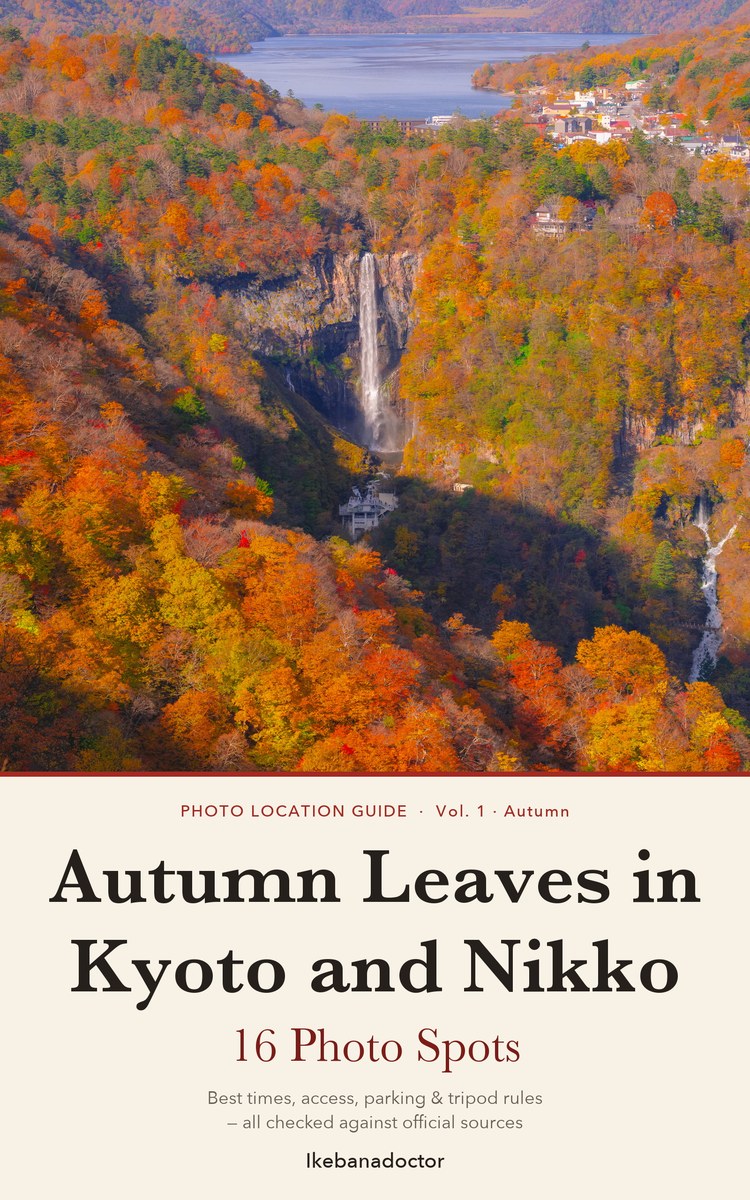
Sixteen of the places in this table ― best weeks, access, opening hours, parking, admission and each place’s tripod rules, all checked against official sources ― are gathered in Autumn Leaves in Kyoto and Nikko: 16 Photo Spots. Where an official source said nothing, the book says so rather than filling the gap with a guess.
See the book (Kindle $2.99 / paperback $25.99) →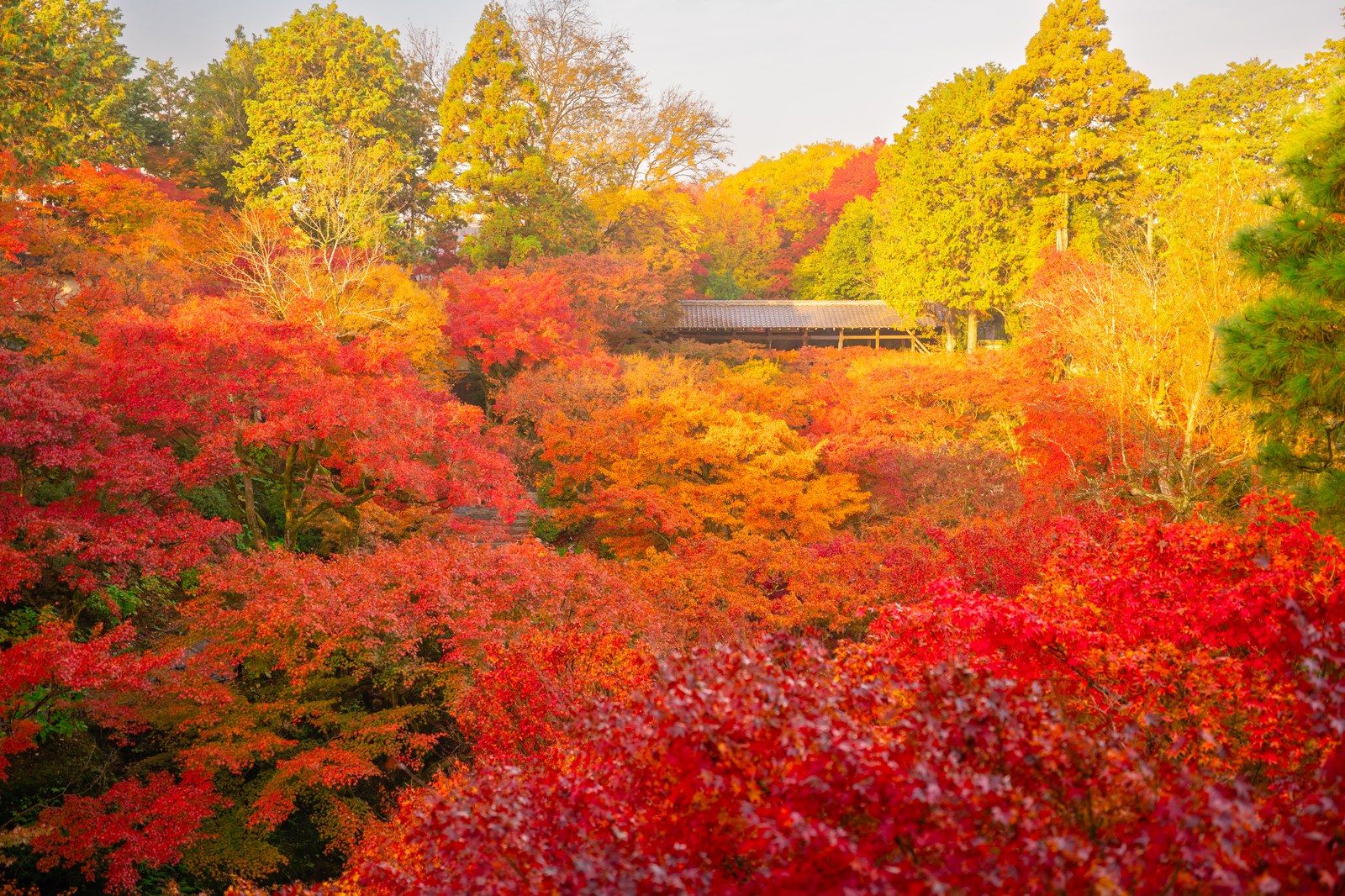
From Tofuku-ji's sea of maples to the night leaves of To-ji, bring home the autumn that stays with you as a true silver-halide print on FUJICOLOR's finest professional paper. Deep tone, rich gradation, shipped worldwide.
💾 A digital download is also available ($4.00 each). Bundles cost less: 3 for $10.20, 5 for $15.00 ($3.00 each) — mix any photographs you like.
View the autumn-leaf prints →