
PHOTO SPOT GUIDE
A Flower and Foliage Calendar — Japan, Month by Month
Every flower has its two weeks. For most of them you get one chance a year. So here is the year rearranged: the locations I have actually travelled to, set out month by month, from January's icicles to December's ginkgo — what is at its best, and where. Each month links straight through to that location's guide and to the photographs from that season. The dates move with the weather, so please check the local official updates before you go.
Winter — January and February
These are the emptiest months for flowers, which is another way of saying there is nothing to agonise over. The winter peonies at the Ueno Toshogu Peony Garden, each under its little woven straw hat, look their best on a day of snow. At Misotsuchi in Oku-Chichibu, water seeping from the rock face of the gorge freezes into a wall of icicles. On the slopes of the Boso Peninsula the daffodils open in the sea wind, and by February the early cherry of Atami and the plum of Kairakuen follow. The colder the morning, the cleaner the air and the straighter the light.
January — winter peonies under straw, and icicles in the gorge
February — daffodils, plum, and the earliest cherry in Japan
Spring — March, April and May
March begins with Kawazu cherry along the rivers and moves on to weeping cherry and night sakura. April belongs to Yoshino, where the whole mountain blooms from Shimosenbon up to Nakasenbon like pale smoke — and in the same weeks the nemophila hills in Ibaraki and Tokyo take on the colour of the sky. By May the nanjamonja tree in Niiza looks overnight as though snow has fallen on it, and poppies sway on the Chichibu highlands and the banks of the Kokai River. After the cherry, the flowers arrive all at once.
March — from riverside Kawazu cherry to weeping trees and night sakura
April — a thousand cherries at Yoshino, and a hill of blue nemophila
May — a white miracle, and poppies in the sky
Every flower has its two weeks.
Which makes a year far shorter than it sounds.
Summer — June, July and August
June is the month you wait for rain. The stone steps at Meigetsuin in Kita-Kamakura are at their bluest when they are wet. July is the month you get up early: the lotus at Shinobazu open between about seven and nine in the morning and close again by midday. Shoot the Akeno sunflowers into the light and the petals turn translucent gold. And in August the great shells rise over Nagaoka. I still remember the night I came off an emergency shift, took the shinkansen, and set up a tripod on the riverbank.
June — the month the rain makes beautiful
July — lotus at first light, sunflowers against the sun
August — night sky over the Shinano River, sunflowers at dusk
Autumn — September to December
In September the red spider lilies burn in a Chiba woodland while, up on the Oku-Nikko highlands, the grass has already begun to turn. October is the month the colour comes down the mountain — Roppozawa, Hangetsuyama, Akechidaira, each day a little lower. November is Kyoto: the Tsutenkyo bridge at Tofukuji, the desk maples of Rurikoin, the round window at Yusaitei. Then in December, as Gyoko-dori turns gold in front of Tokyo Station, the year closes again. Sixteen of these Kyoto and Nikko spots are gathered in the new book.
September — red spider lilies below, grass turning on the highlands
October — the autumn colour comes down the mountain
November — the temples of Kyoto, the lake below Mt. Fuji
December — ginkgo gold, and the clearest dusk of the year
Planning your visit — season
Treat every date here as a typical year, not a promise.
The seasons above are the typical-year figures given in each location guide on this site, gathered in one place. In practice they move with the temperature and rain of the year, and cherry blossom and autumn colour in particular can shift by around a week. Most famous flower sites publish daily bloom updates, so it is worth looking once more the evening before you travel. Admission, opening hours and illumination periods also change from year to year. I often decide where to go the night before, after reading the official bloom report.
Getting there
Most of the locations here are a day trip from Tokyo. Reachable by train alone: Ueno, Hama-rikyu, Rikugien, Chidorigafuchi, the Kyu-Nakagawa, Gyoko-dori and Showa Kinen Park, plus Hitachi Seaside Park and Meigetsuin. Easier by car: Oku-Nikko (Senjogahara, Hangetsuyama, Roppozawa), the Chichibu highlands, the banks of the Kokai River, and the daffodils and sunset coast of the Boso Peninsula. For Kyoto and Yoshino, and for Nagaoka and Fukui, staying the night before is what gets you there for the morning light. Detailed access is given in each individual guide.
Tips for photographers
The beginning and the end of a season look surprisingly different from the peak. Petals rafting on water the week after full bloom; a carpet of maple at the very end of the colour; a gold pavement after the ginkgo have dropped. Even on a day you have missed the peak, there is always something to photograph. Soft morning and evening light is the most reliable thing in the whole year, and after rain both flowers and leaves hold deeper colour. At the busiest places, the first thirty minutes after opening decide the picture. The craft itself is covered in the flower and autumn-leaf articles.
While you're in the area
The same place in a different season is a different place. Miharashi Hill at Hitachi Seaside Park: blue nemophila in spring, zinnias in summer, kochia in autumn. The Ueno Toshogu Peony Garden: winter peonies, spring peonies, autumn dahlias. Showa Kinen Park: nemophila in spring, cosmos in summer and autumn, ginkgo in November. Keeping a few places you can return to three or four times a year lets the turning of the seasons become the work itself.
The developing approach behind the photographs in this article is gathered into 30 presets for Lightroom / Camera Raw ($15.00 — a ZIP download straight after purchase).
View the presets →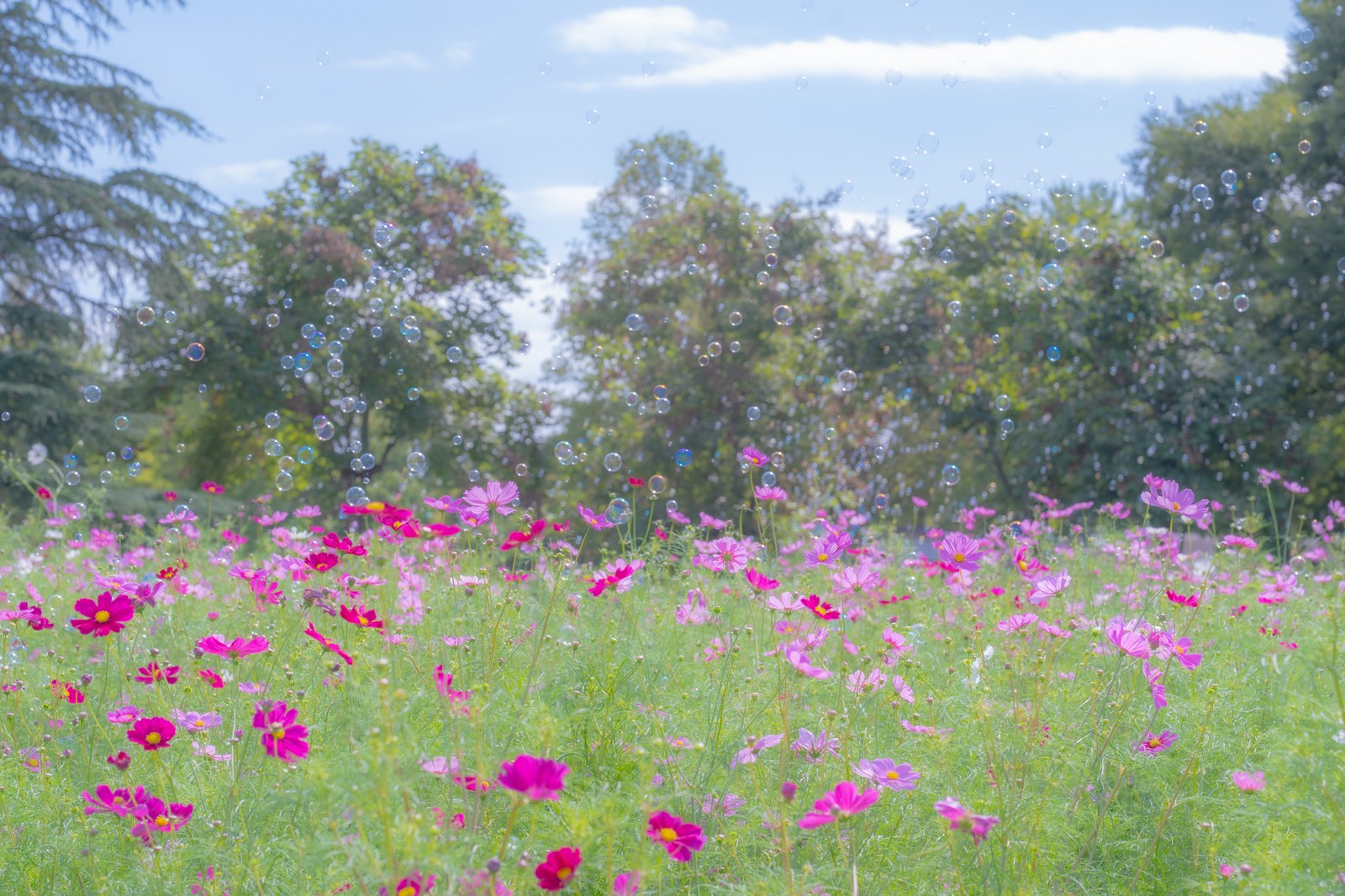
The photographs from this year are available as fine-art silver-halide prints on premium FUJICOLOR paper, hand-printed in Japan and shipped worldwide. Choosing the season first is a good way to choose.
💾 A digital download is also available ($7.00 each). Bundles cost less: 3 for $17.84, 5 for $26.23 ($5.25 each) — mix any photographs you like.
View the print →